|
5 Things You Should Know To Win
Source: "The Art of War" by Sun Tzu
You must know five things to win:
Victory comes from having a capable commander and the government
leaving him alone...
More
The Need for Managing Innovation
Separately
A new product or service may be
launched either from within an established management system or from a
brand-new operation. In both cases, autonomy is a precondition of success
however.
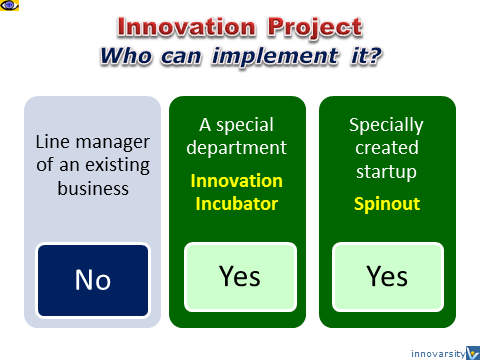
Innovation needs to be managed
separately as the established company would load insupportable burdens on
the new venture: burdensome examples include highly structured reward
schemes, return-on-investment targets, and lack of clear accountability for
the venture. There is the fundamental difficulty in converting a large
and/or non-flexible organization, which has built up policies, people, and
practices along set lines, into the anarchic modes of the entrepreneur. To
picture the problem, just imagine you forcing your right leg to run while
your left leg and the rest of your body keep walking.
"The most important caveat is not
to mix managerial units and entrepreneurial ones" in any way. Venture values
are different from established corporate values. Technology spinouts are
designed to provide independence and space for action and allow management
to enhance market capitalization.
Entrepreneurial management of the venture-building process is
fundamentally different from corporate management that is focused
on delivering the annual operating plan. Not only must "the entrepreneurial,
the new" be organized completely separately from "the old and existing", but
"there has to be a special locus for the new venture within the
organization, and it has to be pretty high up".
However small the new
ventures may be in relation to its parent, "somebody in top management must
have the
specific assignment to work on tomorrow as an entrepreneur and
innovator" and be responsible for developing and implementing
corporate venture strategies.

Managing Innovation through
Spin-outs
By 2000, internal start-ups, a new
form of creating and financing a high-tech company has become more popular.
This novel approach has a number of advantages over a
merger or acquisition
and it plays an increasingly high role for high-tech companies.
A spin-out enterprise differs from
a spin-off. Spinouts remain closely tied to the company that developed them.
In most cases, the ties are both financial and operational. Financial ties
can be enforced through interlocking of stock ownership and financial
oversight by the parent company. Operational ties may include shared
professional and administrative services as well as marketing and leadership
support.
New ventures established as
independent companies can more readily fulfill their potential. In this
case, the entrepreneurs do not have to argue with superiors or put up with
interference.
Success Story
Spinout Model by Thermo Electron Corporation (USA)
Due to its spinout model, from
1983 through 1995, revenues of Thermo Electron Corporation grew from US$ 200
million to US$ 4 billion5. The company has created 23 spinouts
and diversified from a single-product company to a multi-product
corporation. It had made multimillionaires of forty executives and spinout
managers.

|