Effective Management:

Managerial Leadership

Management by Objectives (MBO)

Concept by Peter Drucker. Executive Summary by Vadim Kotelnikov, Founder, Ten3 BUSINESS e-COACH, 1000ventures.com 

Yes!  You are in the right place!  

This site is Ranked Top 5 by Google for

"Management by Objectives"

out of about 11-million-wide (!!!) competition!

"MBO is one of the rational school of management's successful products."

– The Economist

SMART Executive (Ten3 Mini-course)


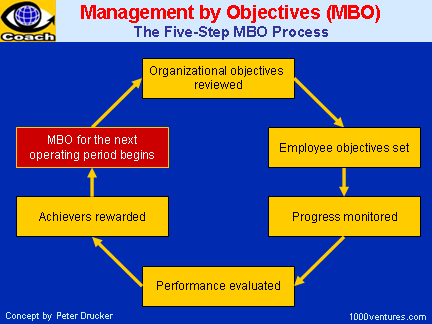
Management by Objectives (MBO) - the 5-Step Process

8 Key Result Areas Where Managers Must Pursue Clear Objectives

Management by Objectives (MBO) Principles

The Two Questions You Need to Answer To Get The Whole Process Rolling

  1. Where do I want to go ? (What is the objective?)

  2. How will I pace myself to see if I am getting there? (What are my milestones, or key results?)

Make sure that the answers are precise!

Types of Objectives1

The objectives must be:

  • focused on a result, not an activity

  • consistent

  • specific

  • measurable

  • related to time

  • attainable

MBO Strategy: Three Basic Parts5

  1. All individuals within an organization are assigned a special set of objectives that they try to reach during a normal operating period. These objectives are mutually set and agreed upon by individuals and their managers.

  2. Performance reviews are conducted periodically to determine how close individuals are to attaining their objectives.

  3. Rewards are given to individuals on the basis of how close they come to reaching their goals.

Six MBO Stages

  1. Define corporate objectives at board level

  2. Analyze management tasks and devise formal job specifications, which allocate responsibilities and decisions to individual managers

  3. Set performance standards

  4. Agree and set specific objectives

  5. Align individual targets with corporate objectives

  6. Establish a management information system to monitor achievements against objectives

Personal Empowerment

The Four Powers you need to do an excellent job:

  1. Freedom to challenge everything and anything

  2. Continuous training and development on the job

  3. Knowledge of, and faith in, the organization's mission

  4. The ability to achieve and see results

MBO: Key Advantages and Disadvantages5

Advantages

  • MBO programs continually emphasize what should be done in an organization to achieve organizational goals.

  • MBO process secures employee commitment to attaining organizational goals.

Disadvantages

  • The development of objectives can be time consuming, leaving both managers and employees less time in which to do their actual work.

  • The elaborate written goals, careful communication of goals, and detailed performance evaluation required in an MBO program increase the volume of paperwork in an organization.

Managing for Results: The Eight Perceptions

  • Results come from exploiting opportunities, not solving problems... More

Inspirational Leadership: 10 Roles

 Discover much more!

Ten3 Global Business Learning Report

Top Management     Leadership

Africa     Asia-Pacific     Europe     North America     South America

Compare Your Country or Region with Others

Ten3 MINI-COURSES (presentation) PRESENTATION: What Business People Strive To Learn in Different Countries Presentation: What Business People Strive To Learn in Different Countries (Ten3 Global Market and Cultural Intelligence Study by Vadim Kotelnikov) Ten3 Business e-Coach (full version) TOP MANAGER (set of Ten3 Mini-courses) Ten3 BUSINESS e-COACH at 1000ventures.com Ten3 Study: GLOBAL OVERVIEW Regional Profile: AFRICA Regional Profile: ASIA-PACIFIC Ten3 Study: EUROPE Regional Profile: NORTH AMERICA Regional Profle: SOUTH AMERICA TOP MANAGEMENT (Ten3 Global Business Learning Report - Africa, Asi

Modern Manager

Leadership-Management Synergy

Delegation DOs and DON'Ts

3 Easy Ways To Maximum Motivation

Project Management

5 Factors that Make a Project Successful

GREAT Model

Smart Corporate Leader

Smart Business Architect

Develop a Clear Vision

Sustainable Growth Strategies

Balanced Approach to Business Systems

6Ws of Corporate Growth

Enterprise Strategies

3 Strategies of Market Leaders

Innovation

4 Categories of Innovation

Free Ten3 Micro-courses

Business Success 360

  Ten3 Mini-Courses   Presentation:    View    Download

SMART Manager  (50 slides)

New Management Model  (45 slides)

SMART Executive  (300 slides)

What is MBO?


Management by objectives (MBO) is a systematic and organized approach that allows management to focus on achievable goals and to attain the best possible results from available resources.

It aims to increase organizational performance by aligning goals and subordinate objectives throughout the organization. Ideally, employees get strong input to identify their objectives, time lines for completion, etc. MBO includes ongoing tracking and feedback in the process to reach objectives.

Management by Objectives (MBO) was first outlined by Peter Drucker in 1954 in his book 'The Practice of Management'. In the 90s, Peter Drucker himself decreased the significance of this organization management method, when he said: "It's just another tool. It is not the great cure for management inefficiency... Management by Objectives works if you know the objectives, 90% of the time you don't."

Core Concepts

According to Drucker managers should "avoid the activity trap", getting so involved in their day to day activities that they forget their main purpose or objective. Instead of just a few top-managers, all managers should:

  • participate in the strategic planning process, in order to improve the implementability of the plan, and

  • implement a range of performance systems, designed to help the organization stay on the right track.

Managerial Focus

MBO managers focus on the result, not the activity. They delegate tasks by "negotiating a contract of goals" with their subordinates without dictating a detailed roadmap for implementation. Management by Objectives (MBO) is about setting yourself objectives and then breaking these down into more specific goals or key results.

Main Principle

The principle behind Management by Objectives (MBO) is to make sure that everybody within the organization has a clear understanding of the aims, or objectives, of that organization, as well as awareness of their own roles and responsibilities in achieving those aims. The complete MBO system is to get managers and empowered employees acting to implement and achieve their plans, which automatically achieve those of the organization.

Where to Use MBO

The MBO style is appropriate for knowledge-based enterprises when your staff is competent. It is appropriate in situations where you wish to build employees' management and self-leadership skills and tap their creativity, tacit knowledge and initiative. Management by Objectives (MBO) is also used by chief executives of multinational corporations (MNCs) for their country managers abroad.

 Case in Point  MBO in Action at Intel

A Manager's Guide at Intel provides the following directions.

  1. Start with a few well-chosen overriding objectives.

  2. Set your subordinates objectives that fit in with your overriding objectives.

  3. Allow your subordinates to set their own key results to enable them to meet their objectives.


Innovation Management Policies for Large Corporations

By: Bill Gates, Founder of Microsoft

  • Prevent competing missions or objectives... More

Setting Objectives

In Management by Objectives (MBO) systems, objectives are written down for each level of the organization, and individuals are given specific aims and targets. "The principle behind this is to ensure that people know what the organization is trying to achieve, what their part of the organization must do to meet those aims, and how, as individuals, they are expected to help. This presupposes that organization's programs and methods have been fully considered. If they have not, start by constructing team objectives and ask team members to share in the process."6

"The one thing an MBO system should provide is focus", says Andy Grove who ardently practiced MBO at Intel. So, have your objectives precise and keep their number small. Most people disobey this rule, try to focus on everything, and end up with no focus at all.

For Management by Objectives (MBO) to be effective, individual managers must understand the specific objectives of their job and how those objectives fit in with the overall company objectives set by the board of directors. "A manager's job should be based on a task to be performed in order to attain the company's objectives... the manager should be directed and controlled by the objectives of performance rather than by his boss."1

The managers of the various units or sub-units, or sections of an organization should know not only the objectives of their unit but should also actively participate in setting these objectives and make responsibility for them.

The review mechanism enables leaders to measure the performance of their managers, especially in the key result areas: marketing; innovation; human organization; financial resources; physical resources; productivity; social responsibility; and profit requirements.

However, in recent years opinion has moved away from the idea of placing managers into a formal, rigid system of objectives. Today, when maximum flexibility is essential, achieving the objective rightly is more important.

Balance between Management and Employee Empowerment

The balance between management and employee empowerment has to be struck, not by thinkers, but by practicing managers. Turning their aims into successful actions, forces managers to master five basic operations:

These Management by Objectives (MBO) operations are all compatible with empowerment, if you follow the main principle of decentralization: telling people what is to be done, but letting them achieve it their own way. To make the principle work well, people need to be able to develop personally. Further, different people have different hierarchy of needs and, thus, need to be managed differently if they are to perform well and achieve their potential.

Empowerment recognizes "the demise" of the command-and-control system, but remains a term of power and rank. A manager should view members of his or her team much as a conductor regards the players in the orchestra, as individuals whose particular skills contribute to the success of the enterprise. While people are still subordinates, the superior is increasingly dependent on the subordinates for getting results in their area of responsibility, where they have the requisite knowledge. In turn, these subordinates depend on their superior for direction and "above all, to define what the 'score' if for the entire organization, that is, what are standards and values, performance and results."

Leadership-Management Synergy

To maximize your long-term success you should strive to be both a manager and a leader and to synergize their functions. Merely possessing management skills is no longer sufficient for success as an executive in today's business world. You need to understand the differences between managing and leading and know how to integrate the two roles to achieve organizational success... More

29 Obstacles To Innovation

  • Micromanagement

     
  • Ensure that highly qualified people do mundane work for long periods... More

Individual Responsibility

Management by Objectives (MBO) creates a link between top management's strategic thinking and the strategy's implementation lower down. Responsibility for objectives is passed from the organization to its individual members. It is especially important for knowledge-based organizations where all members have to be able to control their own work by feeding back from their results to their objectives.

Management by objectives is achieved through self-control, the tool of effectiveness. Today the worker is a self-manager, whose decisions are of decisive importance for results.

In such an organization, management has to ask each employee three questions:

  1. What should we hold you accountable for?

  2. What information do you need?

  3. What information do you owe the rest of us?

Deming's 14 Point's Plan for Total Quality Management

Point 12: Remove the barriers that rob hourly workers, and people in management, of their right to pride of workmanship. This implies, abolition of the annual merit rating (appraisal of performance) and of management by objectives... More

 Case in Point  Canon Production System (CPS)

The Canon Production System (CPS) includes:

  • Management by objectives at all levels of the hierarchy... More

Managing for Results

The only place where meaningful management results can be won is the outside world.

Managing for results is expansion of Management by Objectives (MBO) into the marketplace. It is the theory and practice of how to produce results on the outside, in the market and economy.... More

To achieve these results, you should develop a solid, sound, customer-focused, and entrepreneurial strategy, aimed at market leadership, based on innovation, and tightly focused on decisive opportunities... More


Bibliography:

  1. "Management: Tasks, Responsibilities, Practices", Peter Drucker

  2. "The Frontiers of Management : Where Tomorrow's Decisions Are Being Shaped Today ", by Peter Drucker

  3. "Managing in Time of Great Change", Peter Drucker

  4. "Management Challenges for the 21st Century", Peter Drucker

  5. "Modern Management", Ninth Edition, by Samuel C. Certo

  6. "Essential Manager's Manual", Robert Heller and Tim Hindle

  7. "The Practice of Management", by Peter Drucker

  8. "The Effective Executive", Peter Drucker

  9. "Managing for Results," Peter Drucker

Effective Executive (book by Peter Drucker)  Managing for Results (book by Peter Drucker)

Hover over the image to see valuable information about the product


Map

Ranked #1

Search

Testimonials

Free Downloads

  Products

SMART Learning

Training

 Contact

We invented Business e-Coaching in 2001

Today, we have customers in 100+ countries!

Our customers:

3M, ABB, Adidas, Alcatel, American Express, Bayer, Boeing, British American Tobacco, BP, Canon, Cisco, Citigroup, Colgate, Corning, Deloitte, Ernst & Young, Fujitsu-Siemens, GE, Goldman Sachs, HP, Hitachi, Huyndai, IBM, Intel, Johnson & Johnson, JP Morgan Chase, KPMG, Lufthansa, Microsoft, Motorola, Nokia, Oracle, Samsung, Shell, Siemens, Sony, United Bank of Switzerland

Ten3 Mini-courses: SMART & FAST sets Full version of Ten3 Business e-Coach Ten3 Business e-Coach (home page)

Ten3 Business e-Coach, version 2008

Inventor, Author & Founder – Vadim Kotelnikov

© Vadim Kotelnikov, GIVIS