|
Why New Management Model?
The old traditional
ways of managing not longer work and will never work again. The old
management practice has been erected on the assumption of human limitations
as a basis for organizing. "This assumption is so pervasive that it can be
found in almost every aspect of conventional managing, from the way we
over-bureaucratize our organizations and control the workforce to the way we
develop and impose strategies on others without their participation or
consideration of their potential contribution."3
In the
new knowledge-driven economy,
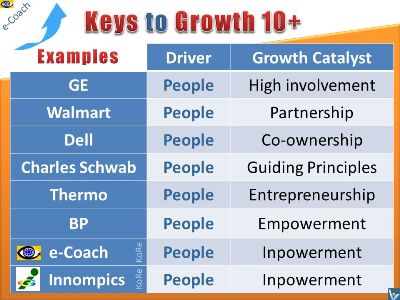
people have become
your firm's most precious and underutilized resource. They are your firm's repository of
knowledge and they are central to
your company's
competitive advantage.
Well
coached, and highly
motivated people are critical to the development and execution of
strategies, especially in today's
faster-paced, more perplexing world, where top management alone can no
longer assure your firm's competitiveness. At all levels, your company needs
people who can deliver at the frontier of performance. They must understand
where your company is going and be able to influence this path. They must
share in your company's fortunes and be motivated to push for greater
achievements.
12 Breakthrough Ideas for the New Economy
Source: Harvard Economic Review
Executive summary by Anastasia Bibikova.
The best ideas related to the practice of management. If you
know somebody has used them, don’t try to repeat. Simply consider them,
debate them and let them inspire your own thinking!...
2. Monopoly on Creativity:
What is nowadays’ key economic resource? It was proved that
only creative
people can “reach the moon” and make the company flourish...
More
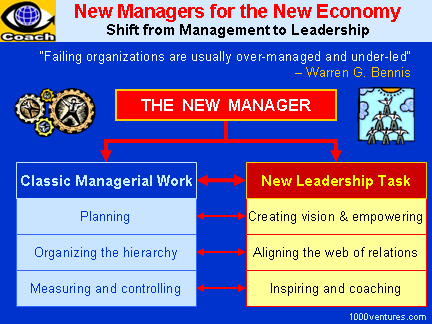
Leadership – the New Managerial Task
In the
new era of rapid changes and
knowledge-based enterprises, managerial work becomes increasingly
a
leadership task.
Leadership is the primary force behind successful
change. Leaders
empower employees to act on the
vision.
They execute through inspiration and develop
implementation capacity networks through a complex web of aligned
relationships.
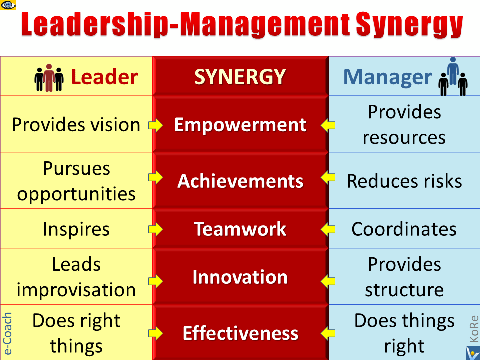
Leadership-Management Synergy
To maximize your long-term success you should
strive to be both a manager and a
leader and to
synergize their functions. Merely
possessing management skills is no longer sufficient for success as
an executive in
today's business world. You
need to understand the differences between managing and leading and know how
to integrate the two roles to achieve organizational success...
More
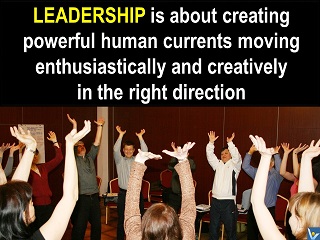
Inspirational Leadership: 10 Roles
Inspirational leaders create an
inspiring culture
within their organization. They supply a shared
vision
and inspire people to achieve more than they may ever have dreamed possible.
They are able to articulate a shared vision in
a way that inspires others to act.
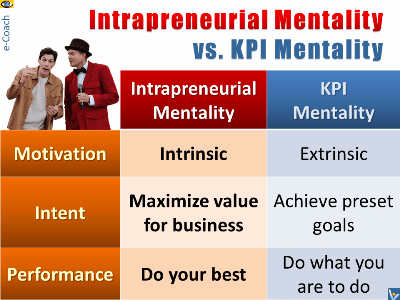
People do what they have to do for
a manager, they do their best for an inspirational leader...
More
Coaching
Effective managers need to coach. Bearing in mind the fast pace of business today and the need
to stay competitive, it's essential that managers should be effective. They
need to be especially effective with their
people
and this requires learning to
coach. For most managers, coaching has been added to their role anyway,
but the majority haven't received any training in coaching skills. More than
80% of organizations use coaching to develop their staff, but only a fifth
train their managers in coaching, according to a survey by the Work
Foundation...
More
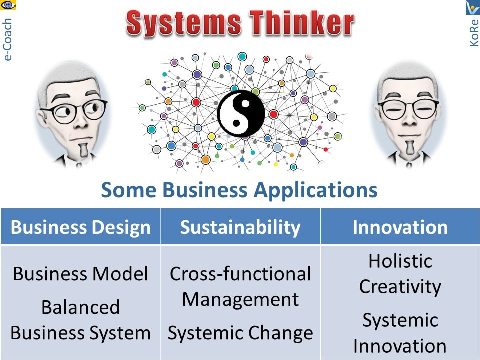
Systems Thinking
Systems
thinking, the ability to see things holistically, including the many
different types or relationships between the many elements in a complex
system, characterizes many of the today's world's leading executives.
Systems thinking "focuses on the whole,
not the parts, of a complex system.
It concentrates on the interfaces and
boundaries of components, on their connections and arrangement, on the
potential for holistic systems to achieve
results that are greater than the sum
of the parts.
Mastering systems thinking means overcoming the major
obstacles to building the
process-managed enterprise - for every business process is a whole
system."13...
More
NLP and the
Modern Manager
Neuro-Linguistic Programming (NLP) is the psychology of excellence and
the technology of achievement and
success. In new era of
rapid change,
systemic innovation,
knowledge enterprises,
employee empowerment and
creative teamwork, an increasing number of executives shift emphasis
from classic control-based managerial practices to managing the web of
relationships in their organizations.
They realize that it is their
expertise in building and maintaining harmonic
relationships
between workers
and managers,
between employees and customers that makes the difference and
helps their companies to achieve sustainable growth. If you wish to be a
new manager, you must
understand that your art of working with other people is the most important
one you should master, and your capability of
influencing others and
motivating them to achieve
corporate goals is the most important manager's talent.
New Focus: Managing
Business Enablers...
Five Key Questions
To Which
Managers Must Provide Coherent Answers...
New Ways of Working with
People...
New Approaches to
Employee Motivation...
Working Within the
Ambiguity...
Leading
Knowledge Workers...
Volatility
Leadership...
Winning Corporate Culture...
Empower Others...
Relentless Growth Attitude...
Energizing Employees...
The Fun Factor...
Five Manager's Mindsets...
Leading Systemic
Innovation
Teams...
Creative Leadership...
Systems Thinking...
Building Business Synergies...
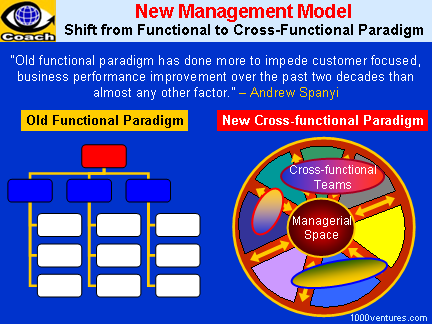
Cross-functional Excellence...
Strategy Pyramid vs. Strategy Stretch...
Case in Point
Lessons from Jack Welch...

|