|
Why Strategic Management?
Strategic management is not a task, but a rather a set of managerial skills
that should be used throughout the organization, in a wide variety of
functions.
Enterprise Strategy
Successful companies are those
that focus their efforts strategically.
Strategy
should be a
stretch
exercise, not a fit exercise.
To meet and exceed
customer satisfaction,
your business team needs to follow an overall organizational strategy. A
successful strategy
adds value for the targeted customers
over the long run by consistently meeting their needs better
than the competition does...
More
The Overall Purpose of Strategic Management
Process
The overall purpose of the experimental
strategic learning and
management process is to establish which strategic options or elements
thereof are robust across the scenarios and use the most healthy elements to
develop your strategic intent
- your core strategic focus or theme.
Leadership-Management Synergy
Leaders:
Pursue opportunities.
Managers:
Reduce risks.
►
Resulting synergy:
Strategic Achievement...
More
SWOT Analysis:
Questions To Answer
-
What is your
strongest business asset?
-
What
unique resources do you have?
-
What do you offer that makes you
stand out from the rest?...
More
Strategic Cross-Functional Management
Strategic cross-functional management is central to capitalizing on
functional excellence, and in order for functional specialists to make the
greatest possible contribution, they must take
a broader view of their functions and understand how they fit into the web of the organizational
processes and, ultimately, into the overall
strategy...
More
Ten Major Schools of Strategic Management
Ten deeply embedded, though quite narrow, concepts typically
dominate current thinking on strategy.
These range from the early Design and
Planning schools to the more recent Learning, Cultural and Environmental
Schools4...
More
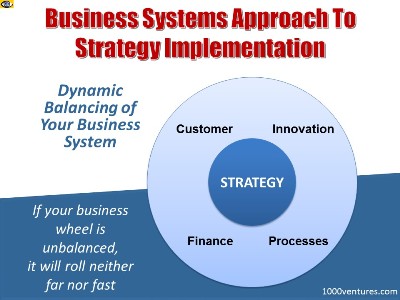
New Systemic Approach
All the above schools, often fighting between themselves,
favor different single-sided approaches to strategy formulation. They
represent both different approaches to strategy formulation and different
parts of the same process. Today's managers have to deal with the entire
business
systems as opposed to dealing with its different parts
independently - not only to keep strategy formulation as a vital force
but also to impart real energy to the strategic process. They must
practice balanced
results-based leadership strategies and apply a balanced approach to business
systems.
Certain positive moves in this direction have been seen
recently. Some of the more recent approaches to strategy formulation take a
wider perspective and cut across the above ten schools in eclectic and
interesting ways, for example Learning and Design in the "Dynamic
Capabilities" approach, or the "Dynamic Strategy" one based on knowledge
working.
The currently dominant view of business strategy
resource-based theory
is based on the concept of economic rent and the
view of the company as a collection of capabilities. This view of strategy
has a coherence and integrative role that places it well ahead of other
mechanisms of
strategic decision making.5
Working
On Your Business
"Most businesspeople are so busy working for their business
or in their business that they never find time to
work on their
business.
Thus they fail to
anticipate what might happen or what they might be able to make happen."7
Unless you regularly schedule time (one-day out-of-the-office meeting a
month at least) to work on your business and answer
critical questions, you'll never achieve your
stretch goals.
6 Attributes of
Successful CEOs
-
Creating, Communicating and Executing a Clear Vision,
Goals and
Strategy.
An executive's
success is affected by the ability to
communicate a vision for a
company's future, helping employees to navigate through change
and
motivating them to achieve specific goals...
More
How To Be
A Great Strategic Thinker
Top 10 Essential Requirements
Essential Element #1: You must have a
vision. And you must be great at
thinking with a strategic purpose and creating a visioning process.
Great strategic thinkers are visionaries...
More
Building Your
Sustainable
Competitive Advantage
Sustainable competitive advantage is the prolonged benefit of
implementing some unique value-creating strategy based on unique
combination of internal organizational
resources
and
capabilities
that cannot be replicated by competitors...
More
Blue Ocean Strategy:
6 Principles
Blue Ocean Strategy is about
revolutionary
value innovation.
The six principles drive the successful
formulation and
execution of Blue Ocean Strategy.
These principles attenuate the six risks...
More
Managing for Results
To achieve results, you
should develop a solid, sound, customer-focused, and
entrepreneurial
strategy, aimed at
market leadership, based on
innovation, and tightly focused on decisive opportunities...
More
Business Architect
Today's companies need
business architects
who can take a
systems view of a business and build
synergies.
Business
architect is a person who
initiates new business ventures
or leads
business innovation, designs a
winning
business model, and builds a
sustainable
balanced business system for a
lasting success...
More
Inspirational Business Plans: Successful Innovation
Operational Plan: "We dont
have a traditional strategy process,
planning process like youd find in
traditional technical companies. It allows Google to
innovate very, very
quickly, which I think is a real strength of the company."
Eric Schmidt...
More
Lessons from Silicon Valley Firms
Deciding If Your Innovation Portfolio Has Enough
Stretch
Adapted from
Relentless Growth, Christopher Meyer
-
Balance between revolutionary and
evolutionary initiatives. First, Silicon Valley companies assess the
overall
balance between
revolutionary and evolutionary projects. The ultimate arbitrator of
portfolio stretch if the innovation leaders judgment, experience,
intuition, and luck...
More
Creating a Culture for Innovation
By: Soren Kaplan
Shaping
culture, especially when it comes to creating
a culture of
innovation, is a daily task that involves elevating the mundane to the
strategic.
By managing the strategic levers of
culture, and by practicing the strategies of envisioning, communicating
and sponsoring, it becomes possible to create a culture of innovation
and drive long-term strategic advantage...
More
4 Entrepreneurial Strategies
By: Peter Drucker
Three Primary Criteria to Assess Your Innovation
Portfolio
Besides assessing each initiative
individually for risk, investment, return, and timing, assess your
total portfolio to ensure that you have the right initiatives in it:
-
Stretch
and strategic fit.
How much does your portfolio push the industry frontiers, and
how well does it fit with your business goals and
strategy?
...
More
Strategy
Management...
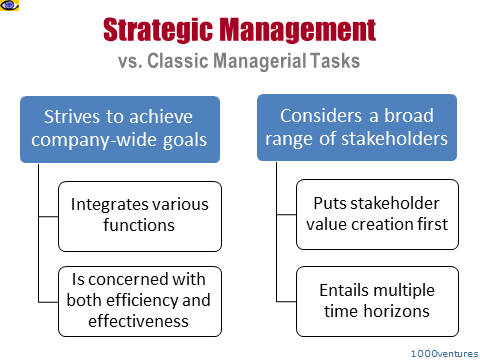
Differences between
Strategic Management and Classic Managerial Functions...
Strategic Programming...
Launching a Crusade...
Strategy Innovation...
New Systemic Approach
to
Strategic Management...
Analysis of the Business Environment...
Business Portfolio Analysis...
Milestone-based Thinking...
Strategic Innovation:
Road-Mapping...
Strategic Project Management...
Strategic Learning...
FutureStep -
a New Strategic
Management Process...
Dynamic Strategy as a Source of
Sustainable Competitive Advantage...
Creating Change...
Creative Leadership...
Leadership Development as a Strategic Task....
Case in Point
Unilever...
Case in Point
Silicon Valley Firms...
Case in Point
Canon...
Case in Point
Microsoft...
Case in Point
Charles Schwab...
Case in Point
Canon...

|