| |
|
Strategic Project Management (SPM)
Modern approach for today's era
of increasing complexity
|
|
 |
 |
|
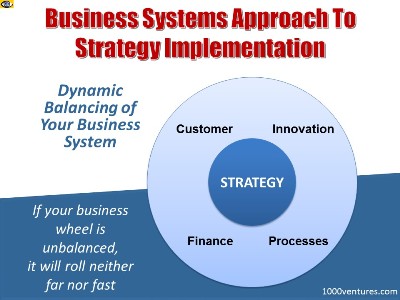
SPM is the
process of managing complex projects by
aligning them with corporate strategies in
order to make the greatest possible
contribution to achieving the company's
strategic intent. |
|
|
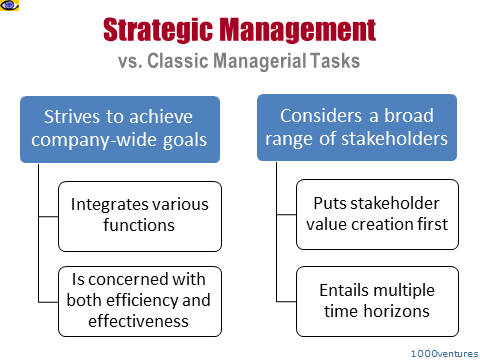
SPM vs. Conventional
Project Management |
| |
Strategic AI Projects
Why do most
strategic artificial intelligence (AI)
initiatives and AI transformations fail before
they start? Unsuccessful AI developers neglect
strategic alignment and jump straight into
developing AI products. Successful AI
strategists, on the other hand, first develop a
winning strategy and only then begin developing
processes and pilot projects...
More |
|
AImpowerment
AI MAGic
AI Intelligence
Human-AI Synergy
AIpedia
AI Optimization |
|
| |
|
Strategic Project Management (SPM)
ensures that individual projects
are directly aligned with an
organization's overarching
strategic intent. The
primary aim of SPM is to make
sure that projects deliver value
that extends far beyond their
immediate scope, contributing
directly to the broader business
strategy. This approach is
crucial for maximizing the
impact and success of project
investments.
|
|
|
 |
|
"Most teachings
about life, leadership, entrepreneurship,
business, strategy, and innovation work well in
life, but only until big challenges arise along
the way. In such cases,
super gamification comes to the rescue,
helping to successfully overcome big
challenges."
~
Vadim Kotelnikov |
|
| |
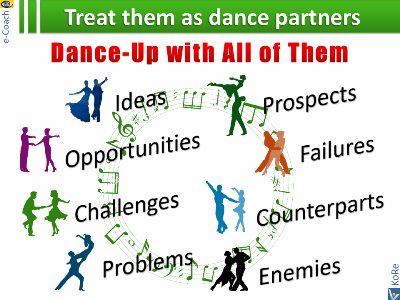
Change Management
Successful change is never a
one-time event, it is a
virtuous spiral journey.
Waltz up with everything –
ideas, challenges,
resistance to change, failures, and
opportunities.
Learn as you go – ask
learning SWOT questions
after every major step into the
unknown and adapt accordingly.
|
|
 |
 |
|
"If you want to
create miracles, don't channel your energy
towards your fears, channel it towards your
dreams.
Stretch your goals, and your goals will
stretch you."
~
Vadim Kotelnikov |
|
| |
|
AI Overview reads:
"Strategic Project Management (SPM)
aligns individual projects with
an organization's long-term
vision and goals, ensuring each
project delivers significant
business value, not just
deliverables. It bridges the gap
between strategic planning and
execution by focusing on "why" a
project matters, optimizing
resource allocation across the
portfolio, and driving
competitive advantage, rather
than just managing timelines and
budgets like
traditional PM. SPM elevates
project management from tactical
task management to a strategic
business function, ensuring
projects become catalysts for
growth and
innovation."
|
|
|
| |
|
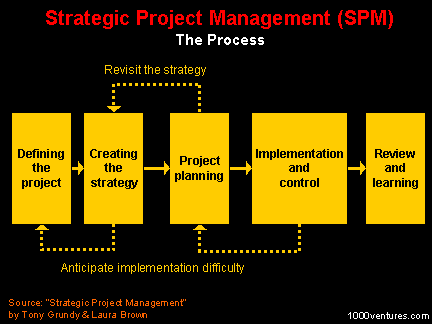
"Strategic project management is
about managing your business
strategy in the most effective
way so that it delivers
organizational breakthroughs...
Strategy is a pattern in a
stream of explicit and implicit
strategic projects designed to
create a specific
competitive positioning,"
write Tony Grundy and Laura
Brown in their book Strategic
Project Management.
|
|
|
 |
|
Strategic Thinking
Strategic thinking is typically associated
with 'very big picture' thinking, or 'helicopter
thinking' It is relevant to project management
at a number of levels.
Business projects
often materialize as a result of formal or
informal strategy development. |
|
| |
Besides projects
which are of a corporate development and
external nature, there are frequently internal
projects which are aimed at reaping major
organizational change.
Individual
business projects which have materialized on a
'bottom-up' basis. |
|
 |
| |
|
Each project of
that kind then needs to be linked back up to the
business strategy.
This should be accomplished by
teasing out the strategic
objectives of each and every
major project.
Within the project itself: each
and every project has both an
internal environment and also
some strategy for achieving its
own, inherent advantage...
More
|
|
|
|
|
|