 |
|
"Most teachings
about life, leadership, entrepreneurship,
business, strategy, and innovation work well in
life, but only until big challenges arise along
the way. In such cases,
super gamification comes to the rescue,
helping to successfully overcome big
challenges."
~
Vadim Kotelnikov |
|
| |
|
Tony Grundy and Laura Brown, the
authors of the book Strategic
Project Management, list the
following differences between
the two approaches:
|
|
|
|
|
Conventional |
Strategic |
|
Link
with
business strategy |
direct and explicit |
vague and distant |
|
Project
definition |
usually portrayed as a 'given' |
highly
flexible, creative,
depending on options |
|
Project
planning |
follows on directly from
project definition |
only done once a
project strategy
is set |
|
Attitude to
detail |
absolutely central
– it is all
about control |
important but only in context
– tries always to see
the big ('helicopter') picture |
|
Importance
of stakeholders |
emphasis on formal structures:
project manager,
team,
sponsor |
far-reaching stakeholder
analysis – requires continual scanning |
|
The
importance of uncertainty |
coped with through critical
path analysis (after activity
planning) |
uncertainty analysis done
first, then activities planned |
|
 |
| |
|
How does SPM differ from
traditional project management?
Strategic Project Management (SPM)
and traditional project
management share fundamentals
(planning, execution, control),
but SPM elevates the granularity
and purpose of projects to drive
strategic outcomes.
Here are the core differences:
Objective and purpose
Traditional PM: Deliver a
project on time, within budget,
and to scope/quality
specifications.
SPM: Ensure every project
contributes to the
organization’s strategic goals
and creates measurable business
value, beyond just delivering
the project outputs.
Alignment and selection
Traditional PM: Projects are
initiated based on internal
requests,
stakeholder needs, or
compliance requirements, with
emphasis on feasibility and
risk.
SPM: Projects are selected,
prioritized, and sequenced based
on strategic impact (ROI,
competitive advantage, market
growth, risk mitigation) and how
well they advance the strategic
roadmap.
|
|
|
|
|
|
Portfolio
perspective
Traditional PM:
Focuses on individual project success metrics.
SPM: Views
projects as an interconnected portfolio.
Decisions consider resource balance,
dependencies, and the cumulative effect on
strategy, with ongoing realignment as strategy
evolves. |
|
| |
|
Benefits realization and value
focus
Traditional PM: Benefits are
often defined at project start
but may be loosely tracked after
delivery.
SPM: Emphasizes benefits
realization planning, measurable
value outcomes, and
post-implementation tracking to
confirm strategic impact (e.g.,
revenue uplift, cost savings,
customer metrics).
|
|
|
|
|
|
Governance and decision rights
Traditional PM:
Governance tends to be project-centric with a
focus on scope, time, cost, and quality.
SPM: Governance
includes strategic review bodies (executive
sponsor councils) that re-prioritize, reallocate
resources, or pivot programs to stay
aligned
with strategic objectives. |
|
| |
|
Time horizon and adaptability
Traditional PM: Follows a fixed
plan with changes managed
through scope and change
control.
SPM: Acknowledges that
strategy evolves. The
approach is more adaptive, with
frequent portfolio
reassessments and dynamic
re-planning to maintain
strategic alignment.
Metrics and measurement
Traditional PM: Success metrics
are schedule, budget, scope, and
quality.
SPM: Adds strategic metrics like
strategic fit score, portfolio
contribution, value realization
metrics, time-to-strategy
impact, and risk-adjusted value.
Stakeholder engagement
Traditional PM: Stakeholders
focus on delivering the product
or service.
SPM: Stakeholders span the
C-suite and business units, with
emphasis on communicating
strategic alignment,
synergy innovation, and the
portfolio’s impact on strategic
goals.
Lifecycle and artifacts
Traditional PM: Project
lifecycle artifacts include
charter, schedule, risk
register, etc.
SPM: In addition to traditional
artifacts, there are strategic
alignment maps, benefits maps, a
dynamic portfolio backlog, and
strategy-to-execution
traceability matrices.
Resource governance
Traditional PM: Resources
allocated to projects based on
project plans.
SPM: Resources are allocated
based on strategic priorities
and long-term capacity;
reallocation of resources is
possible in response to shifts
in strategy or market
conditions.
|
|
|
|
|
 |
|
"If you want to
create miracles, don't channel your energy
towards your fears, channel it towards your
dreams.
Stretch your goals, and your goals will
stretch you."
~
Vadim Kotelnikov |
|
| |
Change Management
Successful change is never a
one-time event, it is a
virtuous spiral journey.
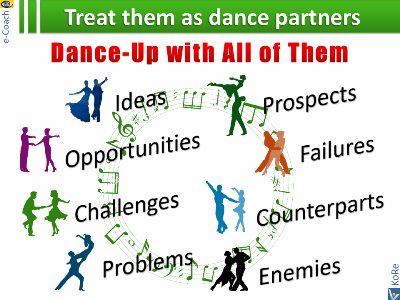
Waltz up with everything –
ideas, challenges,
resistance to change, failures, and
opportunities.
Learn as you go – ask
learning SWOT questions
after every major step into the
unknown and adapt accordingly.
|
|
 |
|
|