|
Strategic Intent
Defined
Strategic intent is a high-level statement of the means by
which your organization will achieve its
vision. It is a statement of design
for creating a desirable future (stated in present terms). Simply put, a
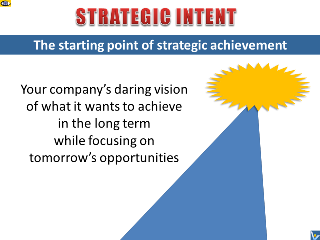
strategic intent is your company's vision of what it wants to achieve in the
long term.
In complexity science's terms, strategic intent is
decomposition of exploration rules into the next level of detail, the
linkages to the exploration rules and the transition rules that define how
it will migrate from its current design and
ecosystem to a future business
design and ecosystem.1
Purpose of Strategic
Intent
The logic, uniqueness and discovery that make your strategic
intent come to life are vitally important for employees.
They have to
understand, believe and live according to it.
Strategy should be a
stretch exercise, not a fit exercise. Expression of strategic intent is to help individuals and
organizations share the common intention to survive and continue or extend
themselves through time and space.

Cases in Point:
Using Strategic Intent to
Inspire Radical Innovation
DuPont asked their scientists to help
the corporation "invent its ways" out of the company financial malaise.
Texas Instruments exhorted their
employees to "find new businesses in the white spaces" between existing
business units.2
In other cases, employees were urged to move
the firm beyond the constraints of current customers, current
business models, and current
technologies to explore growth in new directions.
Analog Devices urged their employees to
get into a new industry (the automotive industry).
Otis Elevators asked their people to
pursue an industry "Holy Grail" (to find a way to move people up and down a
mile-high building).
Air Product
urged their employees to lead the next
industry-transforming breakthrough (gas separation technology).

Developing a
Statement of
Strategic Intent
Strategic intent takes the form of a number of corporate
challenges, specified as short term projects and opportunities.
The strategic intent must convey a significant stretch for
your company, a sense of direction, discovery, and opportunity that can
be
communicated as worthwhile to all employees. It should not focus so much on
today's problems, which are normally dealt with by company visions and
missions, but rather on tomorrow's opportunities.
The strategic focus is the starting point for developing a
statement of strategic intent. A statement of
strategy must become then a
statement of design through which the principles, processes and practices of
an organization are developed. These statements must represent the whole as seen from any
location in the organization.
Strategic intent should specify the competitive factors, the
factors critical to success in the future. The end result should lay beyond
the present planning period. Your strategic intent should also be
accompanied by intermediate goals against which company achievements can be
measured. It cannot be developed in a one-day strategy session, it should
develop and mature with time.
Discovery and detection of opportunity serve as platforms for
developing strategic intent. It is based on a vision of how the
future will look in 10-15 years. A strategic intent creates a
picture of the customer daily life and describes discontinuities and
anticipated changes from the world of today. It describes future
customer's needs and the success factors required for meeting these
needs.
"To achieve great things, you need ambitious visions. And it
does not matter that vision cannot be laid out in details. It is the
direction that counts."3
Linking Creation of a
Strategic Intent with its Implementation...
Strategy Innovation: Evolution of a
Successful Strategy...
System Approach to Management...
Competitive Innovation...
Opportunity driven
Business Development...
Dynamic Strategy as a Source of Sustainable Competitive Advantage...
Strategic Achievement...
Leading
Innovation...
Principles for Driving Growth Through Innovation...
Case in Point
Coca Cola...
Case in Point
Silicon Valley Firms...
Case in Point
Charles Schwab...

|