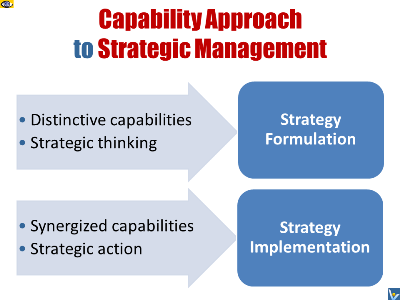
New Paradigm: Resource-Based Theory
The currently dominant view of
corporate strategy
– resource-based theory
or resource-based view (RBV) of firms – is based on the concept of
economic rent and the
view of the company as a collection of
capabilities.
This view of strategy
has a coherence and integrative role that places it well ahead of other
mechanisms of strategic decision making.2
Traditional strategy models such as
Michael Porter\'s five forces model
focus on the company's external competitive environment.
Most of them do not attempt to look inside the company. In contrast, the
resource-based perspective highlights the need for a fit between the
external market context in which a company operates and its internal
capabilities.
In contrast to the Input / Output Model (I/O model), the
resource-based view is grounded in the perspective that a firm's internal
environment, in terms of its resources and capabilities, is more critical to
the determination of strategic action than is the external environment.
"Instead of focusing on the accumulation of resources necessary to implement
the strategy dictated by conditions and constraints in the external
environment (I/O model), the resource-based view suggests that a firm's
unique resources and capabilities provide the basis for a strategy. The
business strategy
chosen should allow the firm to best exploit its core competencies
relative to opportunities in the external environment."1
2 Business Growth Strategies
Resources and
Capabilities
Each organization is a collection of unique resources and
capabilities that
provides the basis for its
strategy
and
the primary source of its returns. In the 21st-century hyper-competitive
landscape, a firm is a collection of evolving capabilities that is managed
dynamically in pursuit of above-average returns4. Thus,
differences in firm's performances across time are driven primarily by their
unique resources and capabilities rather than by an industry's structural
characteristics.
Resources are
inputs into a firm's production process, such as capital, equipment,
the skills of individual employees, patents, finance, and talented
managers. Resources are either tangible or intangible in nature. With
increasing effectiveness, the set of resources available to the firm tends
to become larger.5 Individual resources may not yield to a
competitive advantage. It is through the synergistic combination and
integration of sets of resources that competitive advantages are formed.
A capability is the
capacity for a set of resources to integratively perform a stretch task or
an activity. Through continued use, capabilities become stronger and more
difficult for competitors to understand and imitate. As a source of
competitive advantage, a capability "should be neither so simple that it is
highly imitable, nor so complex that it defies internal steering and
control."6
Building Your
Sustainable
Competitive Advantage
Sustainable competitive advantage is the prolonged benefit of
implementing some unique value-creating strategy based on unique
combination of internal organizational
resources
and
capabilities
that cannot be replicated by competitors...
More