Sustainable Growth:

Strategic Leadership

Strategic Achievement

Successful Strategy Formulation and Implementation

By: Vadim Kotelnikov, Founder, Ten3 Business e-Coach – Innovation Unlimited, 1000ventures.com, 1000advices.com

 Yes! You are in the right place!

This site is Ranked #1 by Google for

"Strategic Achievement"

out of about 7-million-wide (!!!) competition!

"When all is said and done, more is said than done."  

Vince Lombardi


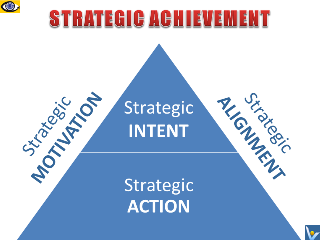
Strategic Achievement Ten3 Business e-Coach: why, what, and how Synergy Strategic Thinking Strategy Innovation Managing Failure Quick Exterimentation Strategic Thinking Synergy Outside-In Company Balanced Approach to Business Systems Searching Questions Continuous Learning 1000ventures.com Strategic Leadership Intuition STRATEGIC ACHIEVEMENT: Strategic Thinking x Strategic Learning x Strategic Action

Two Interwoven Parts of the Strategic Achievement

  1. Formulation: Identifying the best strategy

  2. Implementation: Pursuing it to the desired result

While both parts are essential to achieving superior organizational performance, the implementing strategy is where most companies succeed or fail.

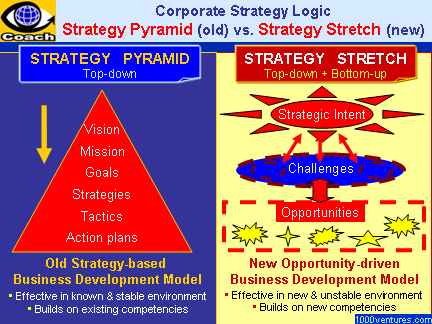
Strategic Intent Opportunity-driven Business Development Enterprise Strategy Vision Mission Goals Enterprise Strategy Discovering Opportunities Change Management Ten3 Business e-Coach: why, what, and how

3 Strategies of Market Leaders

Visionary Growth Strategies

  • Vision and Stretch

  • Competitive and Marketing Strategies

  • Best Practices... More

 Discover much more!

Smart Corporate Leader

10 Rules for Building a Great Business

Effective Leadership

12 Effective Leadership Roles

The 4 Es and 6 Rules for Leadership

Leadership-Management Synergy

Smart Business Architect

Develop a Clear Vision

Strategies for Leading Breakthroughs

Sustainable Growth Strategies

High-growth Business Development Roadmap

Balanced Approach to Business Systems

6Ws of Corporate Growth

10 Rules for Building a Successful Business

8 Attributes of Corporate Success

5 Keys To Building a Great Company

Enterprise Strategies

Look at Your Company from Outside In As Well As Inside Out

Winning and Retaining Customers

Business BLISS

Competitive Strategies

Sustainable Competitive Advantage

5 Strategic Questions

3 Strategies of Market Leaders

7-Part Competitive Strategy of Microsoft

Winning Organization

Innovation-friendly Organization

Organizing for Innovation: Organizational Models that Support Innovation

How To Transform Your Business Into an Innovative and Creative Culture

Guiding Principles To Liberate Employees from the Fear of Trying New Things

7 Tips for Eliminating Bureaucracy

Innovation

Systemic Innovation

7 Dimensions of Strategic Innovation

Free Ten3 Micro-courses

Business Success 360

  Ten3 Mini-Courses   Presentation:    View    Download

Strategic Management (75 slides)

3 Strategies of Market Leaders  (125 slides)

Innovation Strategies  (40 slides)

SMART Executive  (225 slides)   ► Demo

Entrepreneurial Leadership  (40 slides)

Linking Creation of a Strategic Intent with its Implementation


Strategic intent must evolve on the basis of experience during its implementation. "Separating strategy creation from strategy implementation by using corporate planners or consultants for the former activity is thus a hindrance to the evolution of a successful strategy. Linking creation and implementation supports the overall process, and thus a dynamic strategy emerges and evolves."2

Managing for Results

To achieve results, you should develop a solid, sound, customer-focused, and entrepreneurial strategy, aimed at market leadership, based on innovation, and tightly focused on decisive opportunities... More

Leadership-Management Synergy

Leaders: Pursue opportunities. Managers: Reduce risk.

► Resulting synergy: Strategic achievements... More

Leadership and Management

  • Leaders provide vision; Managers provide execution. Both together achieve more.

  • Leaders focus on the what; Managers focus on the how. Both together do more... More

Build Your Sustainable Competitive Advantage

Sustainable competitive advantage is the prolonged benefit of implementing some unique value-creating strategy based on unique combination of internal organizational resources and capabilities that cannot be replicated by competitors... More

Mobilizing Your Organization

In an opportunity-focused organization, dynamic strategy process is both top-down and bottom-up. Opportunity-driven business development "is in large measure a result of the pursuit of opportunities by people at all levels that creates the building blocks for the strategy finally synthesized by top management. Thus mobilizing the organization is vitally important."1... More

The Biggest Impediment to Strategy Implementation

The biggest impediment to strategy implementation is the traditional functional mindset of many senior executives. "The traditional functional mindset, prevalent since the industrial revolution, promotes attitudes and behaviors that are counterproductive in the current business environment.

Functional thinking is based on an inside-out view in which departmental focus, reporting relations, and the flow of authority are predominant factors.


This drives a disproportional preoccupation with company structure and leads to frequent restructuring in the hope that if the organization chart were properly defined and filled, the organization's performance would automatically improve. Functional view also reinforces the traditional view of performance measurement in which the dominant factors are actual-vs.-budget performance by department and a conservative view of technology."1

Organizational Capability Approach

Organizations that excel at strategy execution know how to create sustainable value for customers and shareholders through defining key organizational capabilities and applying a balanced approach to business systems. In the capability model (or resource-based model, "senior managers are predominantly concerned with issues about quality of products and services provided to customers (external and internal), the flow of value-added work, and roles and responsibilities. The dominant view of performance measurement shifts from the traditional focus of actual-vs.-budget to a more balanced model that includes the timeliness, quality, and cost of providing products and services to customers.

Allocation and budgeting of resources moves from the traditional practice of individual units vying for resources based on their own needs towards cross-group teams that jointly assess resource needs based on the flow of work needed to create value for customers. Problem solving would seldom involve situations in which unit managers had to compete with each another; instead, organizations would adapt to departmental interdependence, recognizing that issues are best addressed through cross-group problem-solving sessions focused on providing services to customers and the required flow of work."

"An organizational capability approach nurtures three of the most critical factors essential to achieving superior, sustainable results:

  1. Strategic focus

  2. Organizational alignment, and

  3. Operating discipline.

Conversely, taking action to achieve strategic focus, organizational alignment, and operating discipline develops capability thinking."1


 Discover much more in the FULL VERSION of e-Coach

Strategic Achievement: Focus Areas...

Strategy Management...

Seven Key Focus Areas for Dynamic Strategy Formulation

New Systemic Approach to Strategic Management...

Strategic Innovation: Road-Mapping...

Strategic Project Management...

Strategic Learning...

Strategic Thinking...

FutureStep - a New Strategic Management Process...

Dynamic Strategy as a Source of Sustainable Competitive Advantage...

The Biggest Impediment to Strategy Implementation...

 25 Lessons from Jack Welch  Stretch...



Bibliography:

  1. "Strategic Achievement", Andrew Spanyi

  2. "Changing Strategic Direction", Peter Skat-Rordam


Map

Ranked #1

Search

Glossary

Free Downloads

  Products

Testimonials

Training

 Contact

We invented Business e-Coaching in 2001

Today, we have customers in 100+ countries!

Our customers:

3M, ABB, Adidas, Alcatel, American Express, Bayer, Boeing, British American Tobacco, BP, Canon, Cisco, Citigroup, Colgate, Corning, Deloitte, Ernst & Young, Fujitsu-Siemens, GE, Goldman Sachs, HP, Hitachi, Huyndai, IBM, Intel, Johnson & Johnson, JP Morgan Chase, KPMG, Lufthansa, Microsoft, Motorola, Nokia, Oracle, Renault, Samsung, Shell, Siemens, Sony, United Bank of Switzerland

Ten3 Mini-courses: SMART & FAST sets Full version of Ten3 Business e-Coach Ten3 Business e-Coach (home page)

Ten3 Business e-Coach

Inventor, Author & Founder – Vadim Kotelnikov

© Vadim Kotelnikov, GIVIS