|
What is
Management?
Management is more art than
science. Managing is working with and through other people to accomplish the
objectives of both the
→
organization and its members...
More
Main Business
Purpose
A great business inspires employees by amazing
opportunities and customers by exciting products. Management is perpetual
creation of outstanding value for all stakeholders: customers, employees,
investors and the society.
→
 Customer Value
and buying
decisions are the starting point for the actual practice of management,
its policy and
strategy.
Customer Value
and buying
decisions are the starting point for the actual practice of management,
its policy and
strategy.
Corporate Leader
As a
corporate executive of
your firm, you have a critical responsibility for the direction and
successful operation of all
business units
within your organization.
Smart
Executive
Corporate leadership involves a complex set of
issues that demands a certain cross-unit expertise, which seldom is achieved
through management experience at the business-unit level. You must search
for
synergies
and explore achievements that are possible at the corporate level through
cross-unit activity and the development of entirely new growth
opportunities...
More
25 Lessons from
Jack Welch
Inspirational
Leadership:
10 Roles
Inspirational leaders
create an
inspiring culture
within their organization. They supply a shared
vision
and
inspire people to achieve more
than they may ever have dreamed possible.
They are able to articulate a shared vision in
a way that inspires others to act.
People do what they have to do for
a manager. Inspired and
energized
people do their best for an inspirational leader.
Strategic
Management
Strategic management is not a task, but a rather a set of managerial skills
that should be used throughout the organization, in a wide variety of
functions. Strategic cross-functional management is central to capitalizing
on functional excellence, and in order for functional specialists to make
the greatest possible contribution, managers must take a broader view of
their functions and understand how they fit into the web of the
organizational processes and, ultimately, into the overall
strategy.
The ability to
implement strategies is one of the most valuable of all managerial
skills. Managers intent on implementing strategy must coordinate a broad
range of interconnected efforts aimed at transforming intentions into
action...
More
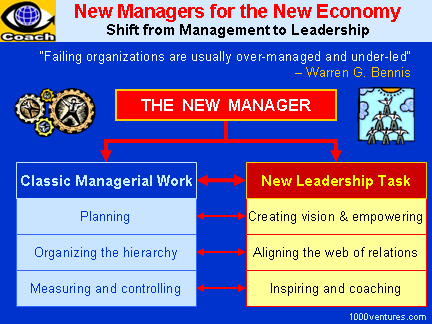
Leadership – the New Managerial Task
Leadership vs.
Management
In the
new era
of rapid changes and
knowledge-based enterprises, managerial work becomes increasingly
a
leadership task. Leadership is the primary force behind successful
change. Leaders
empower employees to act on the
vision.
They execute through inspiration and develop implementation capacity
networks through a complex web of aligned relationship...
More
Leadership-Management Synergy
To maximize your long-term success you should
strive to be both a manager
and a
leader
and to
synergize their
functions. Merely possessing
management skills is no longer sufficient for success as
an executive
in today's business world
. You need to understand the differences between managing and leading
and know how to integrate the two roles to achieve organizational success...
More
Coaching – New
Managerial Task
Effective managers need to coach.
Coaching
aims to enhance the performance and learning ability of your employees.
Coaching at work involves
providing feedback,
effective questioning
and consciously matching your managerial style to the player's readiness to
undertake a particular task12...
More
Managing in
the New Era of Rampant Change
Rapid
change
that is sweeping through every aspect of business today requires
managers to rethink the way they do things
constantly. You must be able to
manage change in both reactive and
proactive manner.
→
Change Management
The
traditional management model
that is geared to a rigid structure and
command-and control mentality
is not enough to get the job done any more...
More
Case
in Point
7-Part
Competitive Strategy of Microsoft
Although Bill Gates, Founder of
Microsoft,
built his empire on technological products, his business mastery is even
more important than his technical skills, and his competitive urge is a huge
driving force.
The early success of
Microsoft was founded on the company's 7-part competitive strategy.
Managing for Results
To achieve results, you should
develop a solid, sound, customer-focused, and
entrepreneurial strategy, aimed at
market leadership,
based on
innovation, and tightly focused on decisive opportunities.
Results-based
Leadership
Managing Up
There are five laws that you absolutely must follow if you have
any hope of creating, maintaining, and managing any productive relationship
with your boss.
Kaizen – the Japanese
Concept of
Continuous Improvement
>>>
→
Kaizen strategy calling for
never-ending effort for
→
Improvement at all organizational levels, is the
most important Japanese management concept and the key to the country's
competitive advantage.
It concentrates at improving the process rather than at achieving
certain results.
Such managerial attitudes make a major difference in how an organization
masters change and
achieves improvements...
More
The Growing Role of the
Business Architect
In today's knowledge- and innovation-driven
complex economy,
business architects
are in growing demand.
To build a winning synergistically
integrated
organization, companies need
cross-functionally
excellent people who can tie several silos of business development
expertise together, create
synergies
and then
lead people who will put their plans
into action....
More
The
Five Types of Management...
The
Eternal Tasks of Management...
Two
Common Traits of Great Leaders and Managers...
Concept of
Effective Management...
New Management
Model...
Managing
Knowledge Workers...
Results-based
Leadership...
Loose-Tight
Leadership...
Thriving in
a Complex Business Environment...
Systems Thinking...
Managing for Results...
Four Keys To Great Managers...
Building Management Team...
Building Cross-functional Team...
Management Is All About Perceptions...
Advanced Management Program (AMP)...
Decentralization and Delegation...
80/20 Theory
of the Firm...
Systems Thinking...
Real-time Business Development...
Managing Rapid Growth...
People Power...
Employee Empowerment...
Persuading People...
Relentless Growth
Attitude...
Energizing Employees...
The Fun Factor...
Five Manager's Mindsets...
Creative Problem Solving (CPS)...
Asking
Searching Questions...
Strategic Road-mapping...
Strategic Achievement...
Systems Approach to Management...
Enterprise-wide
Business Process Management (EBPM)...
|