Sustainable Growth:

Continuous Improvement Firm

Kaizen

The Japanese Strategy of Continuous Improvement


"Japanese management practices succeed simply because they are good management practices. This success has little to do with cultural factors. And the lack of cultural bias means that these practices can be – and are – just as successfully employed elsewhere." ~ Masaaki Imai


Lessons from Konosuke Matsushita, Founder of Panasonic

7 Core Principles of Management Philosophy

  • Relentless Efforts for Improvement... More

The Toyota Way

14 Principles

Transitioning Your Company To a Lean Enterprise

13 Tips

  • Use Kaizen workshops to teach and make rapid changes... More

Main Subjects for Suggestions in Japanese Companies

  • Improvement in the working environment... More

Toyota's 10 Management Principles

  • Relentlessly strive to conduct Kaizen activities... More

The Key Kaizen Practices

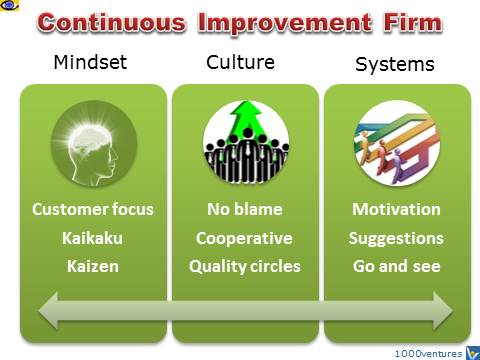
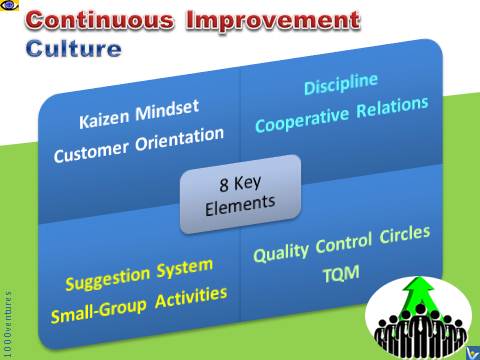
Mindset & Culture

  • customer orientation

  • quality control (QC) circles

  • suggestion system

  • discipline in the workplace

  • small-group activities

  • cooperative labor-management relations

  • total quality management (TQM)

  • quality improvement

Production Process

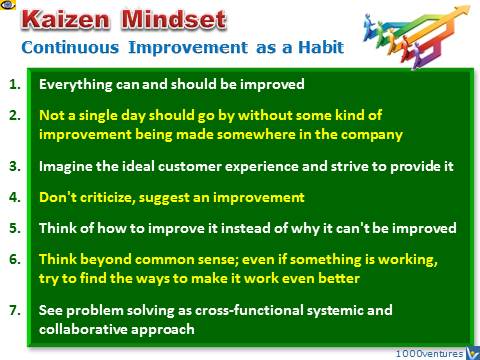
Kaizen Mindset

Setting the Right Mindset & Business Environment

  • Not a single day should go by without some kind of improvement being made somewhere in the company

  • Quality first, not profit first an enterprise can prosper only if customers who purchase its products or services are satisfied

  • Recognition that any corporation has problems and establishing a corporate culture where everyone can freely admit these problems and suggest improvement... More


The Three Basic Principles of Continuous Improvement

  1. Challenge

  2. Kaizen

  3. Go and See... More

Successful Implementation of Kaizen Strategy

7 Conditions

  • Top management commitment... More

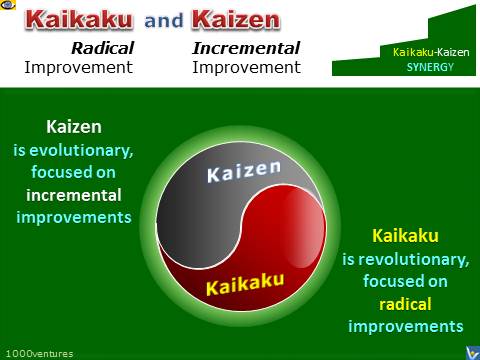
Kaikaku and Kaizen Kaizen Kaizen Mindset 10 Kaikaku Commandments 10 Kaikaku Commandments KAIZEN and KAIKAKU - Yin and Yang

Kaizen and Kaikaku

  • Kaizen is evolutionary, focused on incremental improvements.

  • Kaikaku is revolutionary, focused on radical improvements

10 Kaikaku Commandments

  Keep Your Computer-tired Eyes Healthy


Seven Goals of the Japanese Suggestion System

  1. Making the job easier

  2. Removing drudgery from the job

  3. Removing nuisance from the job

  4. Making the job safer

  5. Making the job more productive

  6. Improving product quality

  7. Saving time and cost... More

Kaizen and Radical Innovation


What is Kaizen?

Kaizen means "improvement". Kaizen strategy calls for never-ending efforts for improvement involving everyone in the organization – managers and workers alike. 

Kaizen and Management

Management has two major components:

  1. maintenance, and

  2. improvement.

The objective of the maintenance function is to maintain current technological, managerial, and operating standards. The improvement function is aimed at improving current standards.

Under the maintenance function, the management must first establish policies, rules, directives and standard operating procedures (SOPs) and then work towards ensuring that everybody follows SOP. The latter is achieved through a combination of discipline and human resource development measures.

Under the improvement function, management works continuously towards revising the current standards, once they have been mastered, and establishing higher ones. Improvement can be broken down between innovation and Kaizen. Innovation involves a drastic improvement in the existing process and requires large investments. Kaizen signifies small improvements as a result of coordinated continuous efforts by all employees.

Implementation of Kaizen Strategy: 7 Conditions

One of the most difficult aspects of introducing and implementing Kaizen strategy is assuring its continuity.

When a company introduces something new, such as quality circles, or total quality management (TQM), it experiences some initial success, but soon such success disappear like fireworks on summer night and after a while nothing is left, and management keeps looking for a new flavor of the month.

This if because the company lacks the first three most important conditions for the successful introduction and implementation of Kaizen strategy... More

Quick and Easy Kaizen

Quick and Easy Kaizen  (or Mini-Kaizen) is aimed at increasing productivity, quality, and worker satisfaction, all from a very grassroots level. Every company employee is encouraged to come up with ideas – however small – that could improve his/her particular job activity, job environment or any company process for that matter. The employees are also encouraged to implement their ideas as small changes can be done by the worker him or herself with very little investment of time.

Quick and easy Kaizen helps eliminate or reduce wastes, promotes personal growth of employees and the company, provides guidance for employees, and serves as a barometer of leadership. Each kaizen may be small, but the cumulative effect is tremendous.

The quick and easy kaizen process works as follows:

  1. The employee notices a problem or an opportunity for improvement... More

Process-Oriented Thinking vs. Result-Oriented Thinking

Kaizen concentrates at improving the process rather than at achieving certain results. Such managerial attitudes and process thinking make a major difference in how an organization masters change and achieves improvements.

8 Best Practices of Successful Companies

  • Value incremental gains... More

 Case in Point  Kaizen Time at Canon

In some Canon plants, the foremen are told to set aside the half-hour as Kaizen time – time to do nothing but thinking improvement in the workshop. The foremen use this period to identify problems and work on Kaizen programs. Factories are advised not to hold meetings during this 30-minute period, and foremen should not even answer the telephone then... More

Five Ss at Canon

Canon has an ongoing workplace improvement program called the Five Ss. The Five Ss refer to the five dimensions of of workplace optimization: Seiri (Sort), Seiton (Set in order), Seiso (Shine), Seiketsu (Standardize), and Shitsuke (Sustain)... More

 Case in Point  7 Principles of Toyota Production System

The Toyota Way: 14 Principles

Toyota Production System (TPS)

  • Employee Involvement and Empowerment: Toyota organized their workers by forming teams and gave them the responsibility and training to do many specialized tasks. Teams are also given responsibility for housekeeping and minor equipment repair. Each team has a leader who also works as one of them on the line.

  • .. More

3 Strategies of Market Leaders

Employee Empowerment: the Suggestion System

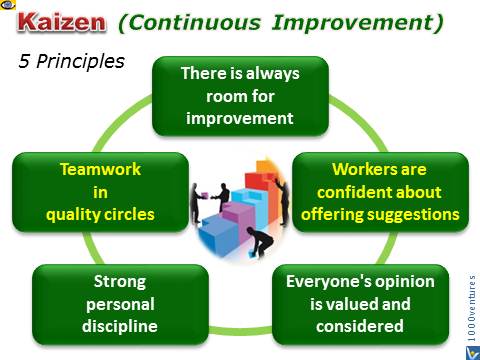
Suggestion Systems are a valuable opportunity for worker self-development  as well as for two-way communication in the workshop. Suggestion systems make employees Kaizen-conscious and provide an opportunity for the workers to speak out with their supervisors as well as among themselves.

Employee Empowerment

The suggestion system is an integral part of an established management system that aims at involving employees in Kaizen. The number of worker's suggestions is regarded as an important criteria in reviewing the performance of the worker's supervisor and the manager of the supervisor.

The Japanese management encourages employees to generate a great number of suggestions and works hard to consider and implement these suggestions, often incorporating them into the overall Kaizen strategy. Management also gives due recognition to employee's efforts for improvement. An important aspect of the suggestion system is that each suggestion, once implemented, leads to an upgraded standard.

Quality control (QC) circles can be viewed as a group-oriented suggestion system for making improvements. QC circle is a small group that voluntarily performs quality-control activities in the workplace.

Total quality control (TQC) involves everyone in the organization and is aimed at improvement of managerial performance at all levels.

According to Masaaki Imai, author of Kaizen: The Key To Japan's Competitive Success, Japanese managers have more leeway in implementing employee suggestions that Western counterparts. Japanese managers are willing to go along with a change if it contributes to any of the seven goals of the suggestion system. This is a sharp contrast to the Western manager's almost exclusive concern with the cost of the change and its economic payback.

Balanced Organization: 5 Basic Elements

Performance Management (Water):

3 Stages of the Suggestion System

1. Encouragement. In the first stage, management should make every effort to help the workers provide suggestions, no matter how primitive, for the betterment of the worker's job and the workshop. This will help the workers look at the way they are doing their jobs... More

Kaizen and Lean Manufacturing

Kaizen is the heart of Lean Manufacturing (also known as the Toyota Production System). Toyota states: "...based on the concept of continuous improvement, or Kaizen, every Toyota team member is empowered with the ability to improve their work environment. This includes everything from quality and safety to the environment and productivity. Improvements and suggestions by team members are the cornerstone of Toyota's success."... More

 Case in Point  Fidelity Investments: Practicing Kaizen

Fidelity’s practice of Kaizen began with the company’s Chairman and CEO, Edward C. Johnson III. A long-time student of eastern philosophy and religion, Johnson became interested in Japanese management practices and discovered Kaizen... More

STRIDES Problem Solving Model

The STRIDES model was developed by the Quality Support Council of Fidelity Investments. This Problem Solving model provides employees in every part of the corporation with a common language and process for implementing Kaizen – a strategy of continuous improvement. As stated in Fidelity's Models for Quality Improvement, STRIDES is the approach to use "where the problem is more complex."... More


References:

  1. Kaizen: The Key To Japan's Competitive Success, Masaaki Imai

  2. Gemba Kaizen: A Commonsense, Low-Cost Approach to Management, Masaaki Imai

  3. Lean Manufacturing That Works, Bill Carreira

  4. The Toyota Way, Jeffrey Liker

  5. The Lean Manufacturing Pocket Handbook, Kenneth W. Dailey

  6. Kaikaku: The Power and Magic of Lean, Norman Bodek

  7. A Team Leader's Guide to Lean Kaizen, William Wes Waldo and Tom Jones

  8. Kaizen, 25 PowerPoint slides by Factory Strategies Group LLC

  9. Kaizen Blitz, DVD by Association of Manufacturing Excellence (AME)

  10. Kaizen Mindset, Vadim Kotelnikov

  11. Kaizen and Innovation, Vadim Kotelnikov

  12. 9 Waste Categories and 6 Guidelines of the Canon's Suggestion System

  13. 10 Commandments of Improvement, Gemba Research

Continuous Improvement Firm (CIF)

3 Basic Principles of Continuous Improvement

5 Elements of Enabling a Lean Approach

3 Broad Types of Waste

7 Wastes

5S

Five Ss at Canon

Deming's 14 Point Plan for TQM

14 Slogans for TQM at Pentel, Japan


This page has been selected by Le Meilleur du Web as a source of valuable information for industry professionals.