 |
|
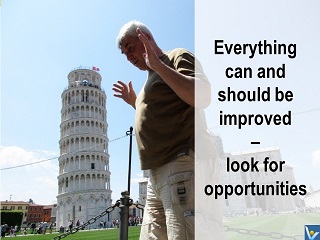
Everything can and should be improved
‒ look for improvement opportunities constantly and pursue them
proactively. Keep in your beautiful mind though that
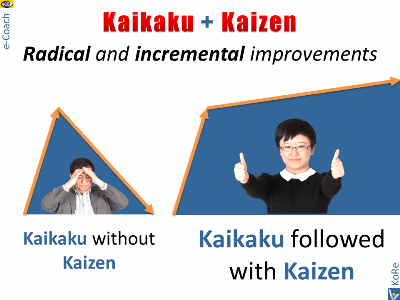
radically-improved objects tend to return to their original state if
a radical improvement (Kaikaku)
is not followed with small continuous improvements (Kaizen). |
|
| |
Continuous Improvement Mindset
Start your continuous improvement journey with improving yourself.
Kaizen
mindset makes continuous improvement an inner need and a habit. Everything can and should be
improved ‒ look for improvement opportunities constantly and pursue them
creatively
and
proactively. |
|
 |
| |
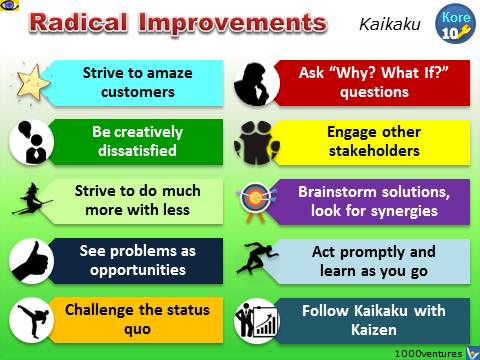
When approaching a
problem situation, you may
need to start with a radical
improvement (Kaikaku) if it is a
major problem.
Having
implemented Kaikaku, keep
improving it continuously
(Kaizen.
|
|
 |
 |
|
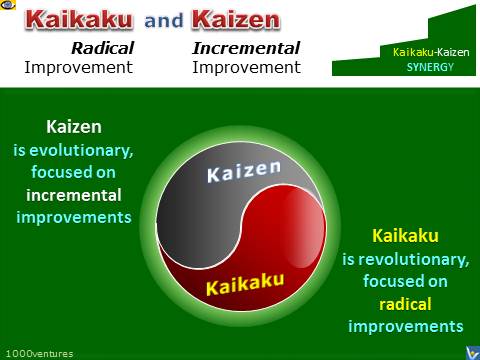
Kaikaku sometimes used as a
precursor to Kaizen activities.
Kaizen is essential for a
long-term lean transformation.
Without continuous improvements
(Kaizen) you are building a
radical improvement (Kaikaku) on
a sandy foundation. And vice
versa.
|
|
 |
|
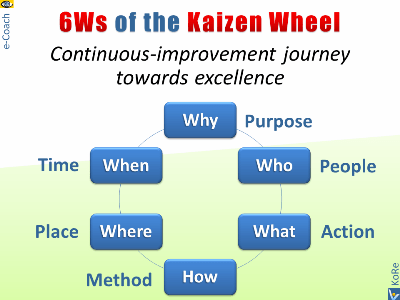
"Kaizen"
means quite
different things in
Japan and
the West.
In Japan, "kaizen" is a
journey
that focuses on people – it calls to start any improvement with
yourself and then improve everything around you.
In the West, "kaizen" is narrowly
focused on improving processes. |
|
| |
|
How to use this information
|
|
|
| |
①
"Adapt what is useful, reject
what is useless, and add what is
specifically your own."
~
Bruce Lee
②
Sleep on this information – your
powerful
superconscious mind will
tell you how to use it when you
wake up
|
|
 |
|
|