|
A
Japanese Spin-off Concept for Successful Business Growth
One of
Japan's best kept secrets, the true engine
of
→
innovation
that has made it one of the most dynamic economies of the last
forty years.
 |
What is
Bunsha?
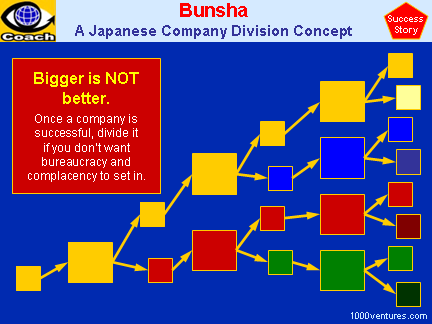
Bunsha means company division. In
practice in means routinely
spinning off
companies from the core group.
Co-founder of one of Japan's
foremost high-tech manufacturing groups, Mr. Kuniyasu Sakai has spent nearly
half-a-century building more than forty stable and profitable companies.
Sakai's experience as a successful manager of a large group of
small
companies led to the development of his business philosophy known in Japan
as Bunsha, or "company division."
|
|
The Origin of
Bunsha
Kuniyasu Sakai and his
partner, Hiroshi Sekiyama, are legendary managers in Japan. They
don't buy the "bigger is better" concept.
Kuniyasu Sakai and Hiroshi
Sekiyama started a business together in the aftermath of World War II. Over
the next few decades they turned it into a
→
highly profitable business.
Rather than build a single, giant firm, they divided it, and then kept on
dividing. Always keeping each of their firms at its optimum size.
In the process of creating a
prosperous Bunsha group of companies, they discovered how to keep their
companies on the
cutting edge, their
employees productive, and their
clients
happy, all at the same time. Their method is what Mr. Sakai calls bunsha
(literally, 'dividing companies'), a system he and Mr. Sekiyama developed
over more than 40 years of real-world corporate management. They
created a group of more than 40 thriving, independent, high-tech
manufacturing companies through bunsha
(company division). Once a company is "successful," they fear that
bureaucracy
 and complacency will set in. What do they do? They divide
it. and complacency will set in. What do they do? They divide
it. |
|
The Key to
Bunsha
Philosophy
Neither an academic theory,
nor some uniquely-Japanese management concept, (Mr. Sakai urges managers to
forget about studying theories and get back to doing what they do best:
managing their companies), Bunsha's message is not merely one of
improving corporate profit through downsizing, it is also a format for
→
improving the lives of each and every employee, increasing both worker and
manager motivation, as well as a viable plan for the rapid revitalization of
any company.
→
Radical Improvement (Kaikaku):
KoRe 10 Tips
According to Sakai, "Splitting up is like
analyzing them under a microscope. When you look at the sections you can see
waste inherent to the old-style approach of large companies. Creating
divisions is not sufficient; the sections have to become separate companies:
that is the key to bunsha philosophy. Being separate allows them to become
more efficient. For example, even the cost systems have to be allowed to
differ. Under the divisional structure, all get the same cost system; it's a
bit like everyone buying suits with the same sleeve length. Under the bunsha
philosophy, every company can develop its own cost systems so they fit
perfectly."
→
Lean Enterprise:
KoRe 10 Tips
In his book
To Expand, We
Divide, Mr. Sakai further explains his "smaller is better" management
philosophy by responding with common-sense and practical solutions to
questions from managers who are either beginning the process of company
division, or considering changing their system of business. Those with
long-term
→
vision are invited to consider and adopt Sakai's
simple program of Bunsha originally developed and set in motion
to insure that his own company would prosper in future.
|
|
Bunsha
in Brief |
|
Once a company
is successful, divide it
if you don't want bureaucracy and complacency to set in.
Give each company a full complement of
functions. Critics say that it is not economical to
duplicate accounting, personnel, and other functions within a group.
But in the information age, centralization limits data collection
and personal contacts. If each company has its own information
networks, in combination they will have access to more information
than any other group of companies.
Pick
→
Capable Leaders
 , then stand back and let
them lead. Give them enough start-up capital in the
beginning and, more importantly, the people they want to work with.
Customer lists can be divided up, or the units can compete head to
head for customers. The new leaders must in turn create an
atmosphere in which employees can contribute through
suggestions,
→
experimentation, etc.
Expect mistakes. As long as they are learned from, they should
be viewed as progress. , then stand back and let
them lead. Give them enough start-up capital in the
beginning and, more importantly, the people they want to work with.
Customer lists can be divided up, or the units can compete head to
head for customers. The new leaders must in turn create an
atmosphere in which employees can contribute through
suggestions,
→
experimentation, etc.
Expect mistakes. As long as they are learned from, they should
be viewed as progress.
See bunsha as a means to alleviate
unemployment and promote
→
Entrepreneurship
. In an
era of massive layoffs, why not give employees an opportunity
to start a new company, with all the inherent risk and
exhilaration involved, rather than the proverbial pink slip?
Bunsha is like tapping into the fountain of youth. Even older
managers are rejuvenated by the process of starting over.
Remember that
small entities are more
likely to adapt and survive rather than expect the environment to
adapt to them. Newer entries are less likely to fail into
the trap of following outdated procedures simply "because we've
always done it this way" and thereby can be more responsive to
changing
customer demand. |
→
10 Rules
for Building a High-growth Business
→
Create Customer Value:
10 Lessons from
Konosuke Matsushita
References:
1.
APO News
2. Bunsha: Improving Your Business Through Company Division, Intercultural
Group
3.
Bunsha: Company Division, My Way, Kuniyasu Sakai, Hiroshi Sekiyana
|


