|
Give More for Less
You must give
customers what they want ‒ the
highest cost/→
benefit
ratio, because if you don't, somebody else will.
Both the cost and the benefit should be
approached holistically.
→
More
benefits come from
more value, more
→
care,
more
→
empathy,
more responsiveness, better delivery,
higher
→
quality,
better service, and more
loving
relationships.
Less cost comes from lower
prices, time saving,
less hassle, simpler procedures, and less sales pressure.
 →
Business e-Coach
→
Business e-Coach
Below are some unsolicited 'Thank-You' notes
from more-than-satisfied users of the Business e-Coach:
-
"Fantastic courses!"
-
"Your teachings,
experience and philosophy are my guiding light."
-
"Thank you for making a positive difference in
my
life." ...
More
→
Innovation is
Love

Customer Expectations
Customer
expectations are
continuously increasing.
Brand loyalty is a thing of the past. Customers seek out products and
value producers that are best able to satisfy their requirements. A product does
not need to be rated highest by customers on all dimensions, only on those
they think are important.
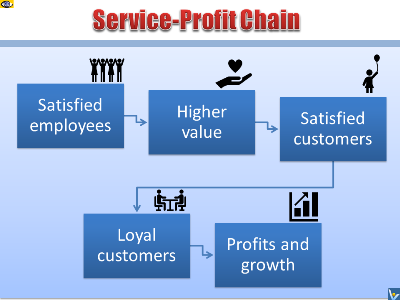
Customer Satisfaction – a Critical Component of Profitability
Exceptional
customer
service results in greater
customer
retention, which in turn results in
higher profitability. Customer loyalty is a major contributor to
sustainable profit growth. >>
 Example
To achieve success, you
must make superior service second nature of your organization. A seamless
integration of all components in the
service-profit chain –
employee
satisfaction,
value
creation, customer satisfaction, customer loyalty, and profit and growth
– links all the critical dynamics of top customer service.
Sadly,
mature companies often forget or forsake the thing that made them
successful in the first place: a customer-centric
business
model. They lose
focus on the customer
and start focusing on the bottom line and quarterly results. They look for
ways to cut costs or increase revenues, often at the expense of the
customer. They forget that satisfying customer needs and continuous
value innovation
is the only path to
sustainable growth.
This creates opportunities for new, smaller companies to emulate and improve
upon what made their bigger competitors successful in the first place and
steal their customers.
Getting Right Customer
Feedback
Don't get customer
feedback
only from surveys and answers to casually posed questions: "How would you
rate your satisfaction with our product or service?" The same results of
such surveys can be interpreted in completely different ways. Surveys and
focus groups don't analyze customer
feedback
with precision, and their results are notoriously susceptible to distortion.
Customer connection comes from
customer
intimacy, involving customers, partnering with them.
Partnering
with customers represents your firm's "capacity to anticipate what
customers need even before they know they need it"4 or to create
customer needs...
More
Process-managed Enterprise
A process-managed enterprise supports,
empowers
and
energizes employees, encourages their initiative, enables and allows its
people to perform process work. "Process work is work that is focused on the
customer, work that is directed toward achieving results rather than
being an end in itself, work that follows a disciplined and repeatable
design. Process work is work that delivers the high-level of performance
that customers now demand."6...
More
Case
in Point
Benefits of
Business Process Management
The payoffs of
process mastery can be breathtaking. Costs melt away,
quality
goes through the roof, and time spans shrink to a fraction of what they
were. Hammer and Company8
surveyed dozens of companies that had adopted the process approach to work
and business.
-
In order fulfilment,
cycle times had typically decreased by 60% to 90%
-
"Perfect orders" (those
delivered on time, with no mistakes) had increased by 25%
These improvements in
process performance paid off in the critical enterprise currencies of
customer
satisfaction, customer retention, and corporate profits...
More
 Dell Dell
"We learned to identify our
core strengths," writes
Michael Dell7, Founder of
Dell Inc. "Pretty early on in the company's life, we
concluded that we wanted to earn a reputation for providing great
customer
service, as well as great products. The idea was that building a
business solely on cost or price was not a
sustainable advantage.
There would always be someone with something that was lower in price or
cheaper to produce. What was really important was sustaining loyalty among
customers and employees, and that could only be derived from having the
highest level of service and very high-performing products."
"We put a great deal of
emphasis on understanding what drove customer satisfaction, whether it was
response times on the telephone, quality of products, valuable features, or
the ease of experience in using the product. Engaging the entire company
–
from manufacturing to
engineering to sales to support staff
–
in the process of understanding
customer
requirements became a constant focus of management, energy, training, and
employee education."
Apple
"I get asked a lot why Apple's customers are
so loyal. It's not because they belong to the Church of Mac! That's
ridiculous," once said
Steve Jobs,
Founder of Apple.
"It's
because when you buy our products, and three months later you get stuck on
something, you quickly figure out how to get past it. And you think, "Wow,
someone over there at Apple actually thought of this!" And then three months
later you try to do something you hadn't tried before, and it works, and you
think "Hey, they thought of that, too." And then six months later it happens
again. There's almost no product in the world that you have that experience
with, but you have it with Apple products."...
More
Case
in Point
Wall-Mart
In his
→
10 Rules for Building a Successful Business, Sam Walton, the Founder of Wall-Mart writes:
"Exceed
your customer's expectations. If you do, they'll come back over and over.
Give them what they want – and a little more. Let them know you appreciate
them. Make good on all your mistakes, and don't make excuses – apologize.
Stand behind everything you do. The two most important words I ever wrote
were on that first Wal-Mart sign: "Satisfaction Guaranteed." They're still
up there, and they have made all the difference."...
More
Amazon.com works hard to achieve
value-added
differentiation
through customer-focused information services. Amazon.com's site retains
customer preferences and provides automated customization for users.
Amazon.com's market success depends on its ability
to maintain and grow its customer base by
knowing and
serving
its customers better than its competitors and providing a higher level of
value-added differentiation in customer service. Due to high level of customer
satisfaction,
repeat customers account for approximately 60% of Amazon.com's orders...
More
Case
in Point
Toyota
The fundamental reason for
Toyota's success in the global marketplace lies in its corporate
philosophy – the set of rules and attitudes that govern the use of
its resources.
Toyota have successfully
penetrated global markets and established a world-wide presence by
virtue of its
productivity. The intent
implicit in the
Toyota
Production System is to
stimulate people to think constantly – a "self-running,
selfimproving" system. Everyone, not just managers, can see what's
happening. Every problem prompts why questions.
Empowered workers can solve problems at a very detailed level. A
lean
learning culture permeates the entire company.
Customer value creation and customer satisfaction results from
enterprise-wide performance...
More
|