|
Understand What Motivates
People
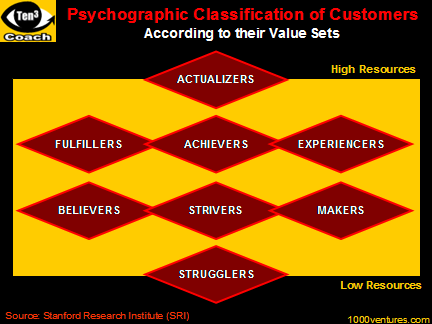
Work to understand who your customers are,
what their
→
emotional drivers,
needs,
habits and
→
perceptions
are and how you can establish an
engagement
method that works to their rhythm. You have to find out
what
→
motivates consumers,
what turns them on, and how to how to press those "hot buttons".
To turn people on, you must, first, find out what they really want, and
then, show them how to get it.
Define Your
Target Market
Think of your target market and clients you
wish to work with – list the best qualities. What is their specific title or
profession? Can they be categorized easily? List every important quality you
can come up with. Consider geography,
→
cultures, age, income level,
values,
interests, etc.
Example:
My target market is
small business owners who provide professional services such as accounting,
architecture, engineering,
IT,
→
coaching, consulting. They operate
their businesses with a high degree of integrity, they value
building
relationships with their clients and they are interested in growing their
companies. Also, they are enjoyable to work with and they appreciate a
good
laugh and fun6!
Customer's
Perspective of Quality
→
Quality
Is all about customers'
→
perceptions.
Like beauty and truth, quality is in the eye of the beholder, your
customer...
More
Offer a
Solution To Your Customers' Problems
What problems do your current or potential
customers face? List 5 distinct problems, issues, pains, dilemmas,
challenges, worries, fears, unsatisfied desires – even if they seem
unrelated to the services you offer. Write these succinctly and clearly.
For each of the 5 problems/pains listed, spell
out your solution – what
→
customer value
do you produce; what can your clients expect to get out of your work with
them? Don't just list your services here. Instead, specify
the end-result benefit they will receive. Speak to your market as
if you know them personally; appeal to your market's desires and pains.
For
example, if the problem is, "They never
have enough time," your solution and
value proposition might be,
"Our services take the pressure off you and give you less to deal with." The
solution is not your service per se, it is the time-saving result your
service translates into.6...
More
Understand the Dynamics of
Customer Needs
Understanding customer needs will help you
define new market opportunities and drive
→
innovation
and
→
revenue
growth in every aspect of your organization.
In the
→
new rapidly changing economy, however,
customer predictability is dead. "Whatever a customer wants today may not be
what he or she wants tomorrow. Or he or she may want more of it. If you're
offering low prices, customers want those prices slashed further. If you're
offering state-of-the art products, they want them newer still. In meeting
ever-increasing customer demands for lower, faster, better, and newer,
companies are driving themselves and their competitors to the brink."4
You can't predict the future, but by
establishing effective
→
change management
practices you can be ready for whatever it brings.
>>>
Use Different Types of
Interaction
You don't need a degree in psychology to
compete successfully in the marketplace, but you do need some way to
figure out the
different styles of interaction different people prefer to use. People
tend to lead their decision-making process with one of the four functions:
intuition, thinking, feeling, and sensing. Vividly
→
differentiated
differences that are anchored to a product and engage the above functions
can enhance memory of your current and prospective customers...
More
Ford Motor Company
The Ford's customer base is becoming
increasingly diverse as the company expand globally and as their established
markets themselves become more diverse. This influences Ford's product
development and marketing approaches.
For example, women make up more than 54 percent
of U.S. Ford's customers. “Your Concept Car” was designed by a group of
female engineers, designers and marketing professionals who strove to
reflect what women say they want in a vehicle.
Ford is also conducting research and vehicle
development geared toward customers with special needs, such as limited
mobility. A Ford Europe product design team focused on making Ford products
the brand of choice for people with mobility issues. At many corporately
owned locations in Europe, Hertz is offering vehicles equipped with hand
controls at no additional charge for disabled customers...
More
Black & Decker (B&D)
By learning what its customers really want for
their projects, toolmaker Black & Decker recaptured its flagging
do-it-yourself market, fighting back strong challenges from Makita and
Sears.5
Like anthropologists, B&D marketing executives studied 50 male home-owners –
ages 25 to 54 – as they used power tools to work on projects. The executives
aimed to discover exactly why users favored certain tools over others.
Dissatisfaction was high. Do-it-yourselfers wanted a cordless drill with
enough power to complete a good sized job. They wanted sanders and circular
saws that didn't kick up clouds of sawdust; safety mechanisms that would
instantly stop saw blades from spinning when they switched off power; a
hotline for questions about home-repair problems. Never before had customers
so clearly voiced their concerns.
As a result, do-it-yourselfers got equipment
that matched their wants: B&D introduced its Quantum line of saws, drills,
and small power tools priced from $50 to $120. The market responded quickly:
Introduced late in 1993, by end of 1994, Quantum surpassed its sales goal
and was already upgrading its tools to QuantumPro. |