|
Two Purposes of Segmentation |
-
Optimizing resources: segmentation
as a strategy you use to concentrate, and thus optimize your
resources within a overall market.
-
Understanding customer needs:
segmentation as the group of techniques you use as a vendor to
segment your target market to develop insights into
customer needs.
|
|
Two Types of Segmentation |
-
By product
-
By customer
|
|
Market Research
Defining
Market Segment
& Customer Profile |
-
Demographic (education,
occupation, income level, age, gender, etc.)
-
Geographic location
-
Business markets (type, size,
location, turnover, etc.)
-
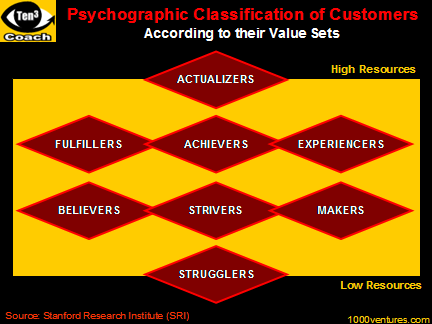
Consumer behavior characteristics
|
|
Market Segmentation by
Consumer Behavior1 |
-
Consumer Characteristics: who buys
-
Geographic (e.g., region – urban or rural)
-
Demographic (e.g., age, gender, and marital status)
-
Socioeconomic (e.g. income, social class, and occupation)
-
→
Cultural
(e.g., lifestyles and
culture)
-
Consumer responses: what is bought
|
|
Why Market Segmentation?
Divide and conquer!
Successful marketers qualify their current and
prospective customers. By doing so, they can better target their
value propositions to different
customer groups, which results in higher sales.
→
Value Innovation:
Yin-Yang Strategies
→
Differentiation
Strategies
 Michael Dell Michael Dell
Discovering
the Power of Segmentation at the Age of 16
The Starting Point of Your Sustainable,
Profitable Growth
→
Surprise To Win:
3 Strategies
→
3 Strategies
of Market Leaders
Innovative segmentation and resegmentation of
your target market is the starting point of your
sustainable
profitable growth.
→
Revenue Model
→
Creating Sustainable Profits:
9 Questions
Any market is the sum of many segments. Each segment
fulfills a need, and these needs are constantly changing.
→
Customer Care
There are many ways to segment a market. You
can resegment a market by consumer age,
→
culture,
motivation and
buying behavior, customer value sets,
value proposition, technology,
price points, distribution channels, line extensions, and the like. You can
also define a new segment, i.e. define a customer need that nobody else has
thought of or addressed before. Besides, segmentations is not once and for
all, it's a dynamic, ongoing exercise and state of mind.
When you break your market down into segments,
you've got a powerful methodology for developing insights into
customer
needs and generating growth ideas. Think expansively,
observe people,
learn everything you can about customers' needs, including those that the
customers haven't yet identified.
Think outside-the-box
to generate market stretching concepts that will change the name of the
game.
→
Benefit
from Your Competitors
 Business
e-Coach Business
e-Coach
Invented in 2001,
→
Ten3 Business e-Coach
has customers all around the World and
licensed trainers in 50+ countries.
→
The Tree of
Online
Success
To create
→
greater value for
diverse groups of e-coach users, I have gradually built
a
→
synergistic
network of e-coaching sites.
Each site focuses on a chosen set of
life values
and/or
→
business
interests...
More
Nike
The tool of segmentation transformed Nike. Nike
has grown by developing new market segments and moving into adjacent ones.
It sliced up the fitness marketplace into many segments capturing nearly
half of the U.S. athletic footwear market and expanding around the world...
More
Dell Computers
|


