|
Why Customer Intimacy?
"Customers grow
ever more demanding, and suppliers must
change just to keep up."
~
Fred Wiersema
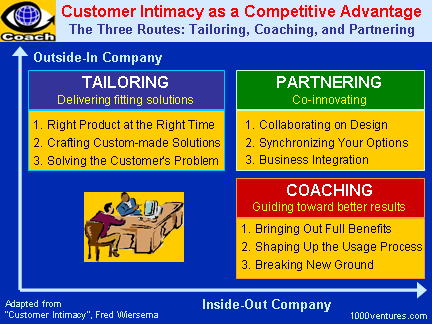
Customer intimacy is a high-potential source of growth,
sustainable competitive advantage,
and profits. Everyone in your organization should practice it.
Customer-intimate companies bring an entirely fresh perspective. They
discover unsuspected problems, detect unrealized potential, and create a
dynamic synergy with customers. They often merge their operations with those of
their customers. In the integration of their operations, suppliers become
more than merely useful: They become indispensable.1
Customer Intimacy as a
Competitive Advantage
Businesses have traditionally relied on
technology and
product innovation for
competitive advantage. However, as products
became commodities due to global competition and relentless technological
advances, the battleground for
differentiation
and
→
customer value creation
shifted to customer intimacy and
service. This service-focused
competitive strategy has worked well
for numerous companies across various industry sectors.
New Mindset – a New Way of
Doing Business
Customer-intimate companies develop a new
mindset –
a new way
of doing business – with new
values,
new
vision,
new
strategies, new
systems, and new structures. They are in the business of
creating new value for their customers. Rather than simply react to
their customers' every whim, customer-intimate suppliers discover how to
provide complete solutions to customers' needs.
Customer Intimacy
vs. Customer Satisfaction
"Customer intimacy doesn't call for increasing
customer satisfaction. It requires
taking responsibility for customer results. It doesn't impose arm's length
goodwill. It requires down-in-the-trenches solidarity, the exchange of
useful information, and the cooperative pursuit of results."1
 →
25 Lessons from Jack Welch →
25 Lessons from Jack Welch
→
Jack Welch's
goal was to make
GE "the world's
most competitive enterprise." Welch believed in trying to know every
employee and every customer, just like a village grocer.
Welch even nicknamed GE "the grocery store": "What is important at the
grocery store is just as important in engines or medical systems. If the
customer isn't satisfied, if the stuff is getting stale, if the shelf isn't
right, or if the offerings aren't right, it's the same thing. You manage it
like a small organization. You don't get hung on zeros."...
More
|