|
Keys To New Product Success
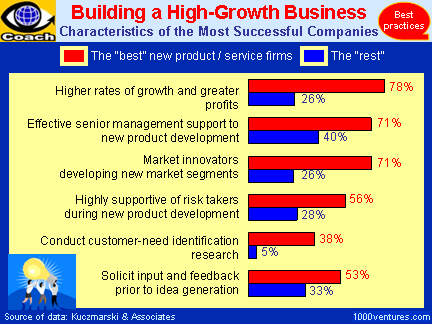
10 Characteristics of the Most Successful Companies
|
|
|
|
4 Entrepreneurial
Strategies
By:
Peter Drucker
|
-
Changing the economic characteristics of the product, a market, or an
industry
– by creating utility, or
pricing, or adaptation to the customer's social and economic
reality, or delivering what represents true
value to the customer....
More
|
|
|
DOs and DON'Ts of a Successful
Innovator
By:
Peter Drucker |
|
DOs
Start small – try
to do one specific thing...
DON'Ts
Don't undershoot,
or you will simply create an opportunity for competition.
|
|
|
Product: a Broad Definition
According to Phillip Kotler, a product is
anything that can be offered to a market for attention, acquisition, use, or
consumption that might satisfy a need or want. Thus, a product may be a
physical good, retail store, person, organization, place, or idea.
Product Innovation as a
Team Sport
The myth that products are developed by lone
geniuses in their labs, who turn sudden inspiration into practical
innovation "wasn't quite true even in Thomas Edison's day, and it certainly
isn't true today," writes Michael Hammer.2
"Reality is far more complex. Talent and
inspiration are necessary but not sufficient. To create and launch
nearly any new product today requires
many people with many different skills."
-
Engineers must envision and design
the product, using customer input provides via
sales representatives, then
-
Marketing experts
must assess the product's potential and help shape its specific
features.
-
Financial types must analyze the
cost of marketing it and determine
a competitive price.
-
Manufacturing specialists
must decide how to make the product in volume.
-
Lawyers must assess how it can be
protected from imitators.
The key to success here are coordination and
discipline.2
Steve Jobs' 12 Rules of
Success
-
Innovate.
Innovation distinguishes a leader from
a follower. Say no to 1,000 things make sure you don't get
on the wrong track or try to do too much. Concentrate on
really important creations and radical innovation. Hire
people who want to make the best things in the world. You
need a very product-oriented culture, even in a technology
company. Lots of companies have tons of great engineers and
smart people. But ultimately, there needs to be some
gravitational force that pulls it all together...
More
3 Strategies of Market Leaders
The market leader is dominant in its industry and
has substantial market share. If you want to lead the market, you must be the
industry leader in developing
new business models and
new
products
or services. You must be on the
cutting edge of
new technologies and
innovative business
processes. Your
customer value proposition must offer a superior solution to a
customers' problem, and your product must be well
differentiated...
More
The Jazz of Innovation
The improvisation-driven model for
innovation
project management doesn’t discard structure, just as there is a clear
structure to good jazz.
In innovation, this structure is created through
roadmaps,
guiding principles,
business processes, systems and organizational
charts.
Strategic-planning
and road-mapping processes cannot guarantee brilliant flashes of creative
insight, but they can prepare minds and increase the odds that such flashes
occur in real time. Thus structure, as chords do in jazz, serves as a basis
for improvisation,
experimentations,
discoveries and
innovation.
Brainstorming
Brainstorming is not just a valuable creative
tool at the
fuzzy front end of projects. It's also "a
pervasive cultural influence for making sure that individuals don't waste
too much energy spinning their wheels on a tough problem when the collective
wisdom of the team can get them "unstuck" in less than an hour."4...
More
Observing People
It is observation-fueled insight that makes innovation possible. Uncovering
what comes naturally to people. And having the strengths to change the
rules...
More
Prototyping
"Quick prototyping is about acting before
you've got the answers, about taking chances, stumbling a little, but then
making it right. Living, moving prototypes can help shape your ideas. When
you're
creating something new to the world, you can't look over your shoulder
to see what your competitors are doing; you have to find another source of
inspiration,"
says Tom Kelly1 from
IDEO...
More
The Art of Innovation: 9
Truths
By: Guy Kawasaki
-
Jump to the next curve. Too many companies duke it out on the
same curve. If they were daisy wheel printer companies, they think
innovation means adding Helvetica in 24 points. Instead, they should
invent laser printing. True innovation happens when a company jumps to
the next curve – or better still, invents the next curve, so set your
goals high.
Radical
Innovation
Long term corporate success
linked to the ability to
innovate.
Although corporate investment in
improvements
to existing products and processes does bring growth, it is new game
changing breakthroughs that will launch company into new markets, enable
rapid growth, and create high return on investment.
Companies that are not bound by prevalent
fallacies and rules of conventional wisdom have been able to break out of
the pack, create a new highly profitable market niche, and
win
customers.
Radical innovation should be a continued
activity to help your company reinvent itself and maintain its market
leadership...
More
Case in Point
Silicon Valley
Companies
Adapted from
Relentless Growth, Christopher Meyer
Deciding If Your
Innovation Portfolio Has
Enough
Stretch:
-
Balance between revolutionary and
evolutionary initiatives. First, Silicon Valley companies assess the
overall balance between revolutionary and evolutionary projects. The
ultimate arbitrator of portfolio stretch if the innovation leaders’
judgment, experience, intuition, and luck..
Creative Leadership
Creative leaders
search for and
discover
opportunities, introduce positive change and make
quantum leaps
forward in creating new products and
processes...
More
Define How
Much Innovation is Required: 4 Questions to be Answered...
Five Levels to a
Product...
Critical Milestones...
Innovation Process: Diversion and Conversion of Ideas...
Diversification Strategies...
Specific Mindset and Skill Requirements...
Systematic Approach to Innovation...
Systems Thinking...
Creative Leadership...
Strategy Innovation...
Process Innovation...
Value Innovation...
New
Product Metrics...
Case in Point Dell
Computer Corporation...
Case in Point
IDEO...
Case in Point
Nike...
Case in Point Gillette...
Case in Point
Charles Schwab...
Case in Point
Fun4Biz...
Case in Point
VVV...
|