|
Five Main
Advantages of TQM |
-
Encourages a strategic
approach to management at the operational level through involving
multiple departments in cross-functional improvements and
→
Systemic Innovation
processes
-
Provides high return on investment
through
improving efficiency
-
Works equally well for service and manufacturing sectors
-
Allows organizations to take advantage of developments that enable
managing operations as cross-functional processes
-
Fits an orientation toward inter-organizational collaboration and
strategic alliances
through establishing a culture of collaboration among different
departments within organization
|
|
TQM and
Continuous Improvement Firm (CIF)
Two
different perspectives of the same phenomenon |
-
The TQM Perspective – the
beliefs and practices required of management to bring about and
perpetuate a
continuous improvement firm (CIF).
-
The CIF Perspective – the
organization itself in all its integrity, full-blown, operating and
practicing the total quality management (TQM) approaches.
|
|
TQM and
Just-in-Time (JIT) |
|
|
|
Barriers
to
Successful TQM |
|
|
|
Main Difference Between
TQM and Six Sigma |
|
|
|
Main
Subjects for Suggestions in Japanese Companies |
|
|
|
Why TQM?
"If you put a
spoonful of wine in a barrel of sewage, you get sewage.
If you put a spoonful of
sewage in a barrel full of wine, you get sewage."
~
Schopenhauer's Law of Entropy
Over the years TQM has become very important for
improving a firm's process capabilities in order to achieve fit and sustain
competitive advantages. TQM focuses on encouraging a continuous flow of
incremental improvements from the bottom of the organization's hierarchy. TQM is
not a complete solution formula as viewed by many
– formulas can
not solve managerial problems, but a lasting commitment to the process of
continuous improvement.
→
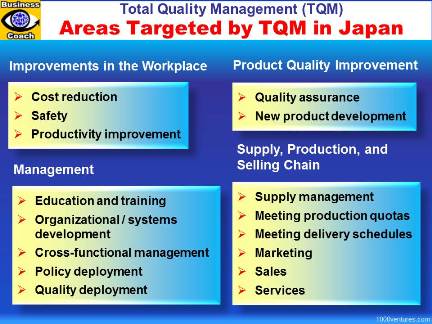
Areas Targeted by
TQM in Japan
The Main Driving Force
The main driving force of TQM is
customer satisfaction.
Deming's 14
Point's Plan for TQM
Point 1:
Create constancy of purpose toward improvement of the product
and service so as to
become
→
competitive
,
stay in business and provide jobs.
Point 2:
Adopt the new philosophy. We are in a new economic age. We no
longer need live with commonly accepted levels of delay,
mistake, defective material and defective workmanship.
Point 3:
Cease dependence on mass inspection; require, instead,
statistical evidence that quality is built in...
More
Case
in Point
14
TQM Slogans at Pentel
Pentel is a Japanese firm manufacturing stationary
products. The following is a list of 14 Pentel's slogans for explaining Total
Quality Management
(TQM) and
Quick and Easy Kaizen
philosophy to its employees.
TQM Requires
Cultural
Transformation
With TQM quality is not the product but the process. To institute the
process, corporate trainers must bring about a
cultural transformation wherein all
employees shed their individualism for a unified set of
corporate values.
TQM was the brainchild
of
Dr.
W. Edward Deming. TQM helped
Japan with its postwar economic
recovery. That was because it meshed with Japanese culture...
More
Be the Best Possible
10 Tips by
Ten3 NZ Ltd.
-
Quality is not just product related.
Quality is not just the product; it's a combination of the product and
"add-ons," i.e. packaging, availability, convenience of use and value
adding customer service, etc. The same applies to you in the
employment market. Possessing a tertiary qualification may only get you
50% of the way towards being internally promoted or externally employed.
The other 50% will depend upon what your acquired "add-ons" are, i.e.
what makes you more valuable than your competitor in the mind of
potential employers/customers. Ask yourself "what value adding
skills have I acquired and applied to my work within the past 2 years
that demonstrate skill flexibility, continuing career development and
quality as an employee?"...
More
Three Stages of the Suggestion
System
1. Encouragement. In the first stage,
management should make every effort to help the workers
provide suggestions,
no matter how primitive, for the
betterment of the worker's job and the workshop. This will help the workers
look at the way they are doing their jobs...
More
Case
in Point
Canon
Case
in Point
Wall-Mart
In his
10 Rules for Building a
Business Success,
Sam Walton,
the Founder of Wall-Mart advises:
"Listen
to everyone in your company and figure out ways to get them talking. The
folks on the front lines
–
the ones who actually talk to the customer
–
are the only ones who really know what's going on out there. You'd better
find out what they know. This really is what total quality is all about. To
push responsibility down in your organization, and to
force good ideas to
bubble up within it, you must listen to what your associates are trying
to tell you."
|