Business Processes:

Efficiency Improvement

Just-in-Time (JIT) Production

By Vadim Kotelnikov, Founder, Ten3 BUSINESS e-COACH - Innovation Unlimited, 1000ventures.com

 Yes!  You are in the right place!

This site is Ranked Top 5 by Google for

"JIT"

out of about 7-million-wide (!!!) competition!

"Overproduction is the central evil that leads to waste in other areas of the production process."

Masaaki Imai


8 Best Practices of Successful Companies

  • Manage inventory in superior fashion... More

Just-In-Time (JIT) JIT- Just-In-Time Manufacturing

KAIZEN Classification of Waste Incurred in the Production Process

  1. Overproduction

  2. Waste time spent at the machine

  3. Waste involved in the transportation of units

  4. Waste in processing

  5. Waste in taking inventory

  6. Waste of motion

  7. Waste in the form of defective units

JIT Advantages

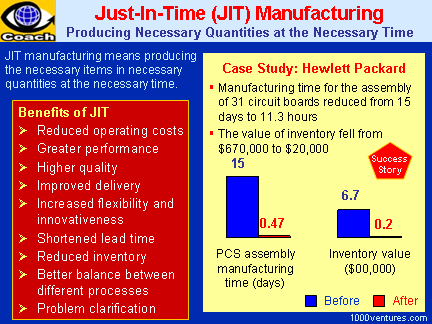
  1. Shortened lead time

  2. Reduced time spent on non-process work

  3. Reduced inventory

  4. Better balance between different processes

  5. Problem clarification

Barriers to Successful JIT

7 Principles of Toyota Production System (TPS)

  • Supplier Involvement

  • Small-Lot Production

  • Pull Production... More


 Discover much more!

Lean Production

7 Principles of Toyota Production System (TPS)

5 Elements of Enabling a Lean Approach

10 Commandments of Improvement

TPS-Lean Six Sigma – Linking Human Capital to Lean Six Sigma

Quick and Easy Kaizen

Kaizen Mindset

Japanese-style Suggestion System

9 Waste Categories and 6 Guidelines of the Canon's Suggestion System

Five Ss at Canon

Business Processes

8 Essential Principles of Enterprise-wide Business Process Management (EBPM)

Deming's 14 Point Plan for TQM

Ten3 Global Business Learning Report

Business Processes

Free Ten3 Micro-courses

Kaizen and Lean Manufacturing

  Ten3 Mini-Courses   Presentation:    View    Download

Synergizing Business Processes  (60 slides)

Synergizing Value Chain  (200 slides)

Smart Business Architect  (150 slides)


Why JIT?

In Kaizen, JIT is a is a collection of concepts and techniques for improving productivity. JIT is a process aimed at increasing value-added and eliminating waste by providing the environment to perfect and simplify the processes.

What is JIT?

Just-in-time manufacturing means producing the necessary items in necessary quantities at the necessary time. It is a philosophy of continuous improvement in which non-value-adding activities (or wastes) are identified and removed.

Putting this concept into practice means a reversal of the traditional thinking process. In conventional production processes, units are transported to the next production stage as soon as they are ready. In JIT, each stage is required to go back to the previous stage to pick up the exact number of units needed.

Benefits

  • Reduced operating costs

  • Greater performance and throughput

  • Higher quality

  • Improved delivery

  • Increased flexibility and innovativeness

JIT Components

  • Production Leveling

  • Pull System

  • Kamban (label or signboard) system

  • Good Housekeeping

  • Small Lot Production

  • Setup Time Reduction

  • Total Preventive Maintenance (TPM)

  • Total Quality Control (TQC)

  • JIT Purchasing

  • Line Balancing

  • Flexible Manufacturing

  • Small-group Activities (SGA)

Kamban – a Communication Tool in JIT Production System

Being a very important tool for just-in-time production, kamban has become synonymous with the JIT production system.


Kamban, meaning label or signboard, is used as a communication tool in JIT system. A kamban is attached to each box of parts as they go to the assembly line. A worker from the following process goes to collect parts from the previous process leaving a kamban signifying the delivery of a given quantity of specific parts. Having all the parts funneled to the line and used as required, the same kamban is returned back to serve as both a record of work done and an order for new parts. Thus kamban coordinates the inflow of parts and components to the assembly line, minimizing the processes.

 Case in Point  Canon

The objectives of Canon Production System (CPS) are to manufacture better quality products at lower cost and deliver them faster.

The three basic parts of CPS are Quality Assurance (QA), Production Assurance (PA) and Personnel Training (PT).

Production Assurance (PA) System is aimed to achieve just-in-time manufacturing, fast delivery, low cost, and also adopt the "visual control" philosophy. Canon has devised two subsystems to attain these PA goals: Canon's HIT System (equivalent to just-in-time) and Signal System. The HIT System means making parts and products only when needed and only in the quantity needed. Canon uses either HIT cards or signals for this purpose... More

JIT-Style Learning and Training

The best kind of quality oriented learning (and training) is just-in-time-style learning, that is, learning that happens on the job and knowledge which is applied immediately as needed. The sooner you can apply the material you learned, the better you will understand it and the longer it will be retained. Instead of training masses of employees for long periods, in JIT-style training, education is implemented as an ongoing series of short sessions (just a few hours a week) during which employees are taught only what they can apply soon, without suffering information overload.

Innovative e-learning services create new opportunities for such on the job JIT-style learning and training. In particular, this first-ever Ten3 online Business e-Coach provides very effective JIT-style e-learning opportunity which is available free anytime to anybody.


  Lean Manufacturing Overview

254 slides by Superfactory

Lean Manufacturing - 5S - Visual Controls - Kaizen - Value Streams - Pull - Mistake Proofing - Quick Changeover - Six Sigma - Theory of Constraints

US$80 ►  See sample slides ►  BUY NOW!


References:

  1. "Kanban Just-In-Time at Toyota," Japan Management Association

  2. "Lean Manufacturing That Works", Bill Carreira

  3. "Toyota Production System," Taiichi Ohno

  4. "The Toyota Way," Jeffrey Liker

  5. "Lean Production Simplified," Pascal Dennis, John Shook

  6. "The Lean Manufacturing Pocket Handbook," Kenneth W. Dailey

KAIZEN (25 slides by Superfactory)
What is Kaizen - Implementation Steps - Kaizen Blitz - Roadblocks

    US$40    See sample slides BUY NOW!


Map

Ranked #1

Search

Testimonials

Free Downloads

  Products

SMART Learning

Training

 Contact

We invented Business e-Coaching in 2001

Today, we have customers in 100+ countries!

Our customers:

3M, ABB, Adidas, Alcatel, American Express, Bayer, Boeing, British American Tobacco, BP, Canon, Cisco, Citigroup, Colgate, Corning, Deloitte, Ernst & Young, Fujitsu-Siemens, GE, Goldman Sachs, HP, Hitachi, Huyndai, IBM, Intel, Johnson & Johnson, JP Morgan Chase, KPMG, Lufthansa, Microsoft, Motorola, Nokia, Oracle, Samsung, Shell, Siemens, Sony, United Bank of Switzerland

Ten3 Mini-courses: SMART & FAST sets Full version of Ten3 Business e-Coach Ten3 Business e-Coach (home page)

Ten3 Business e-Coach, version 2008

Inventor, Author & Founder – Vadim Kotelnikov

© Vadim Kotelnikov, GIVIS