Business Process Management:

Systems Thinking

Business Process Thinking

Shift from Traditional Functional Mindset

By Vadim Kotelnikov, Founder, Ten3 BUSINESS e-COACH and Andrew Spanyi, Managing Director, Spanyi International Inc.

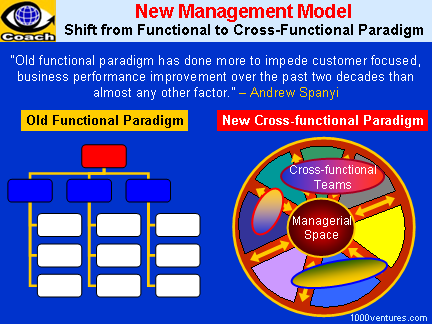
"Traditional functional paradigm has done more to impede customer focused, business performance improvement over the past two decades than almost any other factor." Andrew Spanyi 


Enterprise-wide Business Process Management Cross-functional Teams Traditional Management Model Managrial Leadership Business Process Thinking Ten3 Business e-Coach: why, what, and how

Assess Your Leadership Team Attitude

with respect to a more adaptive business process thinking paradigm4

Leaders believe that:

Leaders are actively engaged in:

  • Monitoring the firm's performance in providing products/services to customers, from a customer's point of view

  • Discussing the performance of the firm's enterprise business processes

  • Managing the flow of cross-functional activity in the enterprise business process for continuous improvement

Four Distinctive Features of Process Thinking1

  1. Processes are goal-oriented: They focus on the outcome of work rather than on work as an end in itself. In a process enterprise, everyone in the company understands the why and what of their work. How people are trained and how performance is measured reinforces the outcome orientation of processes.

  2. Processes are customer-focused: Thinking in terms of processes compels a business to see itself and its work from the customer's perspective, rather than from its own. Marketing and selling is viewed through the lens of forming partnerships with customers to solve their business problems. The old focus on optimizing your own production schedules is replaced by a new one on delivering solutions to customers on time. These new perspectives lead to new ways of working.

  3. Processes are holistic: Process thinking transcends individual activities. It concentrates instead on how activities fit together to achieve the key goal – to deliver superior value to the customer. This goal is achieved by replacing a collection of competing departments with a seamless and synergistic web of strategically aligned collaborators working together for a unified purpose.

  4. Processes are institutionalized: They don't rely on luck, be it leadership, technological, or marketing one. "Process companies seek to institutionalize success by designing high-performance ways of working. They do not denigrate the talents of remarkable individuals, but they recognize that all human talent can and should be leveraged by an overall process. They believe that a company achieves its highest potential by designing processes that mobilize everyone's abilities rather than depending too much on any single individual, however gifted she or he may be."1

Kaizen: Setting the Right Mindset & Business Environment

  • emphasis on process – establishing a way of thinking oriented at improving processes, and a management system that supports and acknowledges people's process-oriented efforts for improvement... More

 Discover much more!

Modern Manager

Management Function vs. Process Focus

Business Processes

Enterprise-wide Business Process Management (EBPM)

8 Essential Principles of Enterprise-wide Business Process Management (EBPM)

10 Commandments of Improvement

4 Phases of IT/Business Alignment

Lean Production

7 Principles of Toyota Production System (TPS)

5 Elements of Enabling a Lean Approach

Quality Management

Deming's 14 Point Plan for Total Quality Management (TQM)

Ten3 Global Business Learning Report

Business Processes

Free Ten3 Micro-courses

Business Success 360

Kaizen and Lean Manufacturing

  Ten3 Mini-Courses   Presentation:    View    Download

Synergizing Business Processes  (60 slides)

Synergizing Value Chain  (200 slides)

Smart Business Architect  (150 slides)

The Central Belief

"Business process thinking is predicated upon the central belief that it is fundamentally the complex, cross-departmental, technology-enabled business process that create value for customers and shareholders."


This predication assumes that every significant management activity should begin with an analysis of customers' needs and have, as an intrinsic objective, the shared understanding of the key business processes or organizational capabilities that are critical to satisfying those needs."2

Transforming the Traditional Functional Mindset

Excerpts from "BPM – Approaches & Best Practices" by Andrew Spanyi

In far too many organizations, senior management's traditional functional mindset represents one of the most significant barriers to change. Indeed, there is reason to believe that the traditional functional paradigm has done more to impede customer focused, business performance improvement over the past two decades than almost any other factor.

This way of thinking stands in the way of executives understanding and improving the flow of cross-functional activities which create enduring value for customers and shareholders. It promotes the type of thinking that impedes the effective deployment of enabling information technology. It promotes also 'silo behavior' and turf protection, and an undue pre-occupation with organization structure. This mindset contributes to the mistaken belief that if it was somehow possible to properly define the boxes on the organizational chart, and fill in the names of the "right" people in the key boxes – then the organization's performance will automatically improve. Yet, little is further from the truth.

Further, it encourages a distorted view of performance measurement and executive rewards, shifting focus away from meaningful measures such as the timeliness and quality of services provided to customers, and towards less significant measures around functional departmental performance.

It reinforces a task focus and traditional command and control behavior, where questions such as 'What is the scope of my responsibility?' 'What tasks I execute?' and 'Who are the key subordinates who can help me look good?' are foremost and top of mind.

Moreover, traditional functional thinking has also led to outdated management practices in the areas of goal setting and problem solving and it stifles innovation.


So what to do? How can you transform the traditional functional mindset such that your organization is designed to make it easy for customers to do business with the company and easier for employees to better serve the company's customers?

There is increasing evidence that an effective way of transforming the traditional functional mindset is to embrace enterprise business process thinking and install enterprise business process management (EBPM) practices.

What does this involve? Frankly, it requires a lot of very hard work, and concepts which will make some of your executives very, very uncomfortable.

Why do it? Simply because the benefits of making this mental model transition are significant.

Kaizen – the Japanese Management Philosophy

Kaizen means "improvement". Kaizen strategy calls for never-ending efforts for improvement involving everyone in the organization – managers and workers alike. It concentrates at improving the process rather than at achieving certain results. Such managerial attitudes and process thinking make a major difference in how an organization masters change and achieves improvements... More

Kaizen Mindset

  • Emphasis on process – establish a way of thinking oriented at improving processes, and a management system that supports and acknowledges people's process-oriented efforts for improvement... More

Making Commitment to Process Thinking

The wholehearted commitment to process and an abandonment of the thinking and practices inherent in functional organizations begins with focusing on twin principles – being organized and being together.

Being organized ('disciplined design') means having concrete, specific designs for processes so that their performance isn't determined by improvisation or luck.

Being together ('common alignment') means "creating an environment in which all process workers are aligned around common goals and see themselves as collaborators rather than adversaries."1  


Bibliography:

  1. "Agenda", Michael Hammer, 2001

  2. "Business Process Management is a Team Sport", Andrew Spanyi, 2003

  3. "BPM - Approaches & Best Practices", Andrew Spanyi, 2003

  4. "Beyond Process Maturity to Process Competence", Andrew Spanyi, 2004

  5. "Synergizing Business Processes," Vadim Kotelnikov

  6. "Synergizing Value Chain," Vadim Kotelnikov

  7. "SMART Business Architect," Vadim Kotelnikov

  8. "Systemic Innovation," Vadim Kotelnikov

SMART Business Architect (Ten3 Mini-course)


Map

Ranked #1

Search

Testimonials

Free Downloads

  Products

SMART Learning

Training

 Contact

We invented Business e-Coaching in 2001

Today, we have customers in 100+ countries!

Our customers:

3M, ABB, Adidas, Alcatel, American Express, Bayer, Boeing, British American Tobacco, BP, Canon, Cisco, Citigroup, Colgate, Corning, Deloitte, Ernst & Young, Fujitsu-Siemens, GE, Goldman Sachs, HP, Hitachi, Huyndai, IBM, Intel, Johnson & Johnson, JP Morgan Chase, KPMG, Lufthansa, Microsoft, Motorola, Nokia, Oracle, Samsung, Shell, Siemens, Sony, United Bank of Switzerland

Ten3 Mini-courses: SMART & FAST sets Full version of Ten3 Business e-Coach Ten3 Business e-Coach (home page)

Ten3 Business e-Coach, version 2008

Inventor, Author & Founder – Vadim Kotelnikov

© Vadim Kotelnikov, GIVIS