|
Toyota's Holistic Approach To Waste
Elimination
→
The Toyota Way:
14 Principles
→
Toyota Production System
Wastes (muda)
are the
activities and results to be eliminated.
→
Radical Improvement (Kaikaku):
Kore 10 Tips
→
Kaizen Mindset
While the elimination of waste may seem like a
clear subject in such environmental concepts as
cleaner production,
it is noticeable that waste is often very conservatively identified. This
then hugely reduces the potential of such an aim. In
→
Lean Manufacturing,
waste is any activity that consumes time, resources, or space but does not
add any value to the product or service.
Lean manufacturing is, in its most basic form, the systematic
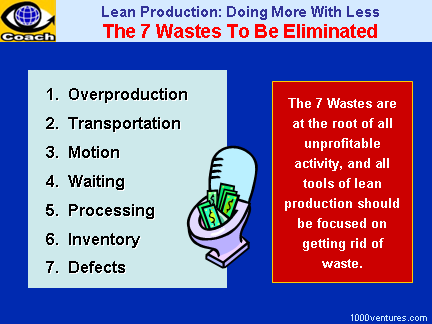
elimination of 7 wastes – overproduction,
waiting, transportation, inventory, motion, over-processing, defective units
– and the implementation of the concepts of continuous flow and customer
pull.
A finer clarification of waste is key to
establishing distinctions between value-adding activity, waste and
non-value-adding work. Non-value adding work is waste that must be done
under the present work conditions. One key is to measure, or estimate, the
size of these wastes, to demonstrate the effect of the changes achieved and
therefore the movement toward the goal.
→
Continuous Improvement
Firm
The "flow" (or smoothness) based approach aims
to achieve Just -In-Time (JIT), by removing
the variation caused by work scheduling and thereby provide a driver,
rationale or target and priorities for implementation, using a variety of
techniques. The effort to achieve JIT exposes many
quality problems
that are hidden by buffer stocks; by forcing smooth flow of only
value-adding steps, these problems become visible and must be dealt with
explicitly.
→
8 Rules for
Quality Management
→
Areas Targeted by
TQM in Japan
The
Three Broad Types of Waste
The elimination of waste is the goal of
Lean.
Toyota
defined
three broad types of waste: muri, mura and
muda.
Muri is all the unreasonable work that management imposes on
workers and machines because of poor organization, such as carrying heavy
weights, moving things around, dangerous tasks, even working significantly
faster than usual. It is pushing a person or a machine beyond its natural
limits. This may simply be asking a greater level of performance from a
process than it can handle without taking shortcuts and informally modifying
decision criteria. Muri also includes bad working conditions, and it will
often push a resource to work harder than its natural limits. Unreasonable work is almost always a cause of multiple
variations.
Mura is the variation and
inconsistency in quality and volume in both products and human conditions.
Muda is the Japanese word for
waste.
It specifies it specifies any human activity, which absorbs resources, but
does not directly add
customer value.
These non-value-adding
activities and results
– overproduction, waiting, transportation, inventory, motion,
over-processing, defective units –
are to be eliminated.
|