Continuous Improvement Firm


Continuous Improvement Firm (CIF):

Lean Manufacturing

5Ss

Sort, Ste in Order, Shine, Standardize, Sustain


"Kaizen means ongoing improvement involving everybody, without spending much money."  ~ Masaaki Imai

More Lean Production Quotes

Continuous Improvement Firm (CIF): Kaizen, Lean Manufacturing, Suggestion Systems, TQM"


5S, Five Ss, Kaizen, Lean Production, Continuous Improvement Firm, CIF

The Five Ss

  1. Sort: Sort out unneeded items

  2. Straighten: Have a place for everything

  3. Shine: Keep the area clean

  4. Standardize: Create rules and standard operating procedures

  5. Sustain: Maintain the system and continue to improve it


The Five Ss

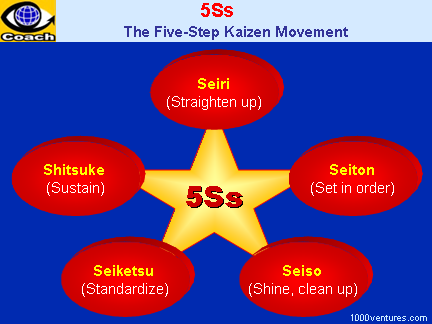
The Five Ss refer to the five dimensions of of workplace optimization: Seiri (Sort), Seiton (Set in order), Seiso (Shine), Seiketsu (Standardize), and Shitsuke (Sustain).


Like many concepts of Kaizen and Lean Manufacturing, the 5S can be interpreted narrowly or broadly, depending on circumstances of their use.

The 5S Program defines the steps that are used to make all work spaces efficient and productive, help people share work stations, reduce time looking for needed tools and improve the work environment.

Implementing Kaizen: 7 Conditions

Phases of 5S

There are 5 primary phases of 5S: sorting, straightening, systematic cleaning, standardizing, and sustaining. Additionally, there is an additional phase, safety, that is sometimes included.

Sorting (Seiri): Eliminate all unnecessary tools, parts, instructions. Go through all tools, materials, etc., in the plant and work area. Keep only essential items. Everything else is stored or discarded.

Straightening or Setting in Order (Seiton): There should be a place for everything and everything should be in its place. The place for each item should be clearly labeled or demarcated. Items should be arranged in a manner that promotes efficient work flow. Workers should not have to repetitively bend to access materials. Each tool, part, supply, piece of equipment, etc. should be kept close to where it will be used (i.e. straighten the flow path). Seiton is one of the features that distinguishes 5S from "standardized cleanup".

Shining or Sweeping or Cleanliness / Systematic Cleaning (Seiso): Keep the workplace tidy and organized. At the end of each shift, clean the work area and be sure everything is restored to its place. This makes it easy to know what goes where and ensures that everything is where it belongs. A key point is that maintaining cleanliness should be part of the daily work not an occasional activity initiated when things get too messy.

Standardizing (Seiketsu): Work practices should be consistent and standardized. Everyone should know exactly what his or her responsibilities are for adhering to the first 3 S's.

Sustaining the discipline (Shitsuke): Maintain and review standards. Once the previous 4 S's have been established, they become the new way to operate. Maintain focus on this new way and do not allow a gradual decline back to the old ways. While thinking about the new way, also be thinking about yet better ways. When an issue arises such as a suggested improvement, a new way of working, a new tool or a new output requirement, review the first 4 S's and make changes as appropriate.

Continuous Improvement Firm (CIF): Kaizen, Lean Manufacturing, Suggestion Systems, TQM, Best Practices


 Free Micro-courses


References:

  1. Lean Manufacturing Overview, Factory Strategies Group LLC

  2. Lean Manufacturing That Works, Bill Carreira

  3. The Toyota Way, Jeffrey Liker

  4. Toyota Production System, Taiichi Ohno

  5. Lean Manufacturing, Wikipedia

  6. Kaizen, 25 PowerPoint slides by Factory Strategies Group LLC

  7. Glossary Kaizen & Lean Production key definitions and concepts

Lean Production

Just-in-Time (JIT)

7 Wastes

Lean Manufacturing Quotes

Continuous Improvement Firm (CIF)

3 Basic Principles of Continuous Improvement

The Toyota Way: 14 Principles

Kaizen – the Japanese Strategy of Continuous Improvement

Kaizen Mindset

Kaizen Strategy: 7 Conditions for Successful Implementation

Quick and Easy Kaizen

Japanese Suggestion System

Kaizen vs. Kaikaku and 10 Kakaku Commandments

Kaizen and Innovation

Employee Empowerment

Getting Employees Involved: 9 Ways

Quality Management

8 Rules for Quality Management

Total Quality Management (TQM)

Deming's 14 Point Plan for TQM

Kaizen and TQM

14 TQM Slogans at Pentel, Japan

Areas Targeted by TQM in Japan

Case Studies

Toyota Production System

Canon Production System (CPS)

Fidelity Investments: Practicing Kaizen


Ten3 Mini-courses

 Slides

Continuous Improvement Firm (CIF)

60

Synergizing Business Processes

60