|
Staying On Course
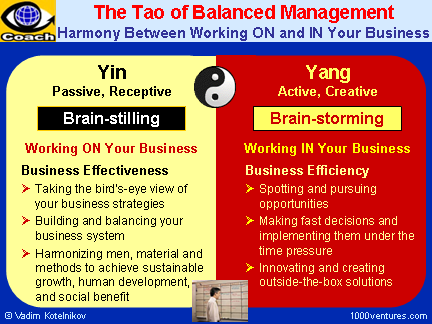
Most businesspeople are so busy working for
their business or in their business that they never find time to work on
their business. Thus they fail to
anticipate what might happen or what they might be able to make happen.1
Unless you regularly schedule time (one-day out-of-the-office meeting a
month at least) to work on your business and answer
critical questions, you'll never achieve your
stretch goals.
Working On Your Business
Instead of Being a Slave To It
Is your business consuming you, taking up all of your time, thoughts and
energy? Do you want more success in your business? Do you think you'll have
to work harder to get it? Your business doesn't have to be like this. You
can choose to change and start
working smarter. Now, you've probably heard people bandy around
expressions such as 'work smarter' but although it sounds good, does it
actually mean anything?5
Balancing Your Business
System
If your business is in flames, stop what you
are doing, quiet
your mind
and take a bird's-eye view of your business. Drop any misconceptions you may
have as to what you should be doing, and then re-balance your business.
As you regain the balance in your business, you will regain control.
A business is more than finance.
Performance measures need to be
aligned with the organization's strategy.
The
Business Systems
approach
considers business as system of interrelated factors of
strategy,
owners, investors, management,
workers,
finance,
processes,
products,
suppliers,
customers, and
competitors...
More
Case
in Point
25 Lessons from Jack Welch
Lead more, manage less,
Don't get bogged down in overmanaging. Don't run your business.
Run is not the right word.
Lead it. Manage
less to manage more. If you use half your capacity on memorizing
thoughts and details, you've got very little time left to look for
things to change and drive. "Since much of business comes down to facing
reality and then acting on that reality, over-managing has the potential
to confuse people. By getting caught up in unimportant details, no one
can see the true reality that might be staring them in the face."8
Don't waste a lot of time on making budgets. They waste energy. The
world is changing quickly. You can't afford to waste time in
Bureaucracy.
Focus on strategic issues and improvement. Work on your business,
not for your business, to figure out exactly what it is you need
to do in order to achieve your goals...
More
Jack Welch's 5 Strategic Questions
New Goals for
Strategic Planning
In the new business environment of rapid
changes, heightened risk and uncertainty, developing effective strategies is
critical. They prepare
executives
to face the strategic uncertainties ahead and serve as the focal point for
creative thinking
about a
company's vision and direction.
Many companies get little value from their
annual strategic-planning process however. To meet the new challenges, this
process should be redesigned to support real-time strategy making and to
encourage 'creative accidents'1...
More
|