|
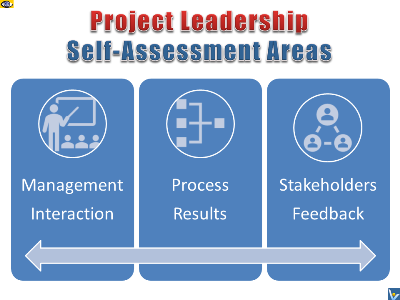
Project Leadership Self-Assessment1
|
|
Complete the following
self-assessment, using a 1 to 5 scale:
1 = never
2 = sometimes
3 = half the time
4 = most of the time
5 = all of the time
-
My projects are completed on time
-
My customers are satisfied with the
project management process and the final deliverables produced
-
Stakeholders are satisfied with the project management process
-
My projects are completed within budget
-
I use a participatory project management method involving the team in
the project planning and decision-making with intensive horizontal
information flow
-
I never begin a project without a
charter
-
I hold a participative kick-off meeting to introduce the team to the
project
-
I make sure that the customer need is well understood
-
I make sure that customer requirements are clearly defined
-
I make sure that the team identifies and manages stakeholder interests
-
The team defines the scope boundaries for the project
-
A subproject tree, showing clear accountability for subprojects and
deliverables, is completed by the team for each project
-
A risk assessment is completed for each of my projects, and
countermeasures to reduce risk are identified and included in the
project plan
-
My schedules include a contingency factor for unforeseen problems
-
Staff effort requirements are documented in the
project plan
-
Project plans are reviewed and approved by the sponsor, customer, and
key stakeholders
-
Change-management procedures are included in each project plan
document
-
The main project team focuses on deliverables and allows the
subprojects to focus on activities
-
Interdependencies are carefully managed at both the main project and
subproject levels
-
Subproject leaders are empowered to get their pieces of the work done
and held accountable for the results
-
All project status reports use a standard format
-
Staff effort actuals are documented on the status report form
-
Project teams perform customer evaluations as part of the close-out
process
-
Lessons learned and recommendations for
improvement are included in the close-out report

|
|
Entrepreneurial Approach to
Project Management
|
|
Today, project managers have to master the
business systems approach and think of projects as having two
parts:
-
Project itself, which creates an outcome.
-
The project outcome lifecycle, in which
the outcome is used or sold.

|
|
Project Leadership
Project management provides a foundation for the
art of leadership. The best project
managers are also outstanding leaders.
Evolving Entrepreneurial
Role of the Project Manager
Today project managers have to go beyond the
traditional project delivery practices and master the
business systems approach. This new system requires thinking of the
project as a business enterprise and managing the project as a business
venture. Thus you have to consider not only the success of the project
itself but also the success of the project outcome. You need to
understand how your organization creates value for its major
stakeholders - shareholders, customers, and the business team, and also
take responsibility for delivering that value.
The new role of the project manager requires
an ultimate knowledge of the
strategy the project is supporting. Taking the business systems
approach requires also knowledge of organization,
motivation,
marketing, accounting, cost control, finance, and quantitative
decision making from the project manager's perspective.
The entrepreneurial approach to project
management essentially expands two dimensions of the project management
process - time and boundaries. Considering the project outcome and its
lifecycle expands time beyond the traditional horizon of project
completion. Project boundaries are also expanded. Stakeholders start
playing more important role as partners. On the other side, market
forces now go beyond the customer and end-user to include additional
factors such as competition.

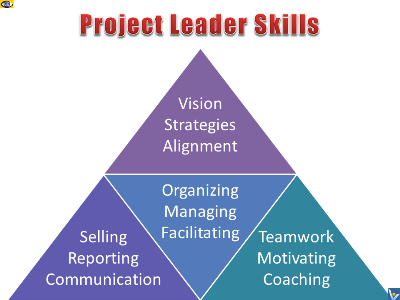
The Key Project Leader Skills
-
Developing a grand
vision
-
Building the project
management team and leading the team through the steps of the
project management process
-
Leadership skills; leading the project
team through the stages of
team
development
-
Communication skills: verbal, both one-on-one and with a group, and
written
-
People-management skills such as constructive
feedback, conflict resolution,
managing individual styles and personalities
-
Facilitation
skills
-
Skills at
interfacing across the organization and removing obstacles for the team
-
Ability to
accept criticism, feedback, and input from
others
-
Skills in using
team-based tools such as
brainstorming, organizing,
decision making, project management,
conflict resolution, and so on.
-
Selling
skills. The ability to promote and sell the project both within and
outside the organization. Presentation
skills.
5 Factors that Make a Project a Success
By: Eric Verzuh, the author of The Fast Forward
MBA in Project Management
To be successful, a project must
have:
-
Agreement
among the
project stakeholders
–
the team, customer, and management
–
on the
goals of the project...
More
Creating a High-Performing Team
Creating a high-performing team takes commitment
on the part of the project leader to lead both the project management and
team processes. You need to be a good facilitator, helping the
team work
through the steps of these processes. Here are some tips on being a good
facilitator as suggested by Martin and Tate1:
-
Allow equal opportunity for participation by all team members
-
Maintain a safe environment
-
Acknowledge each person's contribution
-
Enforce the team ground rules
-
Focus on the team and
project management
processes, not the content
-
Respect each person as an individual
-
Resolve conflicts
as they arise
-
Keep the group on track
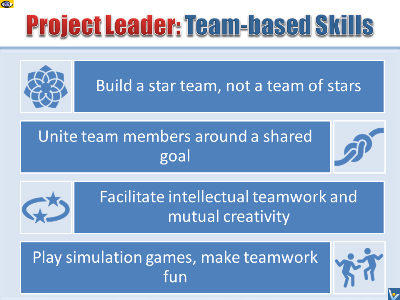
Developing Team-Based Skills
While developing your
team and mastering teamwork, you'll need to hold regular team meetings
so that team members can
monitor progress
and solve problems as they arise. You may
also want to focus on your team skills, such as:
GREAT Model
By: Michael S. Dobson
To make your project team function
effectively, the first thing you need to know is the GREAT model:
Goals; Results;
Expectations / Performance;
Accountabilities / Abilities;
Timing.
The GREAT model specifies what people must know before they can work
together effectively...
More |