| |
New Company-Employee Relationship for the
New Knowledge Economy
New People Partnership is the full
implementation of the new realities that exist between the corporation and
its
employees. The
business environment in
today's economy changes
fast,
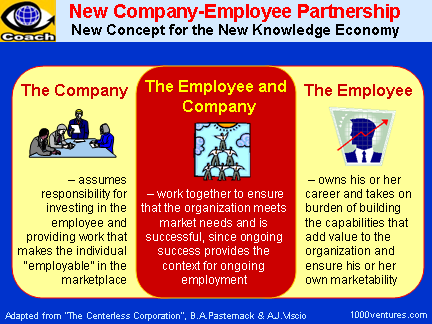
so does the dynamics of relationships between employer and employee. Companies can
no longer guarantee lifetime job security.
Advanced skills are
increasingly required by firms, yet these skills are what make employees
more mobile in the marketplace. Thus, the employee partnership emerged as a
new form in-company relationships and
employee empowerment.
|
 |
|
Key Principles
A successful people partnership is a coherent
set of people systems and processes that reflect the
business environment, the
enterprise
strategy,
and
organizational
values.
Each one will be unique to an organization and
its employees, but there are some
key principles
that are common to all the companies that are exploring the New People
Partnerships.
|
|
|
New People Partnership
Fulfills the Business Need to: |
|
▪
continually improve performance and
enhance value to shareholders
▪ enable the company to attract and retain top talent
▪
inspire and
motivate all
employees to
work to their fullest potential
▪ develop the
skills of white- and blue-collar workers
▪
balance the interests of all
stakeholders, including shareholders, employees, unions, government,
and society |
 |
Treat your associates as partners.
In turn, they will treat you as a partner, and together you will all
perform beyond your wildest expectations.
Behave as a
servant leader
in your partnership. |
Sam Walton |
|
Happy
Business ●
Passionate
Team ●
Team
Culture ●
Synergistic
Partnerships
|
Five
Key Principles
of the New People
Partnership |
|
①
Employee
well-being
Both parties ─ employers and employees ─ commit to employee
well-being
 as a core value as a core value
②
Open communication
Open communication forms the
foundation for the day-to-day relationship
③
Career management
Managers help each employee to
find the right fit;
employees
manage their own careers
④
Employable security
Employees
gain "employable" security by building critical skills
⑤
Accountability
Accountability for performance
extends to all levels of the organization |
| |
Establish a New
Environment
At all levels, your company needs people who
can deliver at the frontier of performance. They must understand where your
company is going and be able to influence this path. They must share in your
company's fortunes and be motivated to push for greater achievements.
"New
People Partnership" will help you attract this vital resource. Recognizing
that lifetime employment is no longer feasible, this "partnership" involves
a mutual commitment to establishing the environment for learning,
self-leadership, and for ongoing employability. In essence, the New People
Partnership is a fresh perspective that dictates that the company owns the
work rather than the employee's career.
→
Inspiring Culture:
5 Elements

|
| |
Dell
Inc.
"The best way I know to establish and maintain a
healthy,
competitive culture is to partner with your people – through
shared
objectives and a
common strategy," writes
Michael Dell, the Founder of
Dell Inc. in his book Direct from Dell.
"Connecting with the outside world
keeps you aware. Connecting with your people – your most valuable asset – is
the way to keep your business and your people healthy and strong."
"Once a reporter asked me which of our competitors represented the biggest
threat to Dell. I said the greatest threat to Dell wouldn't come from a
competitor. It would come from our people. It hasn't been easy, trying to
maintain the
entrepreneurial spirit that has characterized Dell as our company has
grown bigger (in terms of headcount) and more complicated (by way of
infrastructure). Nor has it been easy to
maintain the energy of a focused
team, as we expanded around the
world. But my goal has always been to make sure that everyone at Dell feels
they are a part of something great – something special – perhaps something
even greater than themselves."...
More
→
Inspirational Leader:
10 Roles
|
Getting Employees
Involved: 9 Ways ●
Help
Your People Grow ●
Organizational Fitness Profile (OFP)
|
|


