|
Habits
of Konosuke Matsushita that Fostered His Growth1 |
|
|
|
Konosuke
Matsushita
Quotes |
-
In order to do a good job a person
must like what he or she is doing...
→
'Love thy work',
and you will be
→
successful
...
If you do things just because you have to, then you will never enjoy
work. Nor will you do a good job if you do it simply out of a sense
of duty. Stress is often a by-product of such passive or negative
attitudes toward work. Paradoxically as it may sound, love of work
can be the best medicine for workaholism.
-
The untrapped mind is open enough to
see many possibilities, humble enough to learn from anyone and
anything, forbearing enough to forgive all, perceptive enough to see
things as they really are, and reasonable enough to judge their true
value.
-
Business is
people.
-
A natural response to a natural phenomenon – that is the secret of
success in business and
management. You will always win if you rely
on common sense.
-
No matter how deep a study you make.
What you really have to rely on is your own
intuition and when it
comes down to it, you really don't know what's going to happen until
you do it.
-
If necessity is the mother of
invention, then
simple, unaffected
determination is its father.
-
Even when everyone
around you
say it's impossible, if you step back and rethink your
task in the simplest possible terms, free of the noise of
over-erudite and preconceived notions, often the solutions will come
to you,
out of the blue, so to speak.
-
Recognizing our responsibilities as industrialists, we will devote
ourselves to the progress and development of society and the
well-being of people through our business activities, thereby
enhancing the quality of life
throughout the world.
-
Our social mission as a manufacturer
is only realized when products reach, are used by, and
satisfy the customer... We need to take the customer's skin
temperature daily.
-
Possessing material comforts in no way
guarantees happiness.
Only spiritual wealth can bring
true happiness. If that is correct,
should business be concerned only with the material aspect of life
and leave the care of the human spirit to religion or ethics? I do
not think so. Businessmen too should be able to share in creating a
society that is spiritually rich and materially affluent.
-
If we cannot
make a profit, that means we are committing a sort of crime
against society. We take society's capital, we take their people, we
take their materials, yet without a
good profit, we are using
precious resources that could be better used elsewhere.
|
|
Humble Beginnings
Konosuke Matsushita was born into a well-off
landowning family in 1894 in
Japan. A decline in the family's fortunes during his
childhood meant that Matsushita's education was cut short. At age 9 he
became a brazier's apprentice, then a year later a bicycle shop apprentice.
He stayed five years at the bicycle shop, picking up basic metalworking
skills. At age 16 he went to work in the Osaka Electric Light Company.
|
Inventor and
Entrepreneur
Konosuke Matsushita began the Panasonic’s
journey by inventing a two-socket light fixture. This very important, yet
elegantly simple, breakthrough led to what is now one of the world's largest
electronics companies. Since its founding in 1918, Panasonic Corporation
grew to become the largest Japanese electronics producer.
One of the traits that followed Matsushita
throughout his career was a willingness to take risks. When Konosuke
Matsushita began working for himself, in 1918, at the age of 23, he
had almost nothing: no money, no real formal education, no connections. Yet,
his small firm Matsushita Electric Appliance Factory flourished under the
guiding hand of a clever, wise, and inspired
entrepreneur.
In the late 1980s, Matsushita’s revenues hit a
whopping $42 billion. With nearly 20,000 employees, Matsushita grew such
household brand names as National, Panasonic and Technics.
Matsushita's success has made him Japan's
biggest yen billionaire. He has also made himself the most widely admired
businessman in
Japan.
Matsushita Basic Business
Philosophy
The Matsushita Basic Business Philosophy
consists of three elements...
More
|
Paternal Management
Philosophy
Matsushita believed that a company should
create wealth for society as well as for shareholders, and should always
work to alleviate poverty. His business philosophy led to the
Japanese
"paternal management" tradition, whereby employees are viewed as
being part
of a "family" within the company, and are assured of lifetime employment,
without fear of layoffs.
Devising a New Management
System
In 1933, Matsushita devised a
new management
system, dividing the company into three autonomous
business units: radios, lighting & batteries, and synthetic
resins/electro-thermal products.
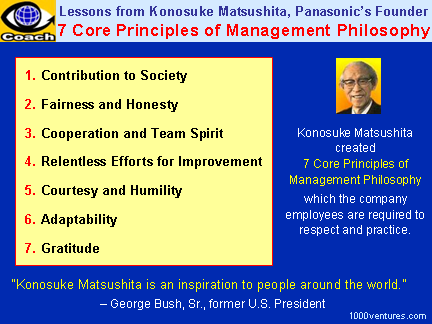
7 Core Principles
of Panasonic Management Philosophy
The Seven Core Principles comprise the
foundation of Panasonic’s management philosophy...
More
Enriching the Society
To Matsushita, his mission of manufacture was
to overcome poverty, to relieve society as a whole from misery, and bring in
wealth. Business and production, to Matsushita, were not meant to enrich
only the business owners, investors, employees or shops, but all the rest of
the society as well. Matsushita never talked narrowly about maximizing
shareholder value as the proper goal of an enterprise. Although he did speak
often about generating wealth, he emphasized the psychological and
spiritual aspects of being – for the good of all people. “Big idealistic /
humanistic goals and beliefs are not incompatible with success in business.
They may even foster achievement, at least in a rapidly changing context, by
supporting those habits, which encourage growth,” Matsushita said.
|