|
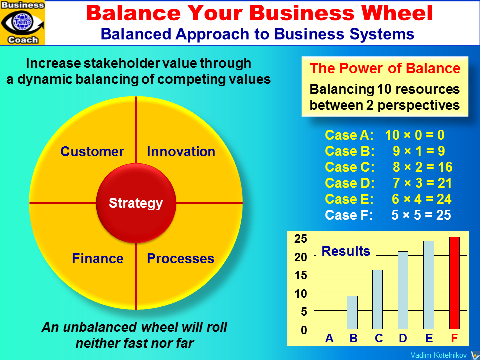
Balanced Approach to Business Systems
A business is more than finance.
Performance measures need to be
aligned with the organization's strategy.
The
Business Systems
approach
considers business as system of interrelated factors of
strategy,
owners, investors, management,
workers,
finance,
processes,
products,
suppliers,
customers, and
competitors...
More
9 Signs of a Losing Organization
-
Poor Cross-functional Collaboration:
functional mindset; lack
of cross-functional goals and cross-functional collaboration spirit;
functional, no
enterprise-wide business process management; no
cross-functional management committees; lack of or powerless
cross-functional teams...
More
Systems Approach to Management Defined
The systems approach to management is based on
general
system theory – the theory
that says that to understand fully the operation of an entity, the entity
must be viewed as a system. This requires understanding the interdependence
of its parts.1
Subsystems
Subsystem is a system created as part of the
process of the overall management system. A planning subsystem increases the
effectiveness of the overall management system.
Management System
The management system is composed of a number
of parts that function interdependently to achieve a purpose.
The management system is an
open systems. It
interacts with its business environment.
Environmental factors with which the management system interacts include
customers, suppliers, competitors, and government. Each of these factors can
significantly change the future of the management system.
7-S Model
The 7-S model is
a framework for analyzing organizations and their effectiveness. It looks at
the seven key elements that make the organizations successful, or not:
strategy; structure; systems; style; skills; staff; and shared values. To be effective, your organization must have a
high degree of fit, or internal alignment among all the seven Ss. All Ss are interrelated, so a change in one has a ripple effect on all the
others. Thus, to improve your organization, you have to pay attention to all
of the seven elements at the same time.
The Growing Role of the Business Architect
In today's knowledge- and innovation-driven
complex economy, business architects
are in growing demand. They are
cross-functionally excellent people who can tie several silos of
business development expertise together, create
synergies, design winning
business model and a
balanced business system and
then lead people who will
put their plans into action...
More

Harnessing the
Power of
Diversity
Diversity is a specialized term describing a workplace that
includes:
You can find a strategic
competitive
advantage in an organizational and cultural context by seeking to
leverage, rather than diminish, opposite forces.
Cross-functional Management (CFM)
Cross-functional management (CFM)
manages business processes across the traditional boundaries of the
functional areas. CFM relates to coordinating and
synergizing the activities of
different units for realizing the superordinate cross-functional goals and
policy deployment. It is concerned with
building a better system for achieving such cross-functional goals as
innovation,
quality,
cost, and delivery...
More
Enterprise-wide Business
Process Management (EBPM)
EBPM, representing the third-wave of Business Process
Management, is "a deliberate and collaborative approach to
systematically – and systemically – managing all of a company's business
processes."1
EBPM addresses the pressing need of the
new knowledge-driven
economy to integrate business process
thinking with strategy,
organizational
structure and people issues.
It requires that your executive team lead and manage differently and
think more systemically about your business.
Case in Point
Canon: Eliminating
9 Wastes
The objectives of
Canon Production
System (CPS) are to manufacture better quality products at lower
cost and deliver them faster.
Canon invited all their employees to suggest
ideas for improvement and developed 6 Guidelines for the Suggestion System
to make it most effective. The company developed also a list of
9 wastes
to help their employees become problem-conscious, move from operational
improvement to systems improvement, and recognize the need for
self-development...
More
Systems Thinking
Systems thinking is your
ability to things as a whole (or holistically) including the many different
types of relationships between the many elements in a complex system.
Systemic Approach to Innovation
Until recently innovation has been seen
principally as the means to turn research results into commercially
successful products, but not all research leads to innovation and not all
innovation is research-based.
Innovation is
systemic. It arises from complex interactions between many individuals,
organizations and their operating environment. Firms which are successful in
realizing the full returns from their technologies and innovations are able
to match their technological developments with complementary expertise in
other areas of their business, such as manufacturing, distribution, human
resources,
marketing, and
customer service...
More


|