| |
|
7S Model
Developed by McKinsey, 7S is a
managerial tool for analyzing
and improving organizations
|
|
|
|
|
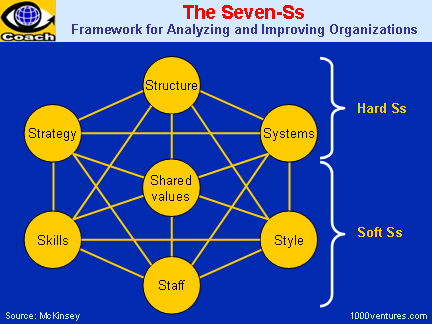
The Seven-Ss is a framework for analyzing
organizations and their
effectiveness. It looks at the seven key elements
that
make
the organization successful,
or not: strategy;
structure; systems; style; skills; staff; and shared values.
|
|
 |
| |
|
7-S Model
– a Systemic Approach to Improving Organizations
|
|
|
|
|
|
The 7S Model helps analyze a company's organizational design and
performance. The goal of the model is to show how effectiveness can be
achieved in an organization through the interaction of 7 key elements –
Structure, Strategy, Skill, System, Shared Values, Style, and Staff.
The 7-S diagram illustrates the
multiplicity interconnectedness of elements that define an
organization's
ability to change.
The theory helped
Change Managers to think about how
companies could be
improved.
7-S model says that it is not just a matter of
devising a new strategy and following it through. Nor is it a matter of
setting up new systems and letting them
generate improvements.
To be effective, your organization
must have a high degree of fit, or internal alignment among all the seven
Ss.
Each S must be consistent with and reinforce the other Ss.
All Ss are
interrelated, so a change in one has a ripple effect on all the others. It
is impossible to make progress on one without making progress on all. Thus,
to improve your organization, you have to master
systems thinking and pay
attention to all of the seven elements at the same time.
There is no
starting point or implied hierarchy – different factors may drive the
business in any one organization.
|
|
|
|
|
Structure
Structure is the organizational chart and
associated information that shows who reports to whom and how tasks are both
divided up and integrated. In other words, structures describe the hierarchy
of authority and accountability in an organization, the way the
organization's units relate to each other: centralized, functional divisions
(top-down);
decentralized (the trend in larger organizations); matrix; network;
holding; etc. These relationships are frequently diagrammed in
organizational charts. Most organizations use some mix of structures –
pyramidal, matrix or networked ones – to accomplish their goals.
Strategy
Strategy
are plans an organization formulates to reach identified goals, and a set of
decisions and actions aimed at gaining a
sustainable
advantage over the competition. The 7S model helps leverage
strategic thinking and improve
strategic management.
Skills
Skills refer to the
dominant
distinctive capabilities and competencies of the personnel or of the
organization as a whole.
|
|
|
|
