|
Defining Your
Core
Competences
Three Main
Characteristics |
-
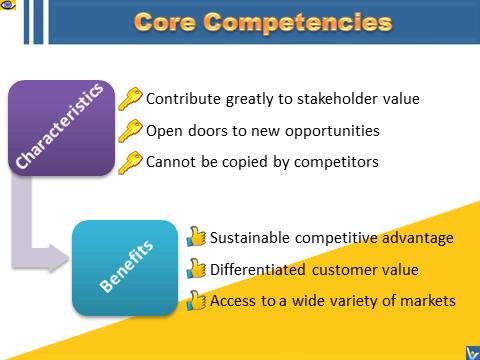
They should make a disproportional contribution to stakeholder value
-
They should open doors to other opportunities
-
They should represent such a unique blend of
tacit and explicit knowledge that it
cannot be copied by competitors
|
|
What
Does the Core Competence Achieve? |
-
Enables the creation of new
products and services that provide potential access to a wide
variety of markets.
-
Makes a significant contribution to the
customer value and
enables a business to deliver a fundamental customer benefit – the
perceived customer benefits of the end product.
-
Helps create sustainable competitive
advantage as it is competitively unique and difficult for
competitors to imitate.
|
|
Individual Competencies vs. Core Competencies |
-
Individual capabilities stand
alone and are generally considered in isolation.
-
Core competencies are
harmonized, intentional constructions. They are more than the traits
of individuals. Capabilities are considered core if they
differentiate a company strategically. Core competencies
are aggregates of
capabilities, where
synergy
is created that has sustainable value and broad applicability. That
synergy needs to be sustained in the face of potential competition
and must not be specific to one product or market.
|

|
What:
is Core Competence?
Core competencies are the most significant
value-creating skills within your
corporation and key areas of
expertise which are distinctive to your company and critical to the
company's long term growth. Your company's core
competencies are the things that you can do better than your competitors in
the critical, central areas of your company where the most value is added to
your products. These areas of expertise may be in any area from
product development to employee dedication.
A competence which is central to your business's operations
but which is not exceptional in some way should not be considered as a core
competence, as it will not generate a
differentiated advantage over rival businesses. It follows from the
concept of Core Competencies that resources that are standardized or easily
available will not enable a business to achieve a competitive advantage over
rivals.4
Core Competence as a
Team Sport
A core competence is a combination of
complementary skills and knowledge bases embedded in a
group or team that taken together makes it possible to provide a
superior product.
The Seven Dimensions of Strategic
Innovation
The Strategic Innovation framework weaves together seven dimensions to
produce a range of outcomes that drive growth.
Core Technologies and
Competencies is the set of
internal
capabilities, organizational competencies and assets that could potentially
be leveraged to deliver value to
customers, including technologies, intellectual property,
brand
equity and
strategic relationships...
More
Building
Synergies
A corporation that builds on core competencies utilizes
skills that combine to strengthen
value chains and build greater competitive
advantages. This leads to synergies among
business units,
whereby they become more productive together than independently.3
Core Competence
vs.
Sustainable Competitive Advantage
If a core competence yields a long term advantage to the
company, it is said to be a
sustainable competitive advantage.

Case in Point
Black and Decker
Black and Decker's core technological
competency is in 200 to 600 W electric motors. All of their
products are modifications of this basic technology (with
the exception of their work benches, flash lights, battery
charging systems, toaster ovens, and coffee percolators).
They produce products for three markets2:
-
the home workshop market
–
in the home workshop market, small electric motors are
used to produce drills, circular saws, sanders, routers,
rotary tools, polishers, and drivers.

-
the home cleaning and maintenance
market – in the home cleaning and maintenance
market, small electric motors are used to produce dust
busters, etc.
-
kitchen appliance market
–
in the kitchen appliance market, small electric motors
are used to produce can openers, food processors,
blenders, bread makers, and fans.
Two Basic Ways to Compete
and Prosper in Any Market...
Three Common Traits of
Marketplace Champions...
Distinctive Corporate Capabilities...
The Framework for a
Growth Strategy: Four Rules...
Building on Your Core Competencies and Accessing Missing Ones...
Virtual Integration
as a Source of Competitive Advantage...
Case in Point
General Electric (GE)...
Case in Point
Microsoft's
Concept of Network Externality...
Case in Point
Saga...
Case in Point
Tesco...

|