|
Estee Lauder's 15 Rules for
Entrepreneurial Success
|
-
Trust your instincts...
More
|

|
8 Attributes of Corporate Success
By
Peters and Waterman |
|
|

|
New
Measures of Business Success |
|
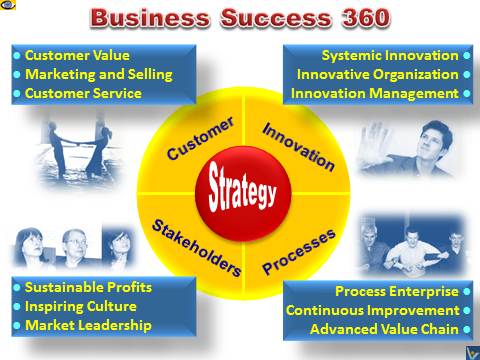
As business and organizational complexity arises,
success can be found in a
balanced business system which
depends on interconnections of its individual elements:
|
|
Transforming Your Business from Mediocre to Great
7 Principles |
|
|

|
Entrepreneurial
Myth
Entrepreneurial Myth11 is the mistaken belief that the vast
majority of people who go into business are entrepreneurs, and it just isn’t
true. The vast majority of people who go into business are not
entrepreneurs; they’re technicians suffering from an
entrepreneurial
seizure.
8 Key Entrepreneurial Questions
Prescription for Winning in
Business: 3Ss
Jack Welch,
the legendary former CEO of
GE, summed up his prescription for winning business in three words:
Sustainable Business Models
In the
new era of unrelenting change and competition, your face a daunting
challenge: how to sustain the
business model
of your firm. "The fact is, no matter how bulletproof
your firm's current business model, it will be challenged by
new business models."4 The new reality is that business models have
shorter shelf life. You must constantly attempt to discover new business
models if you hope to survive and grow...
More

10
Rules for
Building a Successful Business
By:
Sam Walton, Founder of Wal-Mart
-
Celebrate your success.
Find some humor in your failures. Don't take yourself so seriously.
Loosen up, and everybody around you will loosen up.
Have fun.
Show enthusiasm
–
always. When all else fails, put on a costume and sing a silly song.
Then make everybody else sing with you. Don't do a hula on Wall
Street. It's been done. Think up your own stunt. All of this is more
important, and more fun, than you think, and it really fools
competition. "Why should we take those cornballs at Wal-Mart
seriously?"...
More
Smart Business Architect
Building Your
Sustainable Competitive Advantage
Sustainable competitive advantage
is the prolonged benefit of implementing some unique value-creating strategy
based on unique combination of internal organizational
resources
and
capabilities
that cannot be replicated by competitors...
More
Balance Your Business
System
The primary goal of any business is to increase
stakeholder value. It is achieved through a dynamic balancing of competing
values. In order for a business to maximize economic value, it must balance
customer satisfaction and competitive market forces with internal cost
and
growth consideration...
More
Market Leadership
Strategies
The market leader
is dominant in its industry
and has substantial market share.
If you want to lead the market, you must be the industry leader
in developing new business models and new products or services.
You must be on the cutting edge of new technologies and
innovative business processes. Your customer value proposition
must offer a superior solution to a customers' problem, and your
product must be well differentiated...
More
6Ws of
Corporate Growth
To achieve sustainable corporate growth, you and
your people should live the principles of
6Ws of corporate growth.
The "Six Ws" – what, why, who, when, where and how – are very powerful
words. Use them constantly to seek, either from yourself or from others, the
answers needed to manage effectively...
More

The Key Challenges To Organizational Success
A global survey of
team leaders
to
executives
revealed that
“soft” issues such as
inspiring corporate culture are over 3 times as prevalent as “hard” issues
such as finance. Leaders are twice as concerned
about
leadership than all other issues
combined.
9
Signs of a Losing Organization
When divided between “hard” issues
such as finance and supply and “soft” issues such as
culture and
communication, the “soft stuff” appears to be three times
harder...
More
Building an
Innovation-friendly Organization
Leaders of successful, high-growth
companies understand that
innovation is what drives growth, and
innovation is achieved by awesome people with a shared relentless growth
attitude and shared
passion for
entrepreneurial creativity
and for turning ideas into realities...
More
Innovation-friendly
Organization
Building and Transforming
Corporate Culture
In six words,
corporate culture is "How we do things
around here."
Corporate culture is the collective behavior of people using common
corporate vision, goals,
shared values,
beliefs, habits, working language,
systems, and symbols. It is interwoven with processes, technologies,
learning and significant events.
Inspiring Culture: 5 Pillars
Cultural statements become operationalized when
executives articulate and publish
the values of their firm which provide
patterns for how employees should behave. Firms with
strong cultures achieve
higher results because employees
keep asking searching questions and sustain focus both on what
to do and
how to do it.
Corporate culture can be transformed, but leadership to sustain anything
that sweeping has to come from "the top."...
More
Leading
Systemic Innovation
Innovation is
the key driver of
competitive advantage,
growth, and profitability.
Today,
innovation is systemic.
It arises from complex interactions between many individuals,
organizations and their operating environment.
Firms which are
successful in realizing the full returns from their technologies and
innovations are able to match their
technological developments with complementary expertise in other
areas of their business, such as manufacturing, distribution, human
resources, marketing, and
customer service.
There are many parts of the whole field of innovation:
strategy innovation,
new product development,
creative approaches to problem solving,
idea management, suggestion
systems, etc. Though all of these components are important, in the new era
of
systemic innovation, you must
design your firm's
innovation process holistically.
Innovation is not divisible –
‘good in parts’ is no good at all.
Innovation systems
are only as strong as their weakest links...
More
The Complete A to
Z Plan for Business Success
By:
Brian Tracy
Here's why
most businesses fail:
-
Lack of
money – you don't have enough to get
started and grow
-
Lack of knowledge – you don't know what you're
doing
-
Lack of support – you're not able to get the
support of other people and sell them on your ideas...
More

|