|
Recognizing the Type of Mental Maps of Others
Some
Predicates – Preferred Words and
Phrases –
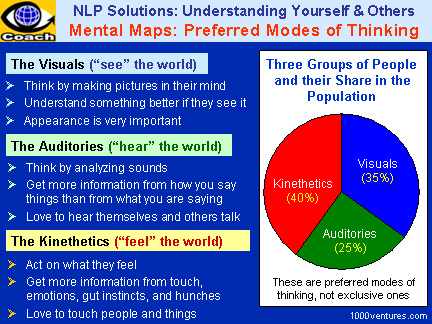
Used by Visuals, Auditories, and Kinethetics1
|
|
Visuals |
Auditories |
Kinethetics |
|
bright
bird's eye view
catch a glimpse
|
accent
articulate
ask
|
affect
boils down to
burning
|
|
...
More |
|
Recognizing the Type of Mental Maps of Others
Selected Characteristics1
|
|
Visuals |
Auditories |
Kinethetics |
|
maintain good
eye contact
voice high-pitched, fast
good with directions
good visual memory |
lower-pitched voice, rhythmic and smooth
try to sound good
like concerts and music
talk to themselves |
feel hot or cold about you
frequent pauses in conversation
like to touch people and things |
|
The Power of
Mental Maps
People have different ways of communicating
their experiences – some express themselves in pictures, others talk about
how things sound to them, and others speak about how things feel.
A Mental Map is a powerful way of expressing
the
→
thought patterns, pictures and associations that already exist in the
brain. "When new information is compatible with your knowledge structures it
is accepted, when it does not mesh with your pre-conceived ideas or past
experience it receives little consideration, is distorted or ignored."7
→
Same Reality,
Different Perceptions
Ask Open Questions
Ask a simple
open-ended question. Then, be
quiet and make note of the exact words the other person uses. When a person
answers an open-ended question, he stops focusing outward and goes inside
his mind. At that instant, he becomes relatively unaware of the words he
uses. Those words point back in time to meaningful memories and
emotional
experiences. Just
→
listen. Most people tell you more about themselves than
they think.9
Cross-Cultural
Communication Challenges
Culture
is often at the root of
→
communication challenges. Exploring historical experiences and the ways
in which various cultural groups have related to each other is key to
opening channels for cross-cultural communication. Becoming more aware of
→
cultural differences,
as well as exploring cultural similarities, can help you communicate and
collaborate with
others more effectively. Next time you find yourself in a confusing
situation, ask yourself how culture may be shaping your own reactions, and
try to see the world from the other's point of view...
More
→
4 NLP Perceptual Positions
 Advertising
Campaign for a Cruise-Line Advertising
Campaign for a Cruise-Line
Nicholas Boothman, a former fashion and
advertising photographer, was briefed for a cruise-line photo shoot for a
new advertising campaign. The agency
→
team told him, "We know that everyone
wants good food and fresh air when they go on vacation; that's given. But
our research also tells us that people have sensory preferences. Some folks
choose a vacation primarily for beautiful scenery; others to get away to
somewhere comfortable, with activities; and yet others are primarily
searching for peace and quite. We know that all three aspects are critical
to the
decision making process, but the final choice comes from satisfying
the person's sensory preference."8 Boothman was told that his
photos had to appeal to all three groups: the seeing people, the feeling
people, and the hearing people. |
