|
Inspirational Quotes
Charles Schwab
Quotes |
-
Lead the life that
will make you kindly and friendly to everyone about you, and you
will be surprised what a
happy life
you will lead.
-
You've got to start
with your gut, with
something you are really
passionate
about, for a good reason. You won’t get there by sitting in a closet and
thinking, ‘Boy I know the world must want this.’
-
A man to carry on a successful business must have
imagination. He must see things as in a
vision, a
dream of the whole thing.
-
The fact that I was out here and scrambling around as a little
entrepreneur with no
resources was fortuitous. I wasn’t encumbered by those old guys
telling me what to do.
-
I feel good every day about helping people invest; helping them
achieve financial independence.
-
I took anybody. They were a full collection of people. They
took risks in their careers. Some were misfits at other places.
I took a lot of misfits in. There were some strange people. Anybody
who was a reasonable person and
communicated well, I hired.
I was one of the first businesses to hire women.
Smart
Executive
|
|
Charles Schwab: From a
Small Firm to the World's Leader
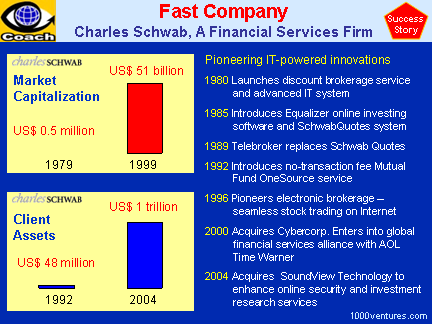
Charles Schwab pioneered seamless stock trading
on Internet in 1996. They went from a tiny firm to
the world's largest financial services company. On their journey, first,
they developed criteria –
Charles Schwab's Guiding Principles – for
making fast decisions.
Second, they realized that they should
own their competitive advantage
to be able to bring financial products to the market faster than their
competitors. They did so, and proved their ability to innovate faster that
others. Finally, they managed to
institutionalize innovation.
3 Strategies of Market Leaders
By late 1994, Chuck Schwab, the firm's Founder
and Chairperson, and Dave Pottruck, President and co-CEO of the
company believed that online trading was going to become huge and created
the Project Hawk. Acting with lightning speed, Charles Schwab introduced
online trading service e.schwab to the market in May 1996 – within months of
conception. The company signed up 25,000 customers within two weeks – their
target for the full year. Being fast made paid off for Schwab. By the start
of 2000, Schwab had an average 25% market share, was handling one of four
stock trades in the United States, was receiving nearly 80 million hits on
pick days, had open up more than 3 million online accounts, and was doing
more than $10 billion weekly in e-commerce. In 1999, market capitalization
of Charles Schwab reached US$51 billion. On January 1, 2000 the market
capitalization of Charles Schwab surpassed that of Merrill Lynch, and Schwab
became the world's largest financial services company.1...
More
Charles Schwab's Guiding
Principles
Charles Schwab his company from being a one-man
startup to the world’s largest financial services firm in record-setting
time.
How?
He wanted to build a
fast company, one that
could respond to changes in the market before they even happened, and to
maintain its velocity throughout. He believed that by following a strict
process and adhering to strict requirements, he would be well-prepared ahead
of time in order to act with lightening speed. So, Schwab established
9 guiding principles for his company, and checked every
strategic move against them before proceeding. These guiding principles
allowed Charles Schwab and his
management team to
make quick decisions. Instead of having to go through a complex process
in order to determine his company’s next strategic step, he simply had to
ask one question: Does it fit our guiding principles?
Acting with lightning speed in accordance with
Charles Schwab's Guiding Principles – always own the core technology;
reinvent the business; and constantly improve what you do, – the company
made fast decisions and was able to introduce online trading service
e.schwab to the market within months of conception...
More
Owning Competitive
Advantage
Initially Charles Schwab, a discounted stock
brokerage company, routinely outsourced, like other financial services
firms, their back office information technology to other companies. By 1979,
Chuck Schwab, the founder of the company, realized that if he was going to
quickly grow the company and gain a
competitive advantage,
he had to own the technology. So, in 1979 he acquired a back-office
computer Beta System for US$500,000 – a big bet as at the time, the net
worth of the entire Charles Schwab company was only US$500,000.
Given their in-house computing capabilities,
owning the technology – their competitive advantage – provided Schwab
the ability to:
-
Push every known boundary and constantly ask
the "what if we could do this for our customers" question without regard
what can't be done
-
Have the technology and other resources ready
by the time people knew they wanted it
-
Be faster than
competitors in getting to market.
As a result, Schwab started unleashing
innovations on the market one after another
and became
the leader in the new market niches it created.
Differentiating Between
Noble Failure and Stupid Failure
Freedom To Fail
David Pottruck, co-CEO of Charles
Schwab, says: "The idea that failure is okay is ridiculous. I am not going
to go around the company and reward someone for failing. But here at Schwab
we differentiate between noble failure and stupid failure."1
Charles Schwab has a set of
criteria for defining
noble failure.
Noble failure occurs when:
-
you have a good plan and know
what you're doing, you've thought everything through carefully, and have
implemented with sufficient management discipline, that if you look back
in review, you'd conclude it was thoughtfully done
-
you have a reasonable
contingency plan to deal with any initial failure and the contingency
plan must have been implemented
-
you need to debrief yourself and
ask what you can learn from the experience that will lead your company
to be smarter next time.
Charles Schwab journals their
failures and lessons they've learned. They maintain also a display of failed
innovations and created a videotape for employee orientation. "When
celebration of noble failure becomes institutionalized, people within
the organization are more willing to
reassess earlier decisions1" and take corrective measures...
More
The Jazz of Innovation: 11 Practice Tips
Asking Effective Questions
Dave Pottruck, former co-CEO of Charles Schwab, says
that most of Schwab's
huge
innovations have come from asking customers questions:
|