 |
If
you stop
learning,
you stop creating history and
become history.
~
Vadim
Kotelnikov |
|
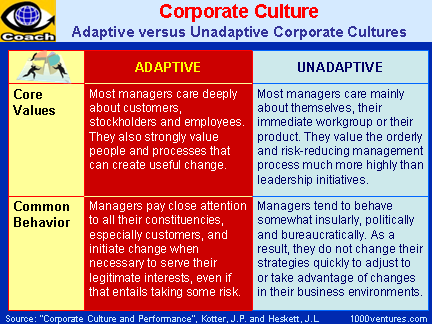
In today's world characterized by rapid unpredictable change and volatility, the sustainable ability to adapt to change is vital. Companies, like any living organism, must become learning organizations that change and adapt to suit their changing business environment.
|
|
| |
"Those who establish adaptable formations will survive even if they are small. While those who establish unadaptable formations shall perish – even if they are large. So it has been since the beginning of time." ~ From The Ancient Book of the Huainan Masters |
|
"It is not the strongest nor most intelligent of the species that survive; it is the one most adaptable to change." ~ Charles Darwin |
|
| |
|
Adaptive Organizations respond better and more quickly to innovations, customers, and fast-changing conditions in the marketplace and economy at large.
|
|
|
| |
For truly adaptive firms, a rapidly changing environment becomes a strategic advantage because the can transform any challenges to opportunities. Build in Adaptiveness at Three Levels ① Strategies ② Organizations ③ Operations |
|
 |
| |
|
"Whoever is stiff and inflexible is a disciple of death. Whoever is soft and yielding is a disciple of life." ~ Tao Te Chin
|
|
|
|
|
|
Flat Organizational Structure When organizations get large, they become ineffective, slow, awkward, inflexible, and difficult to refocus. Innovation-friendly organizations, on the other hand, are flat and participative. They divisionalize to sustain innovation, flexibility and customer intimacy. Division is a business unit having a clear set of customers and competitors... More |
|
|
|