| |
Continuous
Innovation defined:
Continuous
innovation is an ongoing strategically-aligned
bouquet of processes of generating new ideas and
implementing innovative solutions, methods,
technologies, products, or services. |
|
 |
| |
|
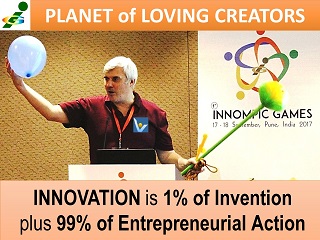
Innovation is above all spurred
by
entrepreneurial action,
aimed at creating value through
the application of knowledge.
|
|
|
 |
Be
an
inspirational leader
– make relentless innovation a
religion and model the way.
~
Vadim
Kotelnikov |
|
Today's economy is led by those
who innovate continuously –
create new solutions,
technologies, products, and
services –
faster than their
competitors.
|
|
| |
|
If
your business is to survive in
today's innovation-driven
rapidly changing environment,
your should either
manage change or change the
management.
|
|
|
 |
|
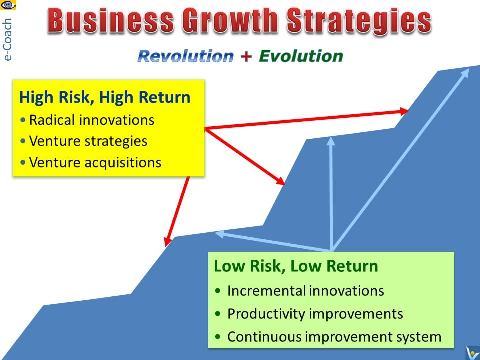
Continuous
innovation includes both radical and incremental
innovation. Rare radical innovations are usually
followed by a continuous chain of incremental
innovations and improvements to processes and
products.
|
|
| |
|
Continuous innovation helps companies gain and
maintain market leadership, stay ahead of the
competition, and keep employee enthusiasm high.
|
|
|
| |
The Choice is "to be or not to be"
"Out there in some
garage is an
entrepreneur who's forging a bullet with
your company's name on it. You've got one option
now – to shoot first. You've got to out-innovate
the innovators."
~ Gary Hamel |
|
|
 |
Not innovating in today's
innovation-driven world equals
falling behind
~
Vadim
Kotelnikov |
|
While continuous innovation
isn't the only route to
corporate growth, it's essential
to creating
sustainable growth, and
vital if you face fierce
competition.
The three main aspects of
organizing for innovation are
corporate culture,
organizational structure, and
business processes.
|
|
| |
|
Most successful practices of the
past are not applicable to new
situations. You must continually
reinvent your business,
responding to changing times
with innovative solutions.
|
|
|
| |
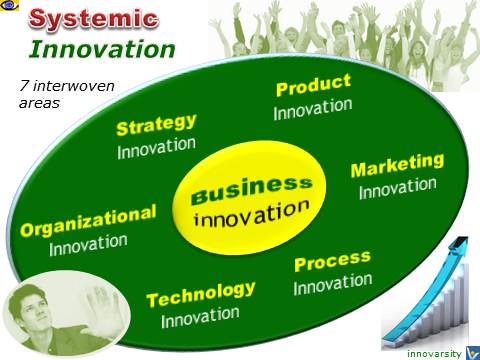
Innovation used to be a
linear trajectory from new knowledge to new
product. Now innovation is neither singular nor
linear, but
systemic.
It arises from
complex interactions among
intrapreneurs, functions and external
factors. |
|
 |
| |
|
Radical & Incremental Innovation
While
radical innovation is the
main source of top-line growth,
incremental innovations and
improvements generate
enterprise value more
consistently, help you deliver
better bottom-line results,
strengthen common ground between
innovation and business, and
drive better employee
engagement. Continuous
evolutionary innovation is about
finding and securing iterative,
incremental wins throughout the
business.
|
|
|
|
|
|
Types of Changes in the
Marketplace |
|
|
|
5
Strategies for Creating a Culture of Questioning
|
|
|
|
Innovation Practice Tips
By:
IDEO |
|
|
|
Mastering Continuous
Innovation
Main Assumptions8 |
|
|
|
The
Jazz of Innovation
11 Practice Tips |
|
The Jazz of Innovation: (A)
create a guiding structure and (B)
encourage improvisation.
-
Provide
strategic alignment.
-
Challenge assumptions
-
Build cross-functional expertise...
More
|
|
Business BLISS
Balance – Leadership – Innovation – Synergy – Speed |
-
Innovation:
Reinvent continually your
business
model,
organization,
processes, technologies, products, and
marketing strategies...
More
|
|
Continuous Change as a Norm
Companies, like any living organism, must become
learning organizations that change and
adapt to suit their changing
business
environment. The constant formation of new units within a
corporation is one means of gearing up to change.
To determine the improvements to make in
response to the change, you should continuously:
Changes – the Source of Opportunities
Innovation is the specific tool of
entrepreneurs.
Doing new things, or doing old things in new ways is how
entrepreneurs
exploit change as an opportunity for a different business or a
different service.
Entrepreneurs see change as the norm and as healthy; they
always search for change, respond to it, and exploit it as an opportunity.
Innovation can be approached methodically, by a
purposeful and organized
search for changes and by identifying the
opportunities that such changes might offer. In your search, focus on
opportunities, not problems, these changes can bring along. Results come
from
exploiting opportunities, not solving problems.
Entrepreneurship as a Continuous Source of
Innovation
Many people equate
entrepreneurship with an individual and his or her startup company.
However, establishing entrepreneurial small business in a big organization
has become very popular in today's rapidly changing and complex world.
Many organizations, willing to exploit the
benefits of new product/service development as
internal ventures, will need to change their
mindset, redefine their concept of organization and loose controls in order
to expand their capacity for speed. Mastering of the new
business systems approach
to managing projects aimed at development of
innovative products and
services will help corporations to
move with speed to capitalize on emerging technology and market
opportunities.
DOs and DON'Ts of a Successful Innovator
By:
Peter Drucker
DOs:
Start small – try to do one
specific thing...
DON'Ts:
Don't undershoot, or you
will simply create an opportunity for competition
Managing for Results
To achieve results, you
should develop a solid, sound, customer-focused, and
entrepreneurial strategy, aimed at
market leadership, based on
innovation, and tightly focused on decisive opportunities.
Road-Mapping
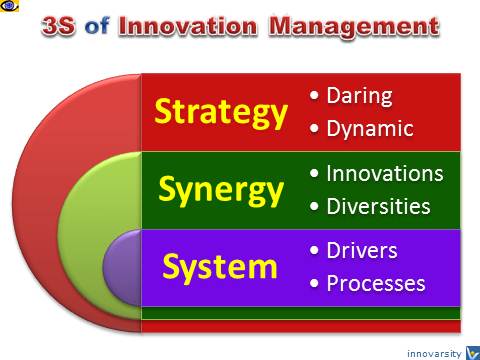
The goal of the
road-mapping is to develop the
innovation strategy – to choose and do the right things. The goal of
innovation management is to implement this strategy well.
Road-mapping leads to effective project
portfolio development and management. It provides for company-wide
technological strategy development and technology assessment, as well as
division-level
project evaluation and strategic aligning. Road-mapping tools provide
also a common language for innovation and building bridges between
technologists and business managers within your corporation, and with you
major suppliers and customers...
More
|
 |
If you're too focused on your
current business, it's hard to look ahead and innovate. |
Bill Gates
Micsosoft |
|
References:
-
The Practice of Management, by
Peter Drucker
-
Management: Tasks, Responsibilities, Practices, by
Peter Drucker
-
"The Frontiers of Management", by Peter Drucker
-
"Managing in Time of Great Change", by Peter Drucker
-
Kaizen:
The Key To Japan's Competitive Success, Masaaki Imai
-
The Road Ahead, by
Bill Gates
-
"Roads to Success", by Robert Heller
-
"Relentless
Growth", Christopher Meyer
-
"Inspiring Innovation", Ellen
Peebles, Harvard Business Review on The Innovative Enterprise
-
"Innovation
and Entrepreneurship," Peter Drucker
|
|
|
|