|
Why In-Company
Ventures?
Today, in-company ventures, or
internal start-ups, a new form of creating and financing a high-tech company
are very popular. As companies must
stand out
from the competition in today's hyper-competitive economy, the growing need for
radical innovation
and
diversification, both related and unrelated, added another dimension of
complexity to managing a large firm.
This complexity is managed through the
creation of "virtual"
small companies within the large company. Corporate
management focuses on the
performance of these in-company ventures as
wholes, while business unit management tends to everyday matters.3
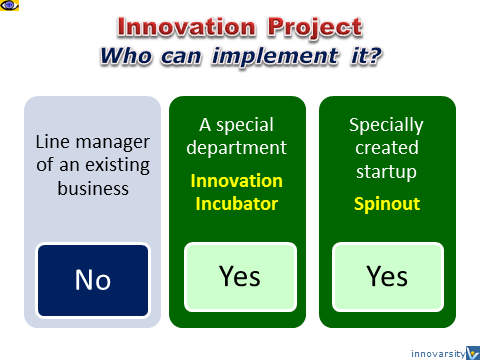
New ventures established as
independent companies, or spinouts, can
more readily fulfill their potential. In this case, the
→
entrepreneurs do not
have to argue with superiors or put up with interference.
In contrast, the in-company venture enjoys the
benefits of the company's greater resources,
brand name and corporate image.
Getting autonomy for a new in-company venture may help it operate more like
an independent. But,
Peter Drucker warns, established
business is also "the main obstacle to
entrepreneurship".
New Upper Management Approaches to Support In-Company
Ventures
Many organizations, willing
to exploit the benefits of new product/service development as internal
ventures, will need to change their mindset, redefine their concept of
organization and loose controls in order to expand their capacity for speed.
Mastering of the new
→
business systems approach
to managing projects aimed at development of innovative products and
services will help corporations to move with speed to capitalize on emerging
technology and
market opportunities.
Corporations should broaden their tolerance to mistakes and encourage
→
entrepreneurial
approaches not only verbally, but by creating conditions
by which you can be an entrepreneur. Top management should be ready to face
the fundamental conflict between the mainstream organization and the
radical innovation
team, and manage the relationships between them. If the new business is
significantly different from the parent company, you may need to break
cultural ties that could get in the way.
→
Top management
should also create an upside opportunity for people in order to retain key
staffers who may wish to leave the corporation and form a startup on their
own. Using such vehicles as phantom stock and stock appreciation rights (SAR),
in-company ventures can provide the feel and reward of a startup.
Project
Leadership
Having a sound research, development, and innovation process is not enough.
It's
→
leadership
that makes the
→
process work. The key is to select project leaders on the
basis of their
cross-functional understanding of technology,
→
marketing, and
manufacturing, as well as their
→
leadership skills and judgment.
Organizations should also provide an enabling environment to empower the
project leaders to
→
act as CEO
and thus to contribute their best to the overall
→
corporate strategy.
Entrepreneurial
approach to project management that understands the dynamics of the
marketplace and competition may require radical change in the project
success measurement and control systems of most organizations.
Business-oriented controls should focus on market performance, timing and
investing for higher return rather than on meeting fixed specifications and
constraints. They must resist the temptation to use operating-plan logic to
manage new ventures.
 GM
OnStar Project GM
OnStar Project
To create OnStar, a new business based on
in-car voice activated communication, General Motors appointed Chef Huber, a
→
nonconformist
inside GM. Huber put together a special-purpose multi-disciplinary team. |