Search


Outside-In Company


Vadim Kotelnikov


Discover growth opportunities by looking at your business from the customer's perspective.


Vadim Kotelnikov (VadiK) business guru, teaching by example

Balance adaptive Yin and proactive Yang business development strategies to stay in harmony with the real world.

~ Vadim Kotelnikov


Outside-In Company - focus on satisfying customer needs and wants


"Company’s vision must be driven by the aspirations of its customers," advised Konosuke Matsushita, the founder of Panasonic.

A sustainable growth strategy of an outside-in company starts with understanding the difference between what you produce and what people need and want.


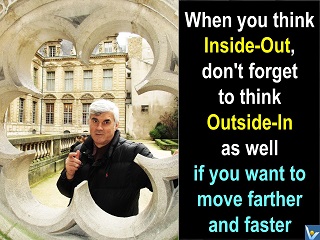
Look at Your Business From Outside In

Masaaki Imai advises asking the following questions relentlessly to understand what's going in the real world:

❶ What's happening in your marketplace?

❷ How the needs are changing?

❸ What's causing the changes?

❹ Where are the resulting opportunities?

Having answered the above questions, work backward:

❶ What needs do you satisfy now?

❷ What need could you satisfy now? In future?

❸ What's the gap between them and what you do now, and how to bridge it?

❹ What advantages and internal capabilities do you have? What advantages and capabilities do you need to create?

❺ What old competencies do you need to deemphasize?


Dynamic Business Models

Business models have shorter shelf life in today's rapidly changing world. You must keep reinventing the ways of creating customers and constantly reassess your past decisions and create new business models and dynamic strategies if you hope to survive and grow... More


Developing Growth Strategy From the Outside In

Every business, regardless of its current state, possesses the potential for exponential growth.

The real world strategic thinking and strategic creativity is both imaginative and highly disciplined. Outside-in thinking can transform businesses that are "commoditized", "mature" or otherwise supposedly without growth prospects.

In the outside-in company, as opposed to inside-out one, the key word is need, not product. Their people think expansively.


Outside-in business thinkers observe people and empathize with customers. T

hey are "totally immersed in the minds of their customers, looking for ways to expand demand. Their business plans and value propositions derive from the marketplace, based on the knowledge gathered at ground level. Often, the needs they define haven't yet been identified by the customers themselves," write Ram Charan and Noel. Tichy in their book Every Business is a Growth Business.


Customer-driven Innovation

SuperThinker

Value of Systems Thinking for Business

AImpowerment

Human-AI Synergy

AI Optimization


Tapping your resources of energy and imagination, you look at your company from the perspective of your once and future customers, and asking awakening questions about what's going on in the real world. Having stepped outside of your business, then work backward to ask questions about your business to find out how you can pursue the market opportunities identified.


A historic example: 3M

Ram Charan and Noel Trichy in their book Every Business Is a Growth Business write: "Many companies have seemingly done well thinking from the inside out. 3M achieved legendary success as an innovator by giving its people room to develop their ideas in quasi-entrepreneurial fashion. For years, it ranked among the leaders of FORTUNE's list of most admired companies. But during the first half of the 90s, 3M grew its top line less than 4% despite the brilliance of its entrepreneurial technologists."


"There wasn't enough feedback from the marketplace – missing were the insight into the customer's mind, and the intuitive observations about needs that could have translated inventiveness into powerful growth."

In late 90s, new leadership got the company back on track with outside-in growth initiatives.