|
The Three Levels of
Enterprise Strategy
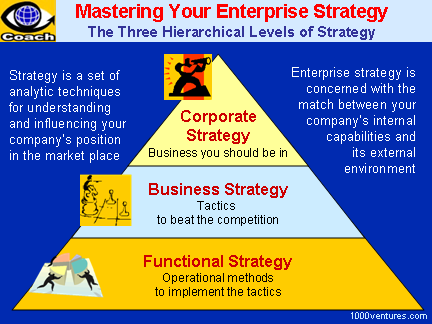
Enterprise strategy can be
formulated and
implemented at three different levels:
-
Corporate level
-
Business unit level
-
Functional or departmental level
At the corporate level, you
are responsible for creating value
through your businesses. You do so by managing your portfolio of businesses,
ensuring that your businesses are successful over the long term, developing
business units, and sometimes ensuring that each business is compatible with
others in your portfolio.
Products and services are
developed by business units. The role of the corporation is to manage its
business units, products and services so that each is competitive and so
that each contributes to corporate purposes.
Corporate Level
Strategy
Corporate level strategy
fundamentally is concerned with selection of businesses in which your
company should compete and with development and coordination of that
portfolio of businesses.
Corporate level strategy is
concerned with:
-
Reach – defining the issues that are corporate
responsibilities. These might include identifying the overall
vision, mission,
and goals of the corporation, the type of business your corporation
should be involved, and the way in which businesses will be integrated
and managed.
-
Competitive Contact – defining where in your corporation
competition is to be localized.
-
Managing Activities and Business Interrelationships –
corporate strategy seeks to develop
synergies by sharing and coordinating staff and other resources
across business units, investing financial resources across business
units, and using business units to complement other corporate business
activities.
-
Management Practices – corporations decide how business
units are to be governed: through direct corporate intervention
(centralization) or through autonomous government (decentralization).
Business Unit Level
Strategy
A strategic business unit
may be any profit center that can be planned independently from the other
business units of your corporation. At the business unit
level, the strategic issues are about both practical coordination of
operating units and about developing and sustaining a
competitive advantage for the
products and services that are produced.
Functional Level
Strategy
The functional level of
your organization is the level of the operating divisions and departments.
The strategic issues at the functional level are related to functional
business processes and
value chain. Functional level
strategies in R&D, operations, manufacturing, marketing, finance, and human
resources involve the development and coordination of resources through
which business unit level strategies can be executed effectively and
efficiently.
Functional units of your
organization are involved in higher level strategies by providing input into
the business unit level and corporate level strategy, such as providing
information on customer feedback or on
resources and capabilities on which the higher level strategies can be
based. Once the higher level strategy or
strategic intent is
developed, the functional units translate them into discrete action plans
that each department or division must accomplish for the strategy to
succeed.3
Case in Point
Textron
Inc.
Source: "Hierarchical Levels of Strategy",
QuickMBA.com
Textron Inc. is a successful conglomerate corporation that
pursues profits through a range of businesses in unrelated industries.
Textron has four core business segments:
-
Aircraft – 32% of revenue
-
Automotive – 25% of revenue
-
Industrial – 39% of revenue
-
Finance – 4% of revenue
While the corporation must manage its portfolio of businesses
to grow and survive, the success of a diversified firm depends upon its
ability to manage each of its product lines. While there is no single
competitor to Textron, you can talk about the competitors and strategy of
each of its business units. In the Finance business segment, for example,
the chief rivals are major banks providing commercial financing. Many
managers consider the business level to be the proper focus for
strategic
planning.
|