|
What is Value Chain?
Value chain is a high-level model of how
businesses receive raw materials as input, add value to the raw materials
through various processes, and sell finished products to customers.
Yin-Yang of Customer Value Creation
Today's Challenges
Old-fashioned command-and-control companies were merely
trying to manage the "white space" in their organizational charts. Today's
companies must manage the white space in entire value chains.
A critical pre-requisite for success in digital
economy is the implementation of an integrated value chain that extends
across – and beyond – the enterprise.
8 Best Practices of Successful
Companies
Case in
Point
Dell Inc.
"We
learned to identify our core strengths," says
Michael Dell, Founder of
Dell Inc. “We wanted to earn a reputation for providing great
customer service, as well as great products.
Engaging the entire company – from manufacturing to engineering to sales
to support staff – in the process of understanding customer requirements
became a constant focus of management, energy, training, and employee
education.“...
More
Customer-driven Innovation: 7 Practice
Tips
Customer-Driven Innovation is not a
one-time event. It's a philosophy, a mindset, and a habit. You
should live this principle daily if you wish to keep creating an
innovative
customer value, developing attractive
product designs, and ultimately win the
value innovation competitive game...
More
Employee
Empowerment
Transition to
knowledge-driven economies made establishment of effective
employee empowerment mechanisms within companies crucial to their
competitiveness...
More
Peter Drucker in his Management by Objectives (MBO)
concept calls for achieving the
balance between
management and employee empowerment. A manager should view members of his or her team
much as a conductor regards the players in the orchestra, as individuals
whose particular skills contribute to the success of the enterprise.
Leadership-Management Synergy
While
people are still subordinates, the superior is increasingly dependent on the
subordinates for getting results in their area of responsibility, where they
have the requisite knowledge. In turn, these subordinates depend on their
superior for direction and "above all, to define what the 'score' if for the
entire organization, that is, what are standards and values, performance and
results."
In Japan, following the
Kaizen strategy, companies practice employee empowerment through such mechanisms as the suggestions system
and quality control (QC) circles...
More
Lean Enterprise
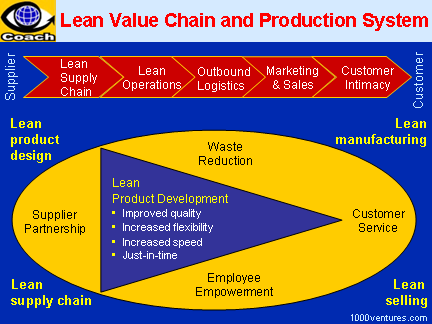
The 'Lean Enterprise' encompasses the entire
production system, beginning with the customer, and includes the product
sales outlet, the final assembler, product design, and all tiers of the
supply chain (to include raw material mining and processing).
Toyota
Production System
Any truly 'lean'
system is highly dependent on the demands of its customers and the
reliability of its suppliers. No implementation of lean manufacturing can
reach its full potential without including the entire 'enterprise' in its
planning...
More
Case in Point
Canon: Eliminating
9 Wastes
The objectives of
Canon Production
System (CPS) are to manufacture better quality products at lower
cost and deliver them faster.
Canon invited all their employees to suggest
ideas for improvement and developed 6 Guidelines for the
Suggestion System
to make it most effective. The company developed also a list of
9 wastes
to help their employees become problem-conscious, move from operational
improvement to systems improvement, and recognize the need for
self-development...
More
Today's Solution: Process-managed
Enterprise
A process-managed enterprise supports,
empowers and
energizes employees,
encourages their initiative, enables and allows its people to perform
process work. Value chain leadership requires
cultivation of a
shared vision in all participants. The shared vision provides common direction
and focus, motivates personal, team, and
organizational
learning, and thus enables all participants in the value chain to work
toward common goals.
"Because multiple value chain participants must
collaborate to deliver value, they must all participate in process analysis
and design - and achieve team learning. Only with the visibility provided by
process management can
end-to-end processes be understood, anomalies spotted, redundancy
eradicated and inefficiencies eliminated. Process management integrates
everyone and everything once; thereafter, process design, transformation and
experience take place freely and continuously, not as a series of
infrequent, long-winded, piecemeal and distracting "integration projects"
for each new process design. In this way, participants truly learn about the
process and the side effects of change on the business."4...
More
The Growing Role of the
Business Architect
Today's companies need
business architects
who can take a
systems view of a business and build
synergies.
Business
architect is a person who
initiates new business ventures
or leads
business innovation, designs a
winning
business model, and builds a
sustainable
balanced business system for a
lasting success...
More
Leveraging Your Service-Profit Chain
The service-profit
chain is a powerful phenomenon that stresses the importance of people -
both employees and customers - and how linking them can leverage corporate
performance. The service-profit chain is a powerful phenomenon that stresses
the importance of people - both employees and customers - and how linking
them can leverage corporate performance.
Extended Enterprise
The term "extended enterprise" represents a new concept that
a company is made up not just of its employees, its board members, and
executives, but also its business partners, its suppliers, and its
customers.
The notion
of extended enterprise includes many different arrangements such as
virtual integration,
outsourcing, distribution agreements, collaborative
marketing, R&D program partnerships,
alliances, joint ventures, preferred
suppliers, and customer
partnership.
Primary
Value Chain Activities...
State-of-the-art Value Chain
for Selling...
Support
Activities Facilitating the Primary Value Chain Activities...
Enterprise-wide Business Process Management (EBPM)...
Business
Process Management Software (BPMS)..
Process
Thinking...
Value
Innovation...
Teaming Up with Suppliers...
Vertical Integration...
Virtual Integration...
Customer Partnership...
Waste
Reduction...
The Tao of Business Success...
Case in Point
General Electric
(GE)...
Case in Point
Procter & Gamble...
Case in Point
Motorola...
Case in Point
Toyota...
Case in Point
Canon...

|