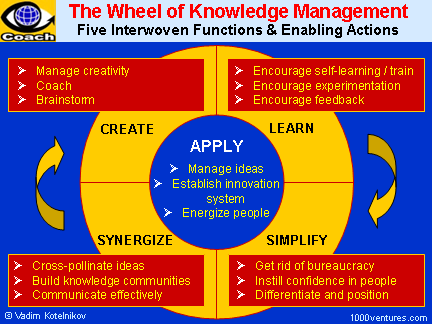
 |
|
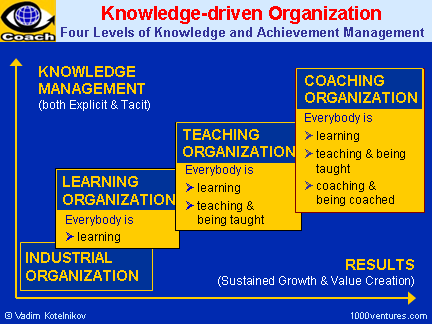
While most
managers agree that managing knowledge is
important, few of them can articulate what the
value is or how to become a learning, teaching,
or coaching organization.
The majority of
companies have their knowledge embedded in
people and organizations. |
|
 |
If
you stop
learning,
you stop creating history and
become history.
~
Vadim
Kotelnikov |
|
Explicit and
Tacit
Knowledge
Explicit knowledge can be
formally articulated, encoded,
more easily transferred and
shared. It is often abstract,
not experience-based.
Tacit knowledge is
difficult to articulate; shared
through highly interactive
conversation and shared
experience...
More
|
|
| |
Knowledge Management vs. Information Management
KM
targets collecting and distributing both explicit and
tacit knowledge throughout the organization.
Information Management deals mainly with documented
explicit knowledge only...
More |
|
Knowledge-based Enterprise
Knowledge Communities |
|
| |
|
"If we wonder often, the gift of
knowledge will come."
~
Indian proverb
|
|
|
|
|
|
Why
Knowledge Management
Knowledge needs to be managed because all too
often,
▪ it is available but not used very much;
▪ it is often intuitive, tacit, rather
than explicit, and
tacit knowledge is an important source of
competitive advantage for a company;
▪ knowledge
sharing improves
holistic
intelligence, which is an
important
source of competitive advantage for an
organization;
▪ it is occasional but not integral to
the business;
▪ it is rarely detailed enough to be
especially valuable;
▪ it exists with multiple points of view
instead of the collective best thinking;
▪ it often gets lost when someone leaves
the company;
▪ there are human
barriers to knowledge-sharing.
Transfer of Best Practices
Transfer of best practices is one of the biggest
issues driving
innovation, cost, efficiency, and
satisfaction in most companies. Transferring the
worst practices is equally important to prevent
other employees from making the same mistakes.
|
|
 |
|
Create a Thirst for Knowledge in Employees
One source of
competitive advantage is to diffuse throughout
your company the unique, proprietary knowledge
about successful methods, customers,
competitors, products, and techniques that
resides in the minds of your employees. |
|
|
 |
 |
|
"Reward people for contributing
to a full flow of knowledge."
~
Bill Gates,
Microsoft
"Reward and celebrate new ideas
to encourage others to want
contribute as well."
~
Jack Welch,
GE
"Inspire advocates. Mental
diversity is very important –
you need individuals who
celebrate different viewpoints."
~
Tom Kelley,
IDEO
|
|
|
|