Change Management:

Knowing People

Resistance to Change

Understanding and Overcoming Human and Organizational Barriers

By Vadim Kotelnikov, Inventor, Author & Founder, Ten3 BUSINESS e-COACH – Innovation Unlimited, 1000ventures.com

 Yes!  You are in the right place!

This site is Ranked Top 5 by Google for

"Resistance To Change"

out of about 7-million-wide (!!!) competition!

"It is easier to resist at the beginning than at the end."  

– Leonardo da Vinci 


10 Differences between a Winner and a Loser

  • Winner says: 'There ought to be a better way of doing this'

  • Loser says: 'Why change it? That's the way it's always been done'... More

The 7 Habits of Highly Ineffective People

By: John R. Covey

Staying Down

  1. Fear change and put off improvement... More

Overcoming Resistance to Change: Most Common Ways2

  • Education and communication

  • Participation and involvement

  • Facilitation and support

  • Negotiation and agreement

  • Manipulation and co-optation

  • Explicit and implicit coercion

Resistance to Change in the Workplace: Main Reasons

  • Fear of the unknown. Change implies uncertainty, and uncertainty is uncomfortable. Not knowing what may potentially happen often leads to heightened anxiety. Resisting change is one of the anxiety-reducing actions.1

  • Fear of failure. The new order may require skill and abilities that may be beyond our capabilities. There is resistance to trying a new approach as people know how to operate in the existing order, but fear they will  not be able to the new skills and behavior that will be required of them.

  • Disagreement with the need for change. Associates may feel that the new direction is a wrong direction.

  • Losing something of value. All associates want to know how the change will affect them. If people believe they will wind up losing as a result of the change, they will resist.

  • Leaving a comfort zone. People are afraid to go after what they want because it would force them to stretch their comfort zones. It's only natural to put off things that scare us, to sidestep goals that require us to leave our comfort zone and take a risk.

  • False beliefs. To put themselves at ease and avoid taking the risk, many people fool themselves into believing everything will all work out someday by itself.

  • Misunderstanding and lack of trust. People resist change when they do not understand its implications and perceive that it might cost them much more than they gain. Such situations often occur when trust is lacking between the person initiating the change and the employees.2

  • Inertia. All organizations suffer from inertia to some degree and try to maintain status quo. Change requires effort, oftentimes, a significant one. So, don't underestimate the power of fatigue and burnout.


 Discover much more!

Change Management

The 8 Stage Change Process

5 Strategies for Creating a Culture of Questioning

Leadership

12 Effective Leadership Roles

7 Habits of Highly Effective People (and 7 Habits of Highly Ineffective People)

The 4 Es of Leadership

3 Rules for Developing Courage

How To Make Better Decisions

Get Away from Old Ideas

Smart Corporate Leader

The 4 Es of Leadership

Develop a Clear Vision

A Leader's Mood: The Dimmer Switch of Performance

Take Time Out For Mental Digestions

  Ten3 Mini-Courses   Presentation:    View    Download

SMART Leader  (50 slides)

Entrepreneurial Leadership  (40 slides)

Your People Skills  (40 slides)


Inspirational Business Plan: Successful Innovation

Marketing Strategy: "Good ideas are not adopted automatically. They must be driven into practice with courageous patience." Hyman Rickover... More

Why Resistance to Change?

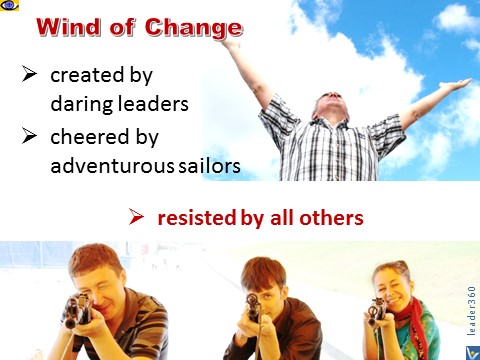
Most people don't like change because they don't like being changed. When change comes into view, fear and resistance to change follow – often despite its obvious benefits. People fight against change because they:

  • fear to lose something they value, or

  • don't understand the change and its implications, or

  • don't think that the change makes sense, or

  • find it difficult to cope with either the level or pace of the change.3

Resistance emerges when there s a threat to something the individual values. The threat may be real or it may be just a perception. It may arise from a genuine understanding of the change or from misunderstanding, or even almost total ignorance about it.

Change as an Unnatural Act

Change theory tells us that human systems seek homeostasis and equilibrium, i.e. prefer a predictable, stable world.4

12 Effective Leadership Roles

Create change, lead change, manage resistance to change... More

A Leader's Mood

Manage the Emotions of Change. Be particularly mindful of how you manage emotions if your organization is undergoing change how you handle emotions during these crucial times can help or hinder the change process. It's a known fact that if the resistance to change is emotional, it is the hardest form of resistance to overcome. As the leader handling a change initiative, don't avoid the emotions that accompany the change process. Set the mood and manage the emotions or they will manage you... More

Humorous Business Plans: How To Succeed In Innovation

Innovation Management Team: "The leaders say: "Let's be more innovative." The staff says: "Bravo. When do we start?" The mid-level managers say: "Wait a minute, let's think about that. What about… and …? Have you REALLY thought it through? Does this mean I have to change?"" – Claude Legrand... More

8 Common Errors in Organizational Change Efforts


By: John Kotter

  • Undercommunicating the vision... More

Breaking the Rules

So what separates extraordinary leaders from proponents of the status quo? They break the rules. Except, not in an arbitrary or capricious way. When you look at examples of extraordinary leadership, like the Founding Fathers of the United States or Jack Welch of GE, certain practices or principles become apparent.

To start, there is a declaration of what the future will be. There is also a purpose, something to stand for. And finally, there is a clearly articulated commitment... More

The 8 Step Change Process

Defrost a hardened status quo:

  1. Establish a sense of urgency... More

29 Obstacles To Innovation

Keep People In The Know

"Transformational leaders empower others by keeping them "in the know," by keeping them fully informed on everything that effects their jobs," says Brian Tracy. "People want and need to feel that they are “insiders,” that they are aware of everything that is going on. There is nothing so demoralizing to a staff member than to be kept in the dark about their work and what is going on in the company."... More


References:

  1. "Managerial Leadership", Peter A. Topping

  2. "What Leaders Really Do", John P. Kotter

  3. "Performance Management", Phil Baguley

  4. "Strategic Management", Third Edition, Alex Miller

  5. "Motivation123", Newsletter, Jason Gracia, March 2005

  6. "Take Time Out for Mental Digestion," Brian Tracy

  7. "Effective Leadership," Vadim Kotelnikov

  8. "Smart Corporate Leader," Vadim Kotelnikov

  9. "Smart Business Architect," Vadim Kotelnikov


Map

Ranked #1

Search

Testimonials

Free Downloads

  Products

SMART Learning

Training

 Contact

We invented Business e-Coaching in 2001

Today, we have customers in 100+ countries!

Our customers:

3M, ABB, Adidas, Alcatel, American Express, Bayer, Boeing, British American Tobacco, BP, Canon, Cisco, Citigroup, Colgate, Corning, Deloitte, Ernst & Young, Fujitsu-Siemens, GE, Goldman Sachs, HP, Hitachi, Huyndai, IBM, Intel, Johnson & Johnson, JP Morgan Chase, KPMG, Lufthansa, Microsoft, Motorola, Nokia, Oracle, Samsung, Shell, Siemens, Sony, United Bank of Switzerland

Ten3 Mini-courses: SMART & FAST sets Full version of Ten3 Business e-Coach Ten3 Business e-Coach (home page)

Ten3 Business e-Coach, version 2008

Inventor, Author & Founder – Vadim Kotelnikov

© Vadim Kotelnikov, GIVIS