Sustainable Growth:

Strategic Partnerships

International Business

What You Need to Succeed

By Vadim Kotelnikov, Founder, Ten3 BUSINESS e-COACH – Innovation Unlimited, 1000ventures.com

Clickable flags


Sample slide

Clickable


Global View

Africa

Asia-Pacific

Europe

North America

South America

Ten3 MINI-COURSES (presentation) PRESENTATION: What Business People Strive To Learn in Different Countries Presentation: What Business People Strive To Learn in Different Countries (Ten3 Global Market and Cultural Intelligence Study by Vadim Kotelnikov) Ten3 Business e-Coach (full version) TOP MANAGER (set of Ten3 Mini-courses) Ten3 BUSINESS e-COACH at 1000ventures.com Ten3 Study: GLOBAL OVERVIEW Regional Profile: AFRICA Regional Profile: ASIA-PACIFIC Ten3 Study: EUROPE Regional Profile: NORTH AMERICA Regional Profle: SOUTH AMERICA CREATIVE ACHIEVER (set of Ten3 Mini-courses) SMART ENTREPRENEUR (set of Ten3 Mini-courses) INNOVATION MANAGEMENT (set of Ten3 Mini-courses) SMART LEADER (Ten3 Mini-course)


"Unless you know the mountains and the forests, the defiles and impasses, the lay of the marshes and swamps, you cannot maneuver with an armed force. Unless you use local guides, you cannot get the advantages of the land."

Sun Tzu, 'The Art of War'


Incorporating International Business Considerations into Your Thinking & Planning

International Issues to Consider1

  • How will your idea, good, or service fit into the international market?

  • Should you enter the market through trade or through investment?

  • Should you obtain your supplies domestically or from abroad?

  • What product/service adjustments are necessary to be responsive to local conditions?

  • What threats from global/local competition should be expected and how can you counteract these threats?

Six Features of Emerging Markets6

  1. a high concentration of ownership

  2. weak recruitment processes and a shortage of experienced directors

  3. poor focus

  4. an inadequate supply of information

  5. complex cultural traditions

  6. underdeveloped legal regimes.

Lessons from Jack Welch, the Former Legendary CEO of GE

Penetrating Foreign Markets: Main Principles

  • Move into global markets fast and powerfully.

  • Build a solid, domestic base before launching the attack.

  • Use acquisitions to create or enlarge a bridgehead.

  • Strengthen under-performing businesses by acquisition and pooling assets.

  • Concentrate on major businesses where you can win.

  • Develop local management, and bring expatriates home as soon as possible.

12 Tips for Global Business Travelers

  • Learn something about the country, local customs, and cultural sensitivities to avoid making faux pas while abroad... More

 Discover much more!

Cultural Intelligence

World Cultures

Eastern vs. Western Philosophy

Pearls of Wisdom

Harnessing the Power of Diversity

Culture Dimension Scores of 10 Selected Countries

Competitive Advantage: US versus Japan

Cross-Cultural Differences: China and United States

Russians: Comparative Character Features

12 Tips for Global Business Travelers

Global Business Learning Report – What leaders strive to excel at

Africa    Asia-Pacific    Europe    North America    South America

  Ten3 Mini-Courses   Presentation:    View    Download

Cultural Intelligence & Modern Management  (e-book)

SMART Executive  (225 slides)   ► Demo

Smart Business Architect  (150 slides)

3 Strategies of Market Leaders  (125 slides)

Sustainable Competitive Advantage  (40 slides)

Winning Customers  (100 slides)


International Business Defined

International business consists of transactions and collaborations that are devised and carried out across national borders to satisfy the strategic intent and objectives of companies, organizations, and individuals. Two primary types of international business are trade and investment. These transactions and collaborations take on various forms – export-import trade, co-innovation, consultancy services  and sub-contracting, business process outsourcing (BPO), and direct foreign investment -  which are often interrelated  Direct foreign investment "is carried out in varied forms, including wholly owned subsidiaries and joint ventures. Additional types of international business are licensing, franchising, and management contracts."1

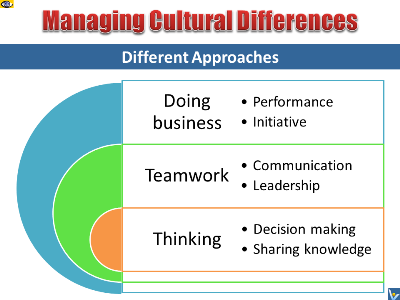
Managing Cross-Cultural Differences


If you wish to reach foreign buyers or sellers or need to bring joint venture projects to a successful outcome, you must be culturally competent. You must understand intercultural communication and effectiveness if you wish to avoid such serious problems as:

  • Unmet commitments from suppliers;

  • Stalled joint projects, deals coming undone;

  • Frequent miscommunications, failed meetings, and unanswered routine communications;

  • Low productivity.

Cultures – both national and organizational – differ along many dimensions. Four of the most important are:

  1. Directness (get to the point versus imply the messages)

  2. Hierarchy (follow orders versus engage in debate)

  3. Consensus (dissent is accepted versus unanimity is needed)

  4. Individualism (individual winners versus team effectiveness)2

 Case in Point  Lessons from Jack Welch


To Jack Welch, the legendary former CEO of GE, "There will only be one standard for corporate success: international market share... The winning corporations – those who can dictate their destiny – will win by finding markets all over the world."

Under Welch's leadership, GE's sales rose by US$60.1 billion between 1987 and 1998. Over half that increase came from abroad. Welch developed strong, direct and simple principles to increase GE's global sales. He regarded globalization as a three-stage process.

  1. Going after markets and expanding the company's horizons.

  2. Globalizing components and products, and sourcing around the world.

  3. Globalizing the intellect.


Bibliography:

  1. "International Business", Sixth Edition; Michael R. Czinkota, Ilkka A. Ronkainen and Michael H. Moffett

  2. "Cultures and Organizations: Software of the Mind", Geert Hofstede

  3. "Control Your Destiny or Someone Else Will", Noel M. Tichy and Stratford Sherman

  4. "Improving Board Performance in Emerging Markets," McKinsey Quarterly

  5. "Smart Corporate Leader," Vadim Kotelnikov

  6. "Smart Business Architect," Vadim Kotelnikov

  7. "Corporate Strategies," Vadim Kotelnikov

  8. "Competitive Strategies," Vadim Kotelnikov

  9. "Strategies of Market Leaders," Vadim Kotelnikov

Map

Ranked #1

Search

Testimonials

Free Downloads

  Products

SMART Learning

Training

 Contact

We invented Business e-Coaching in 2001

Today, we have customers in 100+ countries!

Our customers:

3M, ABB, Adidas, Alcatel, American Express, Bayer, Boeing, British American Tobacco, BP, Canon, Cisco, Citigroup, Colgate, Corning, Deloitte, Ernst & Young, Fujitsu-Siemens, GE, Goldman Sachs, HP, Hitachi, Huyndai, IBM, Intel, Johnson & Johnson, JP Morgan Chase, KPMG, Lufthansa, Microsoft, Motorola, Nokia, Oracle, Samsung, Shell, Siemens, Sony, United Bank of Switzerland

Ten3 Mini-courses: SMART & FAST sets Full version of Ten3 Business e-Coach Ten3 Business e-Coach (home page)

Ten3 Business e-Coach, version 2008

Inventor, Author & Founder – Vadim Kotelnikov

© Vadim Kotelnikov, GIVIS