Strategy Formulation:

Business Portfolio

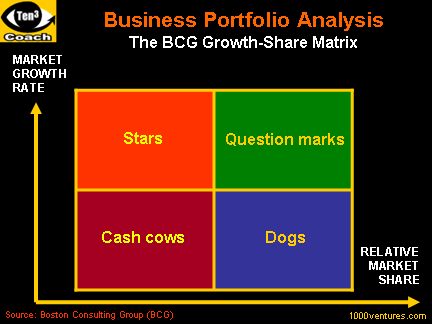
The BCG Growth-Share Matrix

Strategic Business Portfolio Analysis

By Vadim Kotelnikov, Founder, Ten3 BUSINESS e-COACH, 1000ventures.com

"You will either step forward into growth or you step back into safety." Abraham Maslow


Characteristics of Strategic Business Units (SBUs)

  1. It is a single business or collection of related businesses

  2. It has its own competitors

  3. It has a manager who is accountable for its operation

  4. It is an area that can be independently planned for within the organization

 Discover much more!

Smart Corporate Leader

Enterprise Strategies

Competitive Strategies

Strategies of Market Leaders

Business Architect

  Ten3 Mini-Courses   Presentation:    View    Download

Strategic Management  (65 slides)

3 Strategies of Market Leaders  (125 slides)

Smart Business Architect  (150 slides)

SMART Executive  (225 slides)   ► Demo

Innovation Strategies  (40 slides)


What Is BCG Growth-Share Matrix

The Boston Consulting Group (BCG) developed a portfolio analysis tool that helps managers develop organizational strategy based on market share of businesses and the growth of markets in which businesses exist.

Strategic Business Units (SBUs)

The first step in using the BCG Growth-Share Matrix is identifying the organization’s strategic business units (SBUs). A strategic business unit is a significant organization segment that is analyzed to develop organizational strategy aimed at generating future business or revenue. Exactly what constitutes an SBU varies from organization to organization. In larger organizations, an SBU could be a company division, a single product, or a complete product line. In smaller organizations, it might be the entire company.1 Although SBUs vary drastically in form, they have some common characteristics. All SBUs are a single business (or collection of businesses), have their own competitors and a manager accountable for operations, and can be independently planned for.

Categorizing SBUs

After SBUs have been identified for a particular organization, the next step is to categorize each SBU within one of the following four matrix quadrants:

Stars – SBUs that are “stars” have a high share of a high-growth market and typically need large amounts of cash to support their rapid and significant growth. Stars also generate large amount of cash for the organization and are usually segments in which management can make additional investments and earn attractive returns.

Cash Cows – SBUs that are cash cows have a large share of a market that is growing only slightly. These SBUs provide the organization with large amounts of cash, but since their market is not growing significantly, the cash is generally used to meet the financial demand of the organization in other areas, such as the expansion of a star SBU.


Question Marks – SBUs that are question marks have a small share of a high-growth market. They are dubbed “question marks” because it is uncertain whether management should invest more cash in them to gain a larger share of the market or deemphasize or eliminate them. Management will chose the first option when it believes it can turn the question mark into a star, and second when it thinks further investment would be fruitless.

Dogs – SBUs that are dogs have a relatively small share of a low-growth market. They may barely support themselves; in some cases, they actually drain off cash resources generated by other SBUs.


Bibliography:

  1. "Modern Management," Ninth Edition, Samuel C. Certo

  2. "Enterprise Strategies," Vadim Kotelnikov

  3. "Competitive Strategies," Vadim Kotelnikov

  4. "Strategies of Market Leaders," Vadim Kotelnikov


Map

Ranked #1

Search

Testimonials

Free Downloads

  Products

SMART Learning

Training

 Contact

We invented Business e-Coaching in 2001

Today, we have customers in 100+ countries!

Our customers:

3M, ABB, Adidas, Alcatel, American Express, Bayer, Boeing, British American Tobacco, BP, Canon, Cisco, Citigroup, Colgate, Corning, Deloitte, Ernst & Young, Fujitsu-Siemens, GE, Goldman Sachs, HP, Hitachi, Huyndai, IBM, Intel, Johnson & Johnson, JP Morgan Chase, KPMG, Lufthansa, Microsoft, Motorola, Nokia, Oracle, Samsung, Shell, Siemens, Sony, United Bank of Switzerland

Ten3 Mini-courses: SMART & FAST sets Full version of Ten3 Business e-Coach Ten3 Business e-Coach (home page)

Ten3 Business e-Coach, version 2008

Inventor, Author & Founder – Vadim Kotelnikov

© Vadim Kotelnikov, GIVIS