Strategy Formulation:

Business Portfolio

GE Multifactor Business Portfolio Matrix

Analyzing Your Competitive Position and Making Sound Investment Decisions

By Vadim Kotelnikov, Founder, Ten3 BUSINESS e-COACH, 1000ventures.com

"The vision must be followed by the venture. It is not enough to stare up the steps – we must step up the stairs." Vance Havner


Strategy Formulation GE Multifactor Business Portfolio Matrix

Two Dimensions of the Matrix

  1. Industry attractiveness might be determined by such factors as the rate of industry growth, the number of competitors in an industry, and the weakness of competitors within an industry.

  2. Business strengths might be determined by such factors as a company’s core competencies and capabilities, financially solid position, its good bargaining position over suppliers, and its high level of technology use.

 Discover much more!

Corporate Leader

Business Architect

Look at Your Company from Outside In As Well As Inside Out

Sustainable Growth Strategies

3 Strategies of Market Leaders

Enterprise Strategies

SWOT Analysis: Questions To Answer

5 Strategic Questions

Competitive Strategies

Sustainable Competitive Advantage

Creating Competitive Disruption: 7 Strategies

7-Part Competitive Strategy of Microsoft

  Ten3 Mini-Courses   Presentation:    View    Download

Smart Business Architect (150 slides)   ► Demo

Strategic Management  (65 slides)

SMART Business Architect (Ten3 Mini-course)

About the Tool


With the help of McKinsey and Company, a leading consulting group, the General Electric Company (GE) developed a popular business portfolio analysis tool called the GE Multifactor Portfolio Matrix. This tool helps managers develop organizational strategy that is based primarily on market attractiveness and business strengths.

Building the Matrix

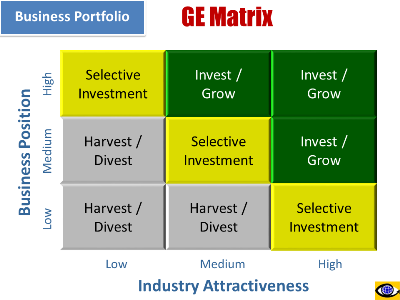
Each of the organization’s strategic business units (SBUs) is plotted on a matrix of two dimensions: industry attractiveness and business strength. Each of these two dimensions is actually a composite of a variety of factors.

Industry attractiveness might be determined by such factors as the rate of industry growth, the number of competitors in an industry, and the weakness of competitors within an industry.

Business strengths might be determined by such factors as a company’s core competencies and capabilities, financially solid position, its good bargaining position over suppliers, and its high level of technology use.

Defining the Position of Business Units

Managers can place pie charts representing a company line of business or SBU on the matrix. Circle size would indicate the relative market size for each line of business.


A shaded portion of a circle would represent the portion of the total SBU market that a company has captured.

Making Investment Decisions

Specific strategies for a company are implied by where their businesses (represented by pie charts) fall on the matrix. Businesses falling in the cells that form a diagonal from higher left to lower right are medium-strength businesses that should be invested in only selectively. Businesses above and to the right of this diagonal are the strongest and the ones that the company should invest in and help to grow. Businesses in the cells below and to the left of the diagonal are low in overall strength and are serious candidates for divesture.


Bibliography:

  1. "Modern Management," Ninth Edition, Samuel C. Certo

Map

Ranked #1

Search

Glossary

Free Downloads

  Products

Testimonials

Training

 Contact

We invented Business e-Coaching in 2001

Today, we have customers in 100+ countries!

Our customers:

3M, ABB, Adidas, Alcatel, American Express, Bayer, Boeing, British American Tobacco, BP, Canon, Cisco, Citigroup, Colgate, Corning, Deloitte, Ernst & Young, Fujitsu-Siemens, GE, Goldman Sachs, HP, Hitachi, Huyndai, IBM, Intel, Johnson & Johnson, JP Morgan Chase, KPMG, Lufthansa, Microsoft, Motorola, Nokia, Oracle, Renault, Samsung, Shell, Siemens, Sony, United Bank of Switzerland

Ten3 Mini-courses: SMART & FAST sets Full version of Ten3 Business e-Coach Ten3 Business e-Coach (home page)

Ten3 Business e-Coach

Inventor, Author & Founder – Vadim Kotelnikov

© Vadim Kotelnikov, GIVIS