| |
|
Human Predictive
Intelligence (HPI) and AIPI
Predictive intelligence is an
ability to anticipate outcomes,
responses, challenges, and
opportunities related to their
actions.
|
|
|
|
 |
|
Summary
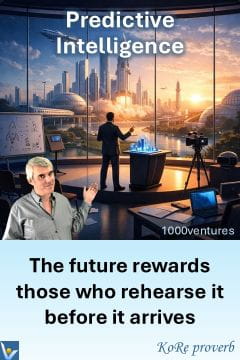
He who sees one step ahead survives; he
who sees five steps ahead shapes the future.
~
KoRe proverb
Predictive intelligence is the discipline of looking beyond the immediate
horizon and anticipating the unfolding chain of events.
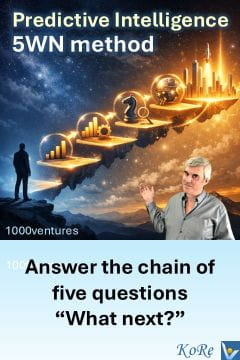
The 5WN Method ("What
Next?" asked five times) transforms uncertainty into foresight by forcing the
mind to explore deeper layers of consequences, counter‑moves, and emerging
opportunities. |
|
| |
Holistic intelligence helps leaders see systems rather than fragments.
Anticipation skills help them detect early signals.
Strategic simulation
games – especially InnoBall (Innovation Brainball)
– train individuals and teams to think like
foresighted and
highersighted
visionaries, leaders, innovators, and cunning disruptors.
AI amplifies all three: it
processes complexity, reveals hidden patterns, and simulates thousands of "What
next?" scenarios in seconds.
→
Examples of of 5
What-Next Q&A
|
|
 |
| |
|
This article explores how predictive intelligence works, how AI strengthens it,
and how the 5WN method can be applied to real
strategic management, developmental,
innovation, and
geopolitical situations. |
|
|
| |
|
Predictive Intelligence: 5WN Method – answering the chain of five questions
"What next?" to forecast future |
|
|
|
 |
|
①
Holistic Intelligence: Seeing the Whole Before the Parts
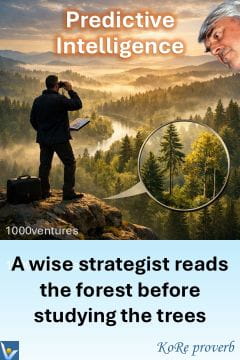
A wise strategist reads the forest
before studying the trees.
~
KoRe proverb
Holistic intelligence is the ability to perceive systems as interconnected
living organisms. In business, this means understanding how markets,
technologies, people, incentives, and constraints interact. Predictive
intelligence begins with this wide-angle lens.
Artificial intelligence (AI) becomes a
"holistic amplifier," expanding the strategist's field of vision. |
|
| |
|
Why holistic intelligence matters
It prevents tunnel vision and single‑factor thinking.
It reveals second‑order and third‑order consequences.
It helps leaders anticipate ripple effects across departments, markets, and
ecosystems.
How AI enhances holistic intelligence
AI excels at integrating diverse data streams – market signals, customer behavior,
competitor moves, macro trends – and revealing patterns humans often miss.
It can:
Map complex systems;
Detect weak signals early;
Simulate multiple futures;
Highlight hidden interdependencies. |
|
|
| |
|
②
Anticipation Skills: Training the Mind to See Ahead
The future rewards those who
rehearse it before it arrives.
~ KoRe proverb
Anticipation is not prediction – it is disciplined imagination. It is the ability
to mentally simulate how events may unfold and prepare for multiple plausible
futures.
Why anticipation skills matter
They reduce surprise and panic.
They help leaders prepare counter‑moves.
They transform uncertainty into strategic advantage. |
|
|
 |
|
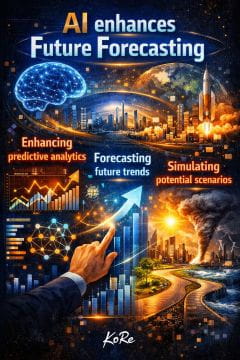
How AI strengthens anticipation
AI can:
Generate scenario trees.
Model cascading consequences.
Stress-test strategies under different conditions.
Reveal non-obvious
"next steps" in complex chains of events.
AI
becomes a sparring partner for strategic
thinking – always ready to ask, "What next?" |
|
| |
|
③
Strategic Simulation Games: Practicing the Future Before It Happens
Those who train in safe arenas
win in dangerous ones.
~ KoRe proverb
Strategic simulation games – especially InnoBall (Innovation Brainball)
– are
powerful tools for developing predictive intelligence.
InnoBall forces teams to
think like:
Visionaries (who see opportunities),
Innovators (who build solutions),
Cunning deceivers (who sabotage weak strategies).
This triad builds resilience, creativity, and foresight.
How AI elevates simulation games
AI can:
Generate realistic adversaries.
Model complex market reactions.
Provide instant feedback loops.
Suggest alternative strategies.
Run thousands of "What next?" branches in parallel.
AI turns simulation games into high‑resolution strategic laboratories. |
|
|
| |
|
Three Empowering Takeaways
1. "He who sees the system
sees the future."
~ KoRe proverb
Holistic intelligence is the foundation of predictive intelligence—leaders must
learn to see interconnections, not isolated events.
2. "The mind that rehearses
tomorrow wins today."
~ KoRe proverb
Anticipation skills and the 5WN method transform uncertainty into strategic
clarity.
3. Simulate boldly, adapt wisely, and let AI be
your multiplier.
Strategic simulation games like InnoBall – and AI as a strategic partner – prepare
leaders to navigate and shape the future with confidence. |
|
|
| |
Application Example
EduNext incorporates predictive intelligence to
improve its strategic-innovation capabilities and
services. The core function
revolves around
AI-assisted strategic simulation that helps
makes better predictions. This allows member businesses and
organizations to anticipate future scenarios, make
proactive decisions design and implement
proactive-futuring initiatives. |
|
 |
| |
|
Human Predictive Intelligence
Predictive intelligence is an
ability to anticipate outcomes,
responses, challenges, and
opportunities related to their
actions.
Highersight,
super-conscious thinking, imagination, and
strategic intuition are human abilities that boost human
predictive intelligence.
|
|
|
| |
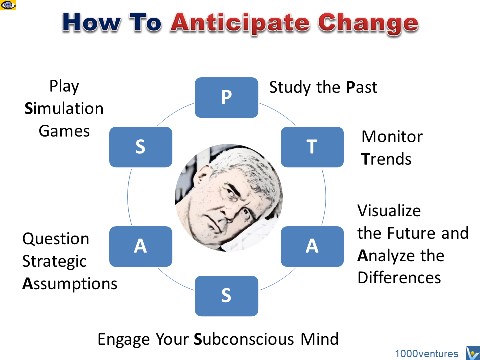
Predictive Intelligence is
considered a crucial aspect of
intelligence and its core
component.
Highersight, super-conscious thinking, imagination, and
strategic intuition are human abilities that boost human
predictive intelligence. |
|
 |
| |
|
While predictive
intelligence is evolving in areas like threat analysis,
it doesn't aim to replace human analysts with machines.
Instead, it focuses on enhancing human capabilities in
anticipating future events and their consequences.
|
|
|
| |
|
Developing Human Predictive intelligence
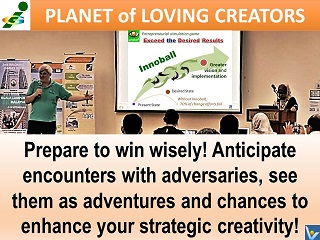
Strategic simulation games, such as
InnoBall (Innovation
Brainball), are a powerful tool for developing
anticipation skills and
predictive intelligence.
|
|
|
| |
You
have to play InnoBall enough times for the anticipation
of further developments to become a
superconscious habit
and begin to happen on autopilot at the speed of light
without any conscious effort. |
|
 |
| |
|
AI Predictive Intelligence (AIPI)
Predictive intelligence, also known as predictive
analytics or predictive AI, is the application of
machine learning and statistical techniques to analyze
historical data and make predictions about future events
or behaviors. It leverages past data to forecast trends,
identify patterns, and anticipate outcomes, enabling
businesses to make proactive decisions and improve
performance. It is a powerful set of tools that enhances work
experiences by using AI and machine learning.
|
|
|
|
|