|
→
10 Rules
for Building a High-growth Business
→
Business Model
→
Revenue
Model
References:
1. "The Early-Stage Equity Market in the USA", by Sohl,J.E.
2. "Mega-Angel Syndicates", by Mayfield,W.M. and Bygrave,W.D.
3. "Angel
Investing", by Osnabrugge, M.V. and Robinson, R.J.
4. "Seed
Investing as a Team Sport", NASVF
|
We can seen a dramatic increase in the number of
business
angels who are
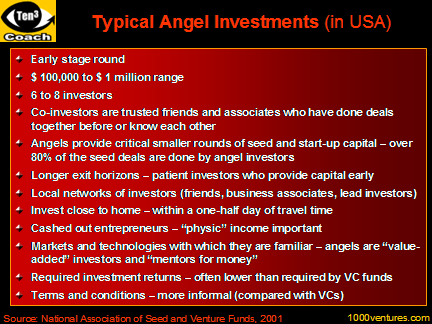
investing as part of an investment syndicate, an
approach that allows them to collectively make larger and more frequent
investments.
>>>
→
3Ws of
Venture Investing
More experienced investors tend to prefer such
co-investment groups. These are large groups of angels, sometimes with
as many as 100 members, that operate through forums.
They usually meet regularly, and deal origination and outside access to
the group is typically through one or more of its members. To retain
members' anonymity, many of these syndicates (also called angel
alliances) establish a storefront (or facade) for the general public.
Angel syndicates offer investors clear advantages:
However, these syndicates also incur certain running costs and may not be
appropriate for those investors who wish to have a large say and active
involvement in their investments.
Typically, a member of the group brings a
particular investment opportunity to the attention of the syndicate, on
the understanding that the member will invest in the deal. The deal is
then evaluated by the group in a venture forum.
>>>
Each member can decide
individually whether to participate in a particular deal that the
syndicate decides to undertake and how much he or she wants to be
involved in each investment they make.
→
Venture Financing Funnel
→
Venture Financing:
Key Documents
→
Startup Business Plan
Once such a commitment is
obtained, the participating angels have to supply the funds within a
certain timeframe, usually thirty to sixty days, as needed. Larger and
more complicated syndicates often look for opportunities with broader
and deeper markets and higher minimum return requirements than simpler
syndicates do.
In most cases, one member of the syndicate
acts as the lead angel, assuming a liaison role between the
→
entrepreneur
and the syndicate. In other cases, an outsider with no financial
commitment to the group (known as an "archangel") is hired to perform
this function. These individuals may be responsible for
performing due
diligence and coordinating the allotment of investment duties among
members. Syndicate deals tend to be more professional than the average
business angel deal. |
