| |
Gain the
Highest through Knowledge |
|
 |
 |
|
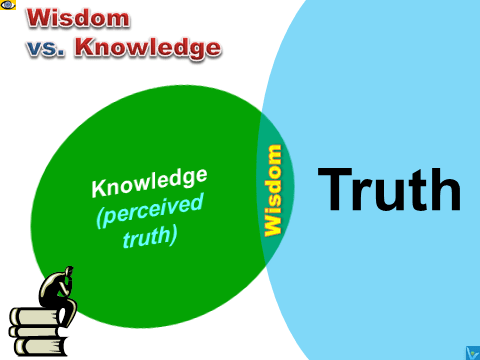
"Education
brings knowledge. Applying knowledge brings
wisdom. Silencing knowledge brings
enlightenment.
Insight
helps you understand what's inside the box.
HIGHERsight helps you see farther and understand
what's outside the box.
HIGHERsight is divine
enlightenment or a "god's-eye view of the
big picture."
~
Vadim Kotelnikov |
|
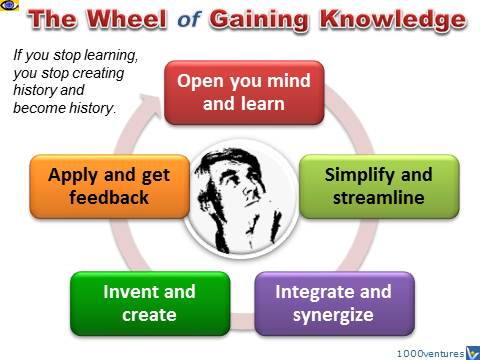
Gaining the highest through knowledge involves consistent
learning and patience. Reading expands vocabulary and can
introduce scientific concepts. Knowledge is primarily
self-acquired through various sources like books, articles,
and workshops. Patience is crucial in the pursuit of
knowledge, as losing it can hinder the learning process.
Learn by Doing
Confucius: ... I do, and I understand.
Explore to Discover
Experiment to Gain Feedback
Virtuous Spiral
| |
"One’s knowledge
is only a handful of sand, there is still an
ocean of
knowledge to learn."
~
Indian proverb
On this path
effort never goes to waste, and there is no
failure. Even a little effort toward spiritual
awareness will protect you from the greatest
fear.
~
Bhagavad Gita |
|
 |
|
|
Learning from the Teacher the Highest
Knowledge of the World and of Your Own Self
| |
Teachings by
Swami Tejomayananda
|
| |
When our minds are purified through
karma (selfless action) and made single-pointed through up-asana
(worship), we cannot remain satisfied with the small achievements in worldly
life.
We begin to
ask
questions, such as: "What is
the purpose of
life? What is my true nature?
What is the source and origin of this entire creation?"
When questions of this kind arise in a person's
mind, his or her quest for
knowledge begins. The
quest can be satisfied only when the student approaches a spiritual master and
learns from him his highest knowledge of the Self.
|
| |
This knowledge is the subject matter of the third
and the last portion of the Vedas, which we call the Upanishads, otherwise known
as Vedanta. When we say 'Vedanta' philosophy, we refer to the knowledge revealed
in the Upanishads.
Upanishad is a combination
of three words:
upa, ni, and
sad. Upa means near; ni means
below and determination, and sad means, to sit down. Thus the simple
meaning of Upanishad is "near below sitting".
The indicative meaning is that a student, having
developed sufficiently good qualities of heart and mind, with burning desire for
knowledge, approaches a
teacher; sits at his feet, tunes his mind to the
teachings given by the master; and tries his best to absorb and practice the
teachings. In short, the Upanishads contain that knowledge which can be gained
be a seeker of Truth when he is sitting at the feet of his master.
|
| |
Why is it said that the student must sit at the
teacher's feet? Just as the flow of water is natural and effortless from an
upper to a lower level, sitting at the feet of the teacher is symbolic of the
student looking up to the teacher: With this
attitude
the knowledge of the teacher flows easily to him.
The other meanings of the word sad are to
destroy and to lead. When the student receives this knowledge from the teacher,
his ignorance of the real nature of the world and of his own Self is destroyed.
Therefore, the purpose of the Upanishad is
ajnana nasa
(the destruction of ignorance.) The most important point is that the word
Upanishad does not, essentially, refer to a book, but to the
knowledge of
the Self.
|
| |
The word ni, in Sanskrit, also means
determination. This indicates that the student must approach the teacher with a
firm determination to gain knowledge.
A Sanskrit verse says beautifully: Deham va
patayami karyam va sadayami. "Either this body will fall down dead or I will
accomplish my goal". This is the firm determination with which the student has
to approach the teacher.
>>>
|
 |
When meditation is mastered, the
mind is unwavering like the
flame of a lamp in a windless
place. |
Bhagavad
Gitta |
 |
There are knowledgeable people, and
there are wise people. Knowledgeable people are those who know a
lot. Wise people are those who
understand what they know. |
Mikhail
Zadornov |
 |
Live as if you were to die tomorrow;
learn as if you were to live forever. |
Mahatma Gandhi |
 |
Yoga means a change
of consciousness; a mere mental activity will not bring a change of
consciousness, it can only bring a change of mind |
Sri
Aurobindo |
|
|