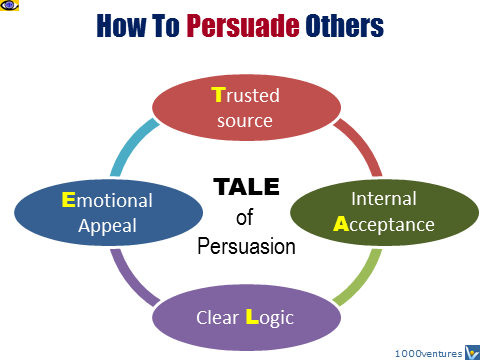
Influencing People:

Persuading People

Become a Master of Persuasion

Earning the Support of Others

By Brian Tracy.  Used by permission.

"Persuasion is the art of getting people to do what you want them to do, and to like it." President Eisenhower


Persuasion power can help you get more of the things you want faster than anything else you do. It can mean the difference between success and failure. It can guarantee your progress and enable you to use all of your other skills and abilities at the very highest level. Your persuasion power will earn you the support of others.

You Have Two Choices

There are always two choices: either you can persuade others to help you or you can be persuaded to help them. It is one or the other. Most people are not aware that every human interaction involves a complex process of persuasion and influence. And being unaware, they are usually the ones being persuaded to help others rather than the ones who are doing the persuading.

The Key To Persuasion

The key to persuasion is motivation. Every human action is motivated by something. Your job is to find out what motivates other people and then to provide that motivation. People have two major motivations: the desire for gain and the fear of loss. The desire for gain motivates people to want more of the things they value in life. They want more money, more success, more health, more influence, more respect, more love and more happiness. Human wants are limited only by individual imagination. No matter how much a person has, he or she still wants more and more. When you can show a person how he or she can get more of the things he or she wants by helping you achieve your goals, you can motivate them to act in your behalf.

A Presidential Insight

President Eisenhower once said that, “Persuasion is the art of getting people to do what you want them to do, and to like it.” You need always to be thinking about how you can get people to want to do the things that you need them to do to attain your objectives.

The Fear of Loss

People are also motivated to act by the fear of loss. This fear, in all its various forms, is often stronger than the desire for gain. People fear financial loss, loss of health, anger or disapproval of others, loss of the love of someone and the loss of anything they have worked hard to accomplish. They fear change, risk and uncertainty because these threaten them with potential losses.

Use Dual Motivation

Whenever you can show a person that, by doing what you want them to do, they can avoid a loss of some kind, you can influence them to take a particular action. The very best appeals are those where you offer an opportunity to gain and an opportunity to avoid loss at the same time.

Action Steps

Here are two things you can do immediately to put these ideas into action.

First, before trying to convince someone of something, take a little time to think and ask questions to find out what it is he really wants. Then, motivate him to act by showing him how you can help him get it.

Second, think about how you can save a person from some loss or guarantee them a particular outcome if they accept your ideas.

Remember, people are motivated for their reasons, not yours.

 Discover much more!

People Skills

The Tao of Communication

Building Relationships

Effective Listening

12 Rules of Effective Listening

10-Step Yoga Guideline for Resolving Inner and Outer Conflict

Effective Leadership

Develop a Clear Vision

Empathy

Effective Selling

How To Become an Irresistible Sales Communicator with Integrity and Power

Make the Competition Irrelevant

How To Present With Passion

Selling by Listening

The ABC of Selling: Always Be Closing

Marketing and Selling Quotes

Cultural Intelligence

Managing Cross-cultural Differences

  Ten3 Mini-Courses   Presentation:    View    Download

Your People Skills  (40 slides)

Winning Customers  (100 slides)

The Four P's of Persuasion


There are four “Ps” that will enhance your ability to persuade others in both your work and personal life. They are power, positioning, performance, and politeness. And they are all based on perception.

Develop Personal Power

The first “P” is power. The more power and influence that a person perceives that you have, whether real or not, the more likely it is that that person will be persuaded by you to do the things you want them to do. For example, if you appear to be a senior executive, or a wealthy person, people will be much more likely to help you and serve you than they would be if you were perceived to be a lower level employee.

Position Yourself Properly

The second “P” is positioning. This refers to the way that other people think about you and talk about you when you are not there. Your positioning in the mind and heart of other people largely determines how open they are to being influenced by you.

Watch Everything You Do

In everything you do involving other people, you are shaping and influencing their perceptions of you and your positioning in their minds. Think about how you could change the things you say and do so that people think about you in such a way that they are more open to your requests and to helping you achieve your goals.


Perform At Your Best

The third “P” is performance. This refers to your level of competence and expertise in your area. A person who is highly respected for his or her ability to get results is far more persuasive and influential than a person who only does an average job.

Commit To Excellence

The perception that people have of your performance capabilities exerts an inordinate influence on how they think and feel about you. You should commit yourself to being the very best in your field. Sometimes, a reputation for being excellent at what you do can be so powerful that it alone can make you an extremely persuasive individual in all of your interactions with the people around you. They will accept your advice, be open to your influence and agree with your requests.

Treat People Politely

The fourth “P” of persuasion power is politeness. People do things for two reasons, because they want to and because they have to. When you treat people with kindness, courtesy and respect, you make them want to do things for you. They are motivated to go out of their way to help you solve your problems and accomplish your goals. Being nice to other people satisfies one of the deepest of all subconscious needs, the need to feel important and respected. Whenever you convey this to another person in your conversation, your attitude and your treatment of that person, he or she will be wide open to being persuaded and influenced by you in almost anything you need.

Perception Is Everything


Again, perception is everything. The perception of an individual is his or her reality. People act on the basis of their perceptions of you. If you change their perceptions, you change the way they think and feel about you, and you change the things that they will do for you.

Action Exercises

Here are two things you can do immediately to put these ideas into action.

First, think continually about the impression you want to make on others and then make sure that everything you do or say is consistent with that perception.

Second, be nice to people. Practice the Golden Rule in your interactions with others. Always be polite and make others feel important. The more people like you, the more open they are to being influenced by you.


Map

Ranked #1

Search

Testimonials

Free Downloads

  Products

SMART Learning

Training

 Contact

We invented Business e-Coaching in 2001

Today, we have customers in 100+ countries!

Our customers:

3M, ABB, Adidas, Alcatel, American Express, Bayer, Boeing, British American Tobacco, BP, Canon, Cisco, Citigroup, Colgate, Corning, Deloitte, Ernst & Young, Fujitsu-Siemens, GE, Goldman Sachs, HP, Hitachi, Huyndai, IBM, Intel, Johnson & Johnson, JP Morgan Chase, KPMG, Lufthansa, Microsoft, Motorola, Nokia, Oracle, Samsung, Shell, Siemens, Sony, United Bank of Switzerland

Ten3 Mini-courses: SMART & FAST sets Full version of Ten3 Business e-Coach Ten3 Business e-Coach (home page)

Ten3 Business e-Coach, version 2008

Inventor, Author & Founder – Vadim Kotelnikov

© Vadim Kotelnikov, GIVIS