 |
|
Definition:
Interpersonal Intelligence (IPQ) is the ability
to understand others and interact effectively
with them.
Enablers:
IPQ is characterized by sensitivity to
perceptions, motivations, personalities, moods,
and feelings.
Benefits:
IPQ enhances understanding, communication,
empathy, and relationship-building. |
|
| |
|
Succeeding in Collaborative
Environments
|
|
|
| |
People with high
interpersonal intelligence (IPQ) are "people
smart". They are often effective leaders,
influencers, teachers, coaches,
negotiators, or psychotherapists adept in
teamwork, intellectual collaboration, win-win
conflict resolution, and understanding subtle
social cues. |
|
 |
 |
Hard skills make
you eligible.
Soft skills make you desirable.
~
Vadim
Kotelnikov |
|
Individuals with high
interpersonal intelligence are
often described as "people
persons" due to their aptitude
to managing, and navigating
social dynamics. This
intelligence is critical
succeeding in collaborative
environments. |
|
| |
|
"Look at the means which a man
employs, consider his motives,
observe his pleasures. A man
simply cannot conceal himself!"
~
Confucius
|
|
|
| |
|
"One can know a man from his
laugh, and if you like a
man's laugh before you know
anything of him, you may
confidently say that he is a
good man."
~
Fyodor Dostoyesvski
|
|
|
| |
|
"Talk is cheap. Learn to
listen with your eyes. Actions
do speak louder than words.
Watch what a person does more
than what he says."
~
Robert Kiyosaki
|
|
|
| |
Interpersonal Intelligence
involves the ability to note and take into consideration
cultural, typological and other distinctions among
others, It involves sensitivity to deep
values,
perceptions, motivations, moods and temperaments of
others, effective verbal and non-verbal communication,
and the ability to entertain multiple
mental maps and perspectives.
People with higher interpersonal intelligence are able
to pick up on the mood, feelings, motivation and
intentions of those around them easier.
They are good at making others feel welcome and
understood.
Others often seek them out for an
empathetic advice.
Develop your interpersonal intelligence to be a better
relationship builder, value creator, writer,
communicator, leader, seller, and negotiator.
Respect perceptions and feelings of others and do your
best to understand them.
Listen
to emotions,
engage all your senses,
empathize.
Observe people to make accidental discoveries.
Understand cultural differences to expand your
interpersonal intelligence.
Look for feedback to grow your interpersonal
intelligence.
Practice
empathy to make your interpersonal intelligence
intuitive.
Artistic
Performances
Watch Creation Show
People reveal their deeper self when they create and
showcase their creative works.
Read
Novels, Watch Movies
Novels and movies are a
rich source of insights into interpersonal
relationships. They help you discover, understand and
experience diverse motives and points of view of the
characters. These discoveries, understandings and
experiences can help you in practice of
empathy and interactions with other people.
Practice
Theatre
Theatric performance are a
great way to put yourself the shoes of other characters
and behave and act in accordance with their perceptions
and feelings. While interacting with other actors, you
can learn about their practical approaches to
reincarnation and also develop your
social skills.
You can also practice
theatre alone. For instance, give yourself an attitude
(happiness, sorrow, joy, etc.) or a situation, draw a
facial expression, take a selfie and see how it looks.
You can also select a verse, look at it through the eyes
of a person you choose, read it aloud, record it and
listen how it sounds.
***
IPQ is an ability to
understand others, to treat others empathetically and to
provide appropriate responces.
IPQ is a facility for understanding the inner world of
others. Recognizing feelings, motivation and intentions
of others are part of the capabilities that
interpersonal intelligence entails.
Empathy helps understand the inner world of others.
IPQ appears strongly in effective leaders,
communicators, psychologists, value innovators,
politicians, teachers, playwriters, negotiators, and
salespersons.
Individuals with highly developed IPQ can inspire and
encourage others effectively. They can guide others
towards efficient social decision making and conflict
resolution. They can also help others identify and
resolve their problems.
IPQ is a highly valuable soft skill.
Entrepreneurs and business leaders with high IPQ manage
to inspire workers to carry out an organized work
together as a team.
IPQ is of vital importance for the construction,
maintenance and improvement of social ties.
Persons with strong IPQ are flexible and efficient
teambuilders, negotiators and salespersons.
They are able to read emotions of others and act on them
appropriately.
How To Develop IPQ
* Listen empathetically and actively without judging.
Excersise attention. Listen to emotions. Engage all your
senses.Don't interrupt, create a safe and trustworthy
communication space.
* Try to understand people, their way of thinking,
personality and motivation when they are explaining
something to you.
* Practice empathy, put yourself in the shoes of others
* Take and explore different perceptual positions to
understand others and resolve conflicts both effectively
and efficiently
* Observe and try to understand non-verbal language:
tone of voice, facial expressions, body language.
* Observe customers using your solution and try to
understand their emotions.
* Invite feedback on a product, a movie or an event to
understand different points of view. Give feedback in a
healthy way and obsrrve the reactions.
* Work in team cooperative activities and do your best
to understand of divetse styles of contribution
pexercised by team members.
* Learn about cultural differences and put this
knowledge in practice by connecting with a diversity of
people with your mind open to deeper insights and new
discoveries.
🔸️
Product / service idea:
Video collection of short monologues and dialogues for
masteting IPQ, observing people and understanding
non-verbal communication (the dialogues could be
borrowed from novels or movies).
➡️ Read Facial Expressions & Body Language
First, watch the video with the sound off - once or more
times as required - and try to guess what is being
communicated by the speaker / interlocutors.
Then turn the sound on and check how correct your guess
was.
➕ Tone of Voice
Watch a foreign-language video - once or more times as
required - and try to understand what is being
communicated.
Then watch the video with English subtitles to check how
correct your your understanding was.
🔸️🔸️🔸️
INTELLIGENCE
Types of Intelligence
Personal intelligence is an ability to successfully
manage your relationships with yourself and others. It
involves quickly understanding your intentions,
connecting with your desires, making distinctions and
any other type of approach to social contact with other
people.
Self-Intelligence (Intrapersonal Intelligence) is an
ability to know oneself.
Perceptual Intelligence is an ability to see messages,
relationships, interactions, situations, life, value,
and the entire world from various perceptual positions.
(loving creator, life designer, child, observer, ...)
Spacial Intelligence is an
ability to see the world from different perspectives:
from a distance, from different angles, to take a
helicopter view to see the big picture, to get insight.
|
|
 |
|
Definition
of Soft Skills
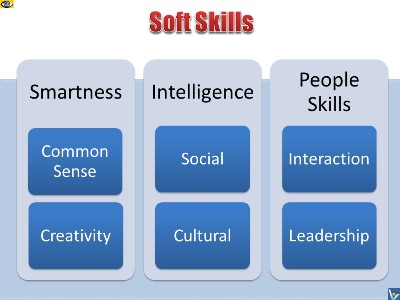
Soft skills are a cluster of
productive capabilities that characterize one's
relationships in a social environment.
It is an umbrella term for
skills under three key functional elements: achievement
know-how, people skills, and social skills.
|
|
| |
Soft skills are a synergistic
combination of common sense, creativity, decision making
skills, problem solving skills, empowering attitudes, the
ability to make a desired first impression and to be
charismatic, people skills, social skills, communication
skills, the ability to build rapport, the ability to lead,
teamwork, social intelligence, interpersonal intelligence, emotional intelligence,
cultural intelligence, and empathy among others, that enable
people to navigate their environment, work well with others,
perform efficiently, and
achieve their goals with complementing hard skills. |
|
Importance of Soft Skills
As business is people, soft skills are more important than hard skills because
they are the foundation of thinking, cooperation,
management, innovation, marketing, etc.
The influence of soft skills
on the outcome of business activities depends on the
circumstances in which the business activity takes place.
For instance, innopreneurial soft skills help innovative
entrepreneurs build successful startups.
Development
of Soft Skills
The development of soft skills
is much more difficult than the development of hard skills.
While hard skills can be
learned studying from a book or from trainings,
development of soft skills
needs a combination of
environment and other people to be mastered.
It requires addressing multi-dimensional challenges,
actively interacting with others on an ongoing basis and
being willing to learn from all sorts of feedback both
verbal and situational.
Social
Skills
A social skill is any
competence facilitating
understanding of, interaction and
communication with
others where social rules and relations are created,
communicated, and changed in verbal and
nonverbal ways...
More
First
Impressionism
First Impressionism is a new vital art & science
introduced by and taught at the
Innompic University.
Knowing how to make a great
first impression is a key to lasting positive social
interactions.
First Impression contests pioneered by
Innompic Games (see
best examples and
videos) help people − adults (examples:
female;
male), kids (example),
teams (example)
− master this highly important social skill.
Creativity
In the digital economy where
the large majority of the work can be done by computers,
artificial intelligence systems and smart machines, the
primary role of human beings is to use their imagination and
creativity to invent new things and to solve problems in
outside-the-box ways.
Intuition
Intuitive anticipation and decision making are highly
important soft skills. There are
two levels of intuition − subconscious and divine.
Subconscious intuition can be developed through
practice of
engaging your fast-thinking subconscious mind and
turning it into a
habit.
Leadership
Soft skills form the basis of
successful leadership and are, therefore, highly important
for those in leading positions. Leaders are to inspire, to
provide a strategic direction, to align, motivate and
energize people in order to achieve desired goals.
Leadership is a process of influence through a series of
interactions between a leader and their followers. In order
to be effective in these roles, the leader has to possess
relevant soft skills.
Communication
Effective communication inside
the company is the foundation of successful business
activities. Communication allows employees at all levels to
coordinate their actions to achieve a common objective.
Decision
Making
Although strategic plans are
developed by a top management team, due to the scope and
complexity of business operations, top managers have to rely
on their staff to assist them in the decision-making
process. Staff members can broaden the understanding of
current business activities by developing situational
awareness and assisting top managers in building their
situational understanding by providing relevant information
and recommendations regarding business activities.
Cross-Cultural Competency
A globally connected world is
a key driver of structural change for the global workforce.
The diversity of stakeholders
is an important point to consider. Employee, customers,
partners, competitors are all made up of people of different
ethnical backgrounds, who have different views, perceptions,
beliefs, and values.
Innovation became a systemic
phenomenon. It is achieved through synergizing diversities
and is increasingly more dependent on the collaboration
between actors from different cultural backgrounds who
combine their own perceptions, thinking habits and expertise
to create something new. This happens on all levels −
individual, team, institutional. Diversity of thought
increases creativity and, with it, the innovation potential
of individuals, teams, corporations and joint ventures.
Business activities that take
place abroad emphasize the importance of cultural
intelligence and effective cross-cultural communication
between the business and local people. Unless company
representatives have good understanding of the local
traditions and values, they might behave in such a way that
is considered offensive or inappropriate in another culture
and facilitate conflict, putting the whole local business at
risk. In order to effectively perform business activities in
a different cultural setting, company representatives must
possess such soft skills, as sociocultural competence and
empathy.
Groundbreaking Soft Skills
empower you to create remarkable positive change in
yourself, your organization and its business.
|