|
Sustainable
Development Challenges
According to the definition by
the World Commission on Environment and Development, sustainable development
“should include management of the use of a resource so it can meet human
demands of the present generation without decreasing opportunities for
future generations”.
ESTs – a Way
to Sustainable Development
Application of environmentally
sound technologies (ESTs) is a way to sustainable development.
“Environmentally sound” is a relative term however. Furthermore,
environmental soundness is not an attribute of technology by itself but of
technology in the particular socio-ecological context in which it is
intended to be applied.
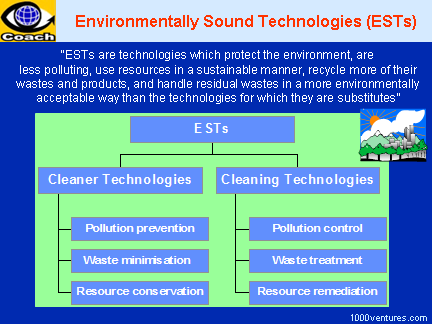
Broadly speaking, ESTs can be
defined as technologies which protect the environment, are less polluting,
use resources in a sustainable manner, recycle more of their wastes and
products, and handle all residual wastes in a more environmentally
acceptable way than the technologies for which they are substitutes. Chapter
34 of the Agenda 21 emphasises that ESTs are not just “individual
technologies, but total systems which include know-how, procedures, goods
and services, and equipment as well as organisational and managerial
procedures”.
The Two
Principle Groups of ESTs
ESTs could be divided into two
large groups:
1. cleaner technologies and
2. cleaning technologies.
Cleaner technologies are
production
processes, including monitoring and control techniques, which are less
polluting, use resources (raw materials, natural resources, energy, etc.) in
a more efficient way, produce cleaner products and less harmful residual
wastes, if any.
→
Continuous Improvement Mindset
→
5 Principles of Kaizen
Cleaning technologies are
processes and products developed to neutralise the environmentally harmful
effects of a given process or activity. This group includes pollution
monitoring, assessment and control technologies (e.g. air pollution control,
waste water treatment, treatment), waste treatment (e.g. solid/hazardous
waste treatment, garbage disposal/recycling), and remediation technologies
(e.g. soil/water remediation, air cleaning)
Design for Environment (DfE)
Design for Environment (DfE), also known as
eco-design and green design, recognizes that environmental impacts must be
considered during the
new product design
process, along with all of the usual design criteria.
The purpose of green design is to evaluate and identify ways to minimize the
environmental burden resulting from products...
More
Design for Waste Minimization
Waste minimization is a series
of cyclical systems where materials are re-used or re-cycled as part of a
closed loop....
More
Design Strategies for Product and Materials Recycling
New product design strategies for waste recycling include use of simple
materials, effective disassembly and recycling...
More
Life-Cycle Assessment (LCA)
LCA is a process for analyzing the
environmental impacts generated over the entire life cycle of a product from
provision of raw materials to final disposal of the product...
More |